0.6 to 1.2 mg/dl (50 to 110 μmol/L [CF: 88.4; SMI: 10 μmol/L]). Fig. E21 illustrates the relationship between creatinine clearance and serum creatinine. Factors that may alter serum creatinine level are described in Box 14 .
BOX 14 Factors That May Alter Serum Creatinine (Cr) Level
From Parrillo JE, Dellinger RP: Critical care medicine, principles of diagnosis and management in the adult, ed 4, Philadelphia, 2014, Elsevier.
Figure E21 Relationship between creatinine clearance and serum creatinine.
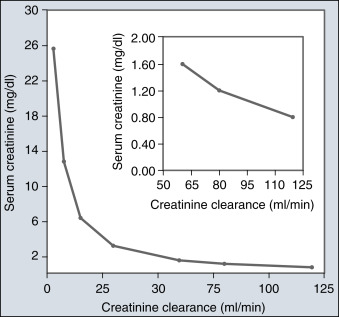
In steady state, serum creatinine should increase twofold for each 50% reduction in creatinine clearance. Inset represents enlarged view of changes in serum creatinine as creatinine clearance decreases from 120 to 60 ml/min. If serum creatinine is 0.8 mg/dl when creatinine clearance is 120 ml/min, creatinine clearance can decrease by 33% such that increased serum creatinine is still within normal range.
From Vincent JL et al: Textbook of critical care, ed 6, Philadelphia, 2011, Saunders.
Renal insufficiency (acute and chronic), decreased renal perfusion (hypotension, dehydration, congestive heart failure), urinary tract infection, rhabdomyolysis, ketonemia
Drugs (antibiotics [aminoglycosides, cephalosporins], hydantoin, diuretics, methyldopa)
The RIFLE criteria for acute kidney injury is summarized in Table E43. A classification of acute kidney injury (AKI) is described in Table E44.
TABLE E43 RIFLE Criteria for Acute Kidney Injury
| GFR and Serum Creatinine Changes | Urine Volume Changes | |
|---|---|---|
| R (Risk) | Increase in SCreat >1.5× | Urine volume <0.5 ml/kg/hr >6 hr |
| Decrease in GFR >25% | ||
| I (Injury) | Increase in SCreat >2× | Urine volume <0.5 ml/kg/hr >12 hr |
| Decrease in GFR >50% | ||
| F (Failure) | Increase in SCreat >3× | Urine volume <0.3 ml/kg/hr >24 hr |
| Decrease in GFR >75% | Anuria >12 hr | |
| SCreat >4 mg/dl | ||
| L (Loss) | Complete loss of kidney function >4 wk | |
| E (ESRD) | End-stage kidney disease >3 mo |
GFR, Glomerular filtration rate; SCreat, serum creatinine.
From McPherson RA, Pincus MR: Henry’s clinical diagnosis and management by laboratory methods, ed 23, St Louis, 2017, Elsevier.
TABLE E44 New Classification for Acute Kidney Injury (AKI) Criteria
| Stage | Serum Creatinine Criteria | Urine Output Criteria |
|---|---|---|
| 1 | >0.3 mg/dl (26.4 μmol/L) or >150%-200% | <0.5 ml/kg for >6 hr |
| 2 | >200%-300% | <0.5 ml/kg for >12 hr |
| 3 | >300%, 4 mg/dl (354 μmol/L) or acute increase of >0.5 mg/dl | <0.3 ml/kg for >24 hr or anuria >12 hr |
From McPherson RA, Pincus MR: Henry’s clinical diagnosis and management by laboratory methods, ed 23, St Louis, 2017, Elsevier.
Diabetic ketoacidosis, administration of some cephalosporins (e.g., cefoxitin, cephalothin)