|
Figure E44 Approach to a young child with six or more café-au-lait macules.
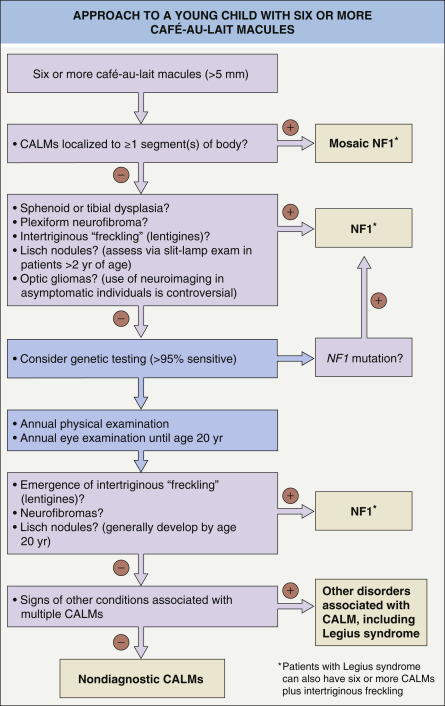
More than half of these patients will eventually prove to have NF1 or, less often, one of the other CALM-associated syndromes (see Table E23). Although uncommon, the latter should be considered if other NF1 signs do not develop. Genetic testing for NF1 is commercially available. CALMs, Café-au-lait macules.
From Bolognia JL: Dermatology, ed 4, Philadelphia, 2018, Elsevier.
TABLE E23 Disorders Associated with Multiple Café-au-Lait Macules (CALMs)
| Disorder | Notes | ||
|---|---|---|---|
| Neurofibromatosis and Related Disorders | |||
| Neurofibromatosis 1 (NF1) | AD; six or more CALMs in >90% of patients; mutations in NF1 gene | ||
| Neurofibromatosis 2 | AD; six or more CALMs in minority of patients; mutations in NF2 gene | ||
| Mosaic (segmental) NF1 (formerly neurofibromatosis 5) | Neurofibromas alone or CALMs ± “freckling” in a block-like or other mosaic pattern; due to a postzygotic NF1 mutation, which may involve the gonads in some patients | ||
| Legius (NF1-like) syndrome | AD; six or more CALMs in >80% and intertriginous “freckling” in ∼50% of patients; lack neurofibromas, Lisch nodules, optic gliomas, and typical osseous lesions of NF1; macrocephaly and learning disabilities are common; lipomas, hypopigmented macules, and vascular anomalies in minority; loss-of-function mutations in SPRED1 gene, the protein product of which inhibits MAPK signaling | ||
| Watson syndrome | AD; short stature; pulmonic stenosis; ID; may also have Lisch nodules, axillary/inguinal freckling, and neurofibromas; allelic with NF1; 60/100∗ | ||
| Jaffe-Campanacci syndrome | Disseminated nonossifying fibromas of long and jaw bones; hypogonadism or cryptorchidism; D; giant cell granulomas (jaws); usually due to NF1 mutation | ||
| Noonan syndrome | AD; short stature; pterygium colli; characteristic facies; cardiac defects, esp. pulmonic valve stenosis; skeletal and testicular abnormalities; keratosis pilaris atrophicans; lymphedema; melanocytic nevi; activating mutations in PTPN11 (allelic with LEOPARD syndrome) >SOS1, RAF1, RIT1 >KRAS, NRAS, MAP2K1, CBL, SHOC2 (with loose anagen hair), and rarely other genes; patients with an NF1-Noonan overlap phenotype have mutations in NF1 gene | ||
| Cardio-facio-cutaneous syndrome | AD; short stature; characteristic facies; low-set ears; cardiac defects; ID; sparse curly hair; dry skin to generalized ichthyosiform eruption; activating mutations in MAPK pathway genes-BRAF >MEK1, MEK2 >KRAS | ||
| Constitutional mismatch repair deficiency syndrome (childhood tumor syndrome with NF1 phenotype; formerly Turcot syndrome type 1) | AR; multiple CALMs, axillary freckling, neurofibromas and/or CNS gliomas (features similar to NF1) as well as hypopigmented macules, hematologic malignancies, and colorectal carcinoma; patients have mutations in both copies of a DNA mismatch repair gene, e.g., MLH1, MSH2, MSH6, PMS2; hereditary nonpolyposis colorectal cancer (HNPCC) syndrome can occur in heterozygotes | ||
| McCune-Albright syndrome | Not inherited; presumably lethal unless in mosaic state; polyostotic fibrous dysplasia; hyperfunction of endocrine glands, esp. gonads (e.g., precocious puberty); CALMs usually appear during infancy and can overlie bony changes; CALMs classically end at midline, but so can larger CALMs of NF; CALMs may follow lines of Blaschko; activating mutations in the GNAS1 gene that encodes Gsα; 35/100∗ | ||
| Disorders with Additional Cutaneous Findings | |||
| Tuberous sclerosis complex (TSC) | AD; ID; seizures; hypopigmented macules; angiofibromas; fibrous plaques; mutations in TSC1 and TSC2 genes | ||
| Westerhof syndrome | AD; congenital hypopigmented and hyperpigmented macules; ID; growth retardation | ||
| Piebaldism | AD; CALMs in involved as well as uninvolved skin; mutations in KIT proto-oncogene | ||
| Familial progressive hyperpigmentation and hypopigmentation | AD; CALMs of variable sizes admixed and overlapping with lentigines and hypopigmented macules and patches; activating mutations in KITLG gene | ||
| Mukamel syndrome | AR; premature graying (infancy); lentigines; depigmented macules; ID; spastic paraparesis, microcephaly, scoliosis | ||
| Noonan syndrome with multiple lentigines (LEOPARD syndrome) | AD; darker “café noir” macules; Lentigines, ECG abnormalities, Ocular hypertelorism, Pulmonic stenosis, Abnormal genitalia, Retardation of growth, Deafness syndrome; mutations in PTPN11; 38/100∗ | ||
| Carney complex (NAME and LAMB syndromes) | AD; darker “café-noir” macules, lentigines, blue nevi; cutaneous and atrial myxomas; endocrine neoplasia of adrenal glands, pituitary gland, and/or testes; mutations in PRKAR1A | ||
| Partial unilateral lentiginosis | Agminated lentigines; debatable if associated neurologic or psychiatric problems; unilateral axillary freckling and Lisch nodules have been described (such patients likely have mosaic NF1) | ||
| Bannayan-Riley-Ruvalcaba syndrome‡ | AD; penile lentigines; vascular malformations; lipomas; intestinal hamartomas; macrocephaly; mutations in PTEN gene; ≤10% of patients have CALMs | ||
| Cowden syndrome‡ | AD; multiple tricholemmomas; cobblestoning of oral mucosa; palmoplantar keratoses; sclerotic fibromas, hamartomas and carcinoma of breast, thyroid, colon; mutations in PTEN gene; ≤10% of patients have CALMs | ||
| Gastrocutaneous syndrome† | AD; multiple lentigines; peptic ulcer/hiatal hernia; hypertelorism; myopia | ||
| Ataxia-telangiectasia | AR; telangiectasias of conjunctivae, head/neck, and acral sites; premature canities; cerebellar ataxia; abnormal DNA repair; lymphomas and leukemias; immunodeficiency; sinopulmonary infections; mutations in ATM gene; 20/100∗ | ||
| Bloom syndrome | AR; telangiectatic erythema of face; photosensitivity; growth retardation; increased sister chromatid exchanges; malignancies; hypogonadism; mutations in BLM gene that encodes the RecQ protein-like-3 DNA helicase | ||
| Fanconi anemia | AR; generalized hyperpigmentation, esp. flexural ± guttate “hypopigmented” macules; pancytopenia; skeletal malformations, e.g., aplasia radii; chromosomal fragility and malignancies, e.g., acute myelogenous leukemia | ||
| Chromosomal anomalies/mosaicism | In particular, ring chromosomes (7, 11, 12, 15, 17); rearrangements of 7 and 14; ring 7 also associated with vascular lesions (hemangiomas and capillary malformations) and congenital melanocytic nevi | ||
| Extensive epidermal and sebaceous nevi | Mosaic; “syndrome” includes seizures, ID, musculoskeletal and ocular abnormalities; hypophosphatemic vitamin D-resistant rickets | ||
| Multiple endocrine neoplasia 1 | AD; tumors of the pituitary, parathyroid, and pancreatic islet cells; multiple facial angiofibromas, collagenomas, gingival papules, confetti-like hypomelanotic macules, lipomas; MEN1 gene | ||
| Multiple endocrine neoplasia 2B | AD; mucosal neuromas; marfanoid habitus; medullary thyroid carcinoma; intestinal ganglioneuromatosis; pheochromocytoma; mutations in RET proto-oncogene | ||
| Johnson-McMillin syndrome | Probable AD; alopecia; anosmia; deafness; hypogonadism; microtia | ||
| Tricho-hepato-enteric syndrome | AR; CALM and lentigines on hips and legs; diffuse pigmentary dilution (skin and hair), woolly hair; dysmorphic facies with hypertelorism; intractable diarrhea, liver disease; immune deficiency; mutations in TTC37 or SKIV2L | ||
| Tay syndrome† | AR; growth retardation; ID; triangular face; cirrhosis; trident hands; premature canities; vitiligo | ||
| Other Disorders§ | |||
| Russell-Silver syndrome | Growth retardation; triangular face; clinodactyly 5th finger; hemihypertrophy; epigenetic changes on chromosome 15p13 or maternal uniparental disomy of chromosome 7; 45/100∗ | ||
Multiple CALMs may also be seen in patients with segmental pigmentation disorder.
AD, Autosomal dominant; AR, autosomal recessive; DNA, deoxyribonucleic acid; ID, intellectual disability; KITLG, KIT ligand; MAPK, mitogen-activated protein kinase.
∗Estimates of prevalence of CALMs [Source: Gutmann DH et al: The diagnostic evaluation and multidisciplinary management of neurofibromatosis 1 and neurofibromatosis 2. JAMA 1997;278:51-57.]
‡ Overlapping conditions collectively referred to as PTEN hamartoma tumor syndrome.
† To date, observed in a single family.
§ Single case reports of multiple CALMs in association with X-linked hypohidrotic ectodermal dysplasia, woolly hair, and osteoma cutis.
From Bolognia JL: Dermatology, ed 4, 2018, Elsevier.