Common types of anemias and their diagnostic workups are summarized in Table 40 .
- See Fig. E18, which describes an algorithm for the evaluation of patients with neutropenia.
TABLE 40 Common Types of Anemias and Their Diagnostic Workups∗
| Anemia | Cause | Common Analyte Abnormality |
|---|---|---|
| Iron deficiency | Low ferritin Increased IBC Decreased serum iron Reduced Fe/TIBC ratio Generally increased RDW | |
| Anemia of chronic disease | Generally high ferritin Normal IBC Decreased serum iron Normal Fe/TIBC ratio Generally normal RDW | |
| Hemolytic anemia | Schistocytosis Increased reticulocytes Low haptoglobin Elevated carboxyhemoglobin Elevated LD and potassium Elevated indirect bilirubin Generally increased RDW | |
| Aplastic anemia | Leukopenia Thrombocytopenia Hypocellular bone marrow Generally normal RDW | |
| Renal failure | Elevated BUN and creatinine Low erythropoietin Burr cells may be present Generally normal RDW | |
| Vitamin B12 and/or folate deficiency | Low vitamin B12 and/or folate Hyperlobulated polymorphonuclear leukocytes Macro-ovalocytes Increased RDW | |
| Hypothyroidism | Elevated TSH Normal RDW |
BUN, Blood urea nitrogen; Fe, iron; IBC, iron-binding capacity; LD, lactate dehydrogenase; RDW, red cell distribution width; TIBC, total IBC; TSH, thyroid-stimulating hormone.
∗Low is equivalent to depressed, and high is equivalent to elevated. Ferritin, haptoglobin, LD, bilirubin, BUN, creatinine, erythropoietin, TSH, and T4 are all expressed as concentrations. All of these analytes are measured in serum.
From McPherson RA, Pincus MR: Henry’s clinical diagnosis and management by laboratory methods, ed 23, St Louis, 2017, Elsevier.
Figure E18 A practical algorithm for the evaluation of patients with neutropenia.

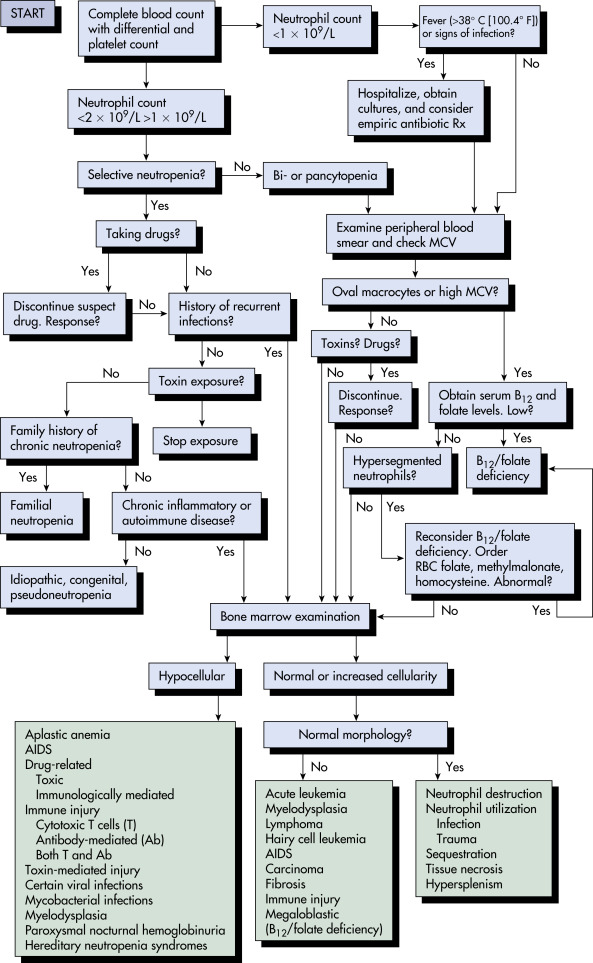
The fundamental diagnostic principle is that for patients with severe neutropenia or for those with bicytopenia or pancytopenia, bone marrow examination will likely be necessary unless the following diagnoses are made: (1) a nutritional (folate or vitamin B12) deficiency or (2) drug- or toxin-induced neutropenia in a patient whose neutropenia resolves after discontinuation of the offending agent. AIDS, Acquired immunodeficiency syndrome; MCV, mean corpuscular volume; RBC, red blood cell.
From Goldman L, Ausiello D [eds]: Cecil textbook of medicine, ed 24, Philadelphia, 2012, Saunders.
- White blood cells 3200 to 9800/mm3 (3.2 to 9.8 × 10⁹/L [CF: 0.001; SMI: 0.1 × 10⁹/L])
- Red blood cells
- Hemoglobin
- Male: 13.6 to 17.7 g/dl (136 to 172 g/L [CF: 10; SMI: 1 g/L])
- Female: 12 to 15 g/dl (120 to 150 g/L [CF: 10; SMI: 1 g/L])
- Hematocrit
- Mean corpuscular volume (MCV): 76 to 100 μm3 (76 to 100 fL [CF: 1; SMI: 1 fL])
- Mean corpuscular hemoglobin (MCH): 27 to 33 pg (27 to 33 pg [CF: 1; SMI: 1 pg])
- Mean corpuscular hemoglobin concentration (MCHC): 33 to 37 g/dl (330 to 370 g/L [CF: 10; SMI: 10 g/L])
- Red blood cell distribution width index (RDW): 11.5% to 14.5%
- Platelet count: 130 to 400 × 103/mm3 (130-400 × 109/L [CF: 1; SMI: 5 × 10⁹/L])
- Differential: