AUTHOR: Shiva Kumar R. Mukkamalla, MD, MPH, FACP

DefinitionSideroblastic anemias (SAs) are a heterogeneous group of blood disorders characterized by ring sideroblasts in the bone marrow (abnormal erythroblasts with pathologic iron deposits in the mitochondria distributed in a “ring-like” fashion around the nucleus) and impaired heme biosynthesis.
SynonymsCongenital sideroblastic anemia (CSA)
Acquired clonal sideroblastic anemia (ACSA)
Acquired reversible sideroblastic anemia (ARSA)
Anemia sideroblastic
TABLE E1 Classification of Sideroblastic Anemias
| Hereditary (Nonsyndromic) |
- X-linked
- Autosomal dominant or recessive
|
|
- Idiopathic acquireda (refractory anemia with ring sideroblasts)
- Associated with previous chemotherapy, irradiation, or in transition myelodysplasia or myeloproliferative diseases
|
| Drugs |
- Alcohol
- Isoniazid
- Chloramphenicol
- Other drugs
|
| Rare Causes |
- Erythropoietic protoporphyria
- Copper deficiency or zinc overload
- Hypothermia
|
| Hereditary (Syndromic) |
- X-linked sideroblastic anemia with ring sideroblasts and cerebellar ataxia
- Myopathy, lactic acidosis, and sideroblastic anemia
- Pearson syndrome
- Thiamine-responsive megaloblastic anemia (TRMA)
- Sideroblastic anemia with immunodeficiency, fevers, and developmental delay
|
From Hoffman R et al: Hematology, basic principles and practice, ed 7, Philadelphia, 2018, Elsevier.
| ICD-10CM CODES | | D64.0 | Hereditary sideroblastic anemia | | D64.1 | Secondary sideroblastic anemia due to disease | | D64.2 | Secondary sideroblastic anemia due to drugs and toxins | | D64.3 | Other sideroblastic anemias |
|
Epidemiology & Demographics12
- Rare disease
- X-linked (40% of CSAs); primarily affects males
- Autosomal recessive (15% of CSAs)
- ACSAs affect middle-aged and older adults
Classification (Table E1)
Physical Findings & Clinical Presentation3Symptoms of SA are similar to those of anemia and iron overload with additional features and variations noted based on the type.
- Mild to moderate anemia with other cytopenias
- Photosensitivity
- Hepatosplenomegaly
- Neurologic deficits
- Cardiomyopathy
- Pancreatic insufficiency
- Hepatic/renal failure
- Headaches
- Bronze skin (iron overload)
- Uncontrolled diabetes mellitus and deafness (TRMA)
Etiology1
- Congenital forms can be X-linked or autosomal recessive.
- Acquired clonal forms may be associated with chemotherapy or irradiation.
- Refractory anemia with ring sideroblasts (RARS) develops as a subtype of myelodysplasia.
- Reversible SA can be caused by alcohol, medications (isoniazid, pyrazinamide, cycloserine, chloramphenicol), lead toxicity, thiamine deficiency, and copper deficiency.
 DIAGNOSIS3,4
The principal feature of SA is mild to moderate anemia in middle-aged or elderly patients, although severe anemias have been reported. SAs are usually microcytic, but normocytic and dimorphic smears are not uncommon. Symptoms of iron overload may be the presenting feature in some. History and clinical findings, together with typical laboratory evidence, usually permit accurate diagnosis of different types of SAs. Molecular defects can be identified in several hereditary forms and in some patients with acquired clonal SAs.
 TREATMENT6,7
Treatment is directed at controlling symptoms of anemia and preventing organ damage from iron overload. Patients with mild or asymptomatic presentation can be observed closely in outpatient setting.

- SA can be thought of as an iron-loading anemia secondary to defective heme synthesis.
- A predisposition to leukemia evolution has not been observed in patients with congenital forms.
- Symptoms rather than an absolute hemoglobin level or hematocrit should guide transfusion therapy.
CommentsVitamin B6, or pyridoxal phosphate, is a required cofactor in heme synthesis, and drugs such as isoniazid, cycloserine, and pyrazinamide can inhibit its function.
DIFFERENTIAL DIAGNOSIS- SA must be differentiated from other causes of microcytic hypochromic anemia, including iron deficiency anemia, thalassemia, anemia of chronic disease, and lead poisoning.
- Tissue iron overload from SA may present similar to hereditary hemochromatosis with liver cirrhosis, diabetes, congestive heart failure, or cardiac arrhythmias.
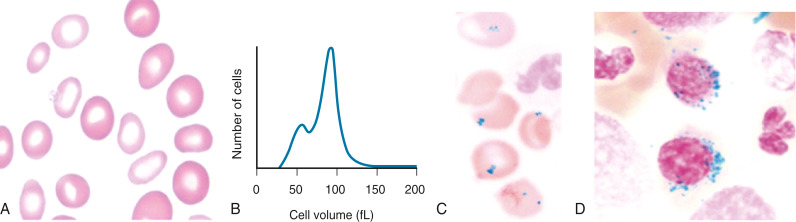
WORKUP5- CBC, peripheral smear, iron studies, free erythrocyte protoporphyrin level, serum copper level, serum lead level, MRI, bone marrow aspiration and biopsy (Fig. E1).
- CBC counts reveal anemia, mostly moderate, although severe anemias have been reported.
- Microcytic, normocytic, or macrocytic and classic dimorphic anemias may be seen along with siderocytes with Pappenheimer bodies (mature hypochromic erythrocytes with basophilic iron deposits).
- High serum iron levels, low transferrin along with increased transferrin saturation and high serum ferritin.
- Bone marrow shows increased iron stores and the classic ring sideroblasts, not seen in normal bone marrow tissue. The ring sideroblasts represent pathologic iron deposits in the perinuclear mitochondria of erythroblasts.
- In transfusion-dependent anemias, monitoring of ferritin and transferrin saturation levels is essential to avoid iron overload.
- Features of ineffective erythropoiesis-like increase in indirect bilirubin concentration, decrease in haptoglobin, increase in LDH, and normal or increase in reticulocyte number may be seen.
- MRI of posterior cranial fossa is indicated in anemia-ataxia syndromes.
Figure E1 A, Peripheral Blood Smear from a Patient with Hereditary Sideroblastic Anemia Shows a Population of Hypochromic and Microcytic ErythrocytesB, Erythrocyte Volume Distribution Curve of a Patient with Hereditary Sideroblastic Anemia. A Dimorphic Size Distribution is Evident. C, Peripheral Blood Showing Pappenheimer Bodies (Prussian Blue Stain). D, The Bone Marrow Smear Stained with Prussian Blue Shows Ring Sideroblasts.
From Hoffman R et al: Hematology, basic principles and practice, ed 7, Philadelphia, 2018, Elsevier.
NONPHARMACOLOGIC THERAPYRemoval of toxic agents that are potentially predisposing to SA is necessary.
ACUTE GENERAL Rx- A trial of pyridoxine (50 to 200 mg/day) is indicated for all patients with congenital SAs.
- 25% to 50% may show full or partial response to pyridoxine.
- Folic acid given along with pyridoxine ensures adequate substrate availability during increased hemoglobin synthesis.
- Patients who do not respond require support with PRBC transfusions.
- Chelation therapy is needed for patients with transfusion-dependent anemia to prevent complications of iron overload.
- Iron overload needs to be treated promptly, since it can result in unresponsiveness to pyridoxine.
- Erythropoietin and granulocyte colony-stimulating factor use may show some success in treating myelodysplasia-associated refractory anemia with ring sideroblasts.
- Secondary SA caused by medications can be reversed by withdrawing the medication and administering vitamin B6.
CHRONIC RxOrgan dysfunction resulting from iron overload will require periodic phlebotomy to keep serum ferritin level <300 ng/ml, as long as the patient is not anemic.
- Iron chelating therapy for patients with moderate to severe anemia who require regular red cell transfusion: Deferoxamine is given as subcutaneous or intravenous infusion; deferiprone and deferasirox are given orally.
- Splenectomy should be avoided at all costs.
- Bone marrow transplant is a last resort in young patients who are pyridoxine resistant and transfusion dependent with iron overload.
PROGNOSISIn patients with anemia alone, life expectancy is normal. In patients dependent on blood transfusions, morbidity from iron overload can be expected.
- RARS: With dysplasia confined to the erythroid cell lineage; survival similar to age-matched controls; no incidence of leukemic transformation.
- RCMD-RS: Approximately 5% will develop acute leukemia. Erythropoietin and granulocyte colony-stimulating factor therapy do not change survival.
REFERRAL- Hematologist
- Neurologist (in anemia-ataxia and myopathy-anemia syndromes)
- Families with severe forms of hereditary sideroblastic anemia should receive genetic counseling