AUTHORS: Klodia M. Hermez, DO, and Snigdha T. Reddy, MD
Chronic kidney disease (CKD) is diagnosed when there is evidence of kidney damage for more than 3 mo (urine albumin >30 mg/g creatinine, hematuria, or parenchymal abnormalities) and/or decreased kidney function (glomerular filtration rate [GFR] <60 ml/min per 1.73 m2.1 Advanced CKD, when GFR is <30 ml/min per 1.73 m2, is characterized by accumulation of metabolic waste products in the blood, electrolyte abnormalities, mineral and bone disorders, and anemia. The pathophysiology of CKD and its manifestations are summarized in Table 1.
TABLE 1 Pathophysiology of Chronic Kidney Disease
| Manifestation | Mechanisms | ||
|---|---|---|---|
| Accumulation of nitrogenous waste products | Decrease in glomerular filtration rate | ||
| Acidosis | Decreased ammonia synthesis Impaired bicarbonate reabsorption Decreased net acid excretion | ||
| Sodium retention | Excessive renin production Oliguria | ||
| Sodium wasting | Solute diuresis Tubular damage | ||
| Urinary concentrating defect | Solute diuresis Tubular damage | ||
| Hyperkalemia | Decrease in glomerular filtration rate Metabolic acidosis Excessive potassium intake Hyporeninemic hypoaldosteronism | ||
| Renal osteodystrophy | Impaired renal production of 1,25-dihydroxycholecalciferol Hyperphosphatemia Hypocalcemia Secondary hyperparathyroidism | ||
| Growth retardation | Inadequate caloric intake Renal osteodystrophy Metabolic acidosis Anemia Growth hormone resistance | ||
| Anemia | Decreased erythropoietin production Iron deficiency Folate deficiency Vitamin B12 deficiency Decreased erythrocyte survival | ||
| Bleeding tendency | Defective platelet function | ||
| Infection | Defective granulocyte function Impaired cellular immune functions Indwelling dialysis catheters | ||
| Neurologic symptoms (fatigue, poor concentration, headache, drowsiness, memory loss, seizures, peripheral neuropathy) | Uremic factor(s) Aluminum toxicity Hypertension | ||
| Gastrointestinal symptoms (feeding intolerance, abdominal pain) | Gastroesophageal reflux Decreased gastrointestinal motility | ||
| Hypertension | Volume overload Excessive renin production | ||
| Hyperlipidemia | Decreased plasma lipoprotein lipase activity | ||
| Pericarditis, cardiomyopathy | Uremic factor(s) Hypertension Fluid overload | ||
| Glucose intolerance | Tissue insulin resistance |
From Kliegman RM et al: Nelson textbook of pediatrics, ed 19, Philadelphia, 2011, Saunders.
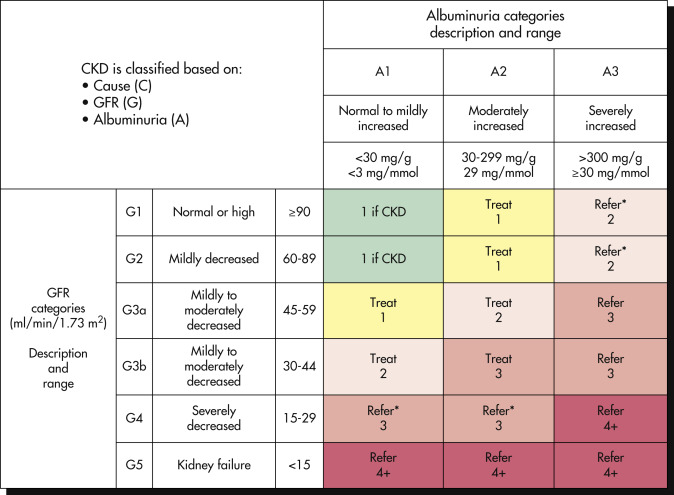
The 2012 Kidney Disease: International Global Outcomes classifies CKD with a C-G-A format: Cause (etiology), GFR (G1 to G5), and albuminuria (A1 to A3) by urine albumin-to-creatinine ratio. This format is recommended when documenting and discussing CKD. Fig. E1 depicts how CKD prognosis worsens with either increasing levels of albuminuria or declining GFR.
The GFR and Albuminuria Grid Depict the Risk of Progression, Morbidity, and Mortality by Color, from Best to Worst (Green, Yellow, Orange, Red, Deep Red). The Numbers in the Boxes are a Guide to the Frequency of Visits (Number of Times Per Year). Green Can Reflect Ckd with Normal eGFR and Albumin-to-Creatinine Ratio (Acr) Only in the Presence of Other Markers of Kidney Damage, Such as Imaging Showing Polycystic Kidney Disease or Kidney Biopsy Abnormalities, with Follow-Up Measurements Annually; Yellow Requires Caution and Measurements at Least Once Per Year; Orange Requires Measurements Twice Per Year; Red Requires Measurements 3 Times Per Yr; and Deep Red 4 Times Per Yr. These are General Parameters Only, Based on Expert Opinion, and Must Take into Account Underlying Comorbid Conditions and Disease State, as Well as the Likelihood of Causing a Change in Management for any Individual Patient. refer Indicates Nephrology Services are Recommended. Referring Clinicians May Wish to Discuss with Their Nephrology Service, Depending on Local Arrangements Regarding Treating or Referring. Ckd, Chronic Kidney Disease; GFR, Glomerular Filtration Rate.
Adapted from Vassalotti JA et al: Practical approach to detection and management of chronic kidney disease for the primary care clinician, Am J Med 2016 Feb, Elsevier.
Chronic renal insufficiency (CRI)
| ||||||||||||||||||||||||||||||||||||||||
GFR is considered the best overall index of kidney function, but it is not the only measure of kidney health. Although quantitation of albuminuria has been less widely adopted in clinical practice than assessment of estimated GFR (eGFR), its evaluation is critical for determining a prognosis. When applying eGFR equations, one must appreciate that CKD is defined over a 3-mo interval (Table 2). Furthermore, changes in calculation of GFR have been recommended by the NKF-ASN Task Force on Reassessing the Inclusion of Race in Diagnosing Kidney Diseases in April of 2021. This change involved excluding race when calculating eGFR in the CKD-EPI equation.4
TABLE 2 Criteria for Definition of Chronic Kidney Disease
| Kidney Disease is defined as abnormalities of kidney structure or function, present for more than 3 mo, with implications for health. These may include the following: | |||
| Markers of kidney damage | Albuminuria (AER ≥30 mg/24 h; ACR ≥30 mg/g [≥3 mg/mmol]) Urine sediment abnormalities Electrolyte and other abnormalities caused by tubular disorders Abnormalities detected through histology Structural abnormalities detected through imaging History of kidney transplantation | ||
| Decreased GFR | GFR <60 ml/min per 1.73 m2 | ||
ACR, Urine albumin-to-creatinine ratio; AER, albumin excretion rate; GFR, glomerular filtration rate; KD, kidney disease.
From KDIGO 2012 clinical practice guideline for the evaluation and management of chronic kidney disease, Kidney Int Suppl 3:1-150, 2013. In Floege J et al: Comprehensive clinical nephrology, ed 6, Philadelphia, 2019, Elsevier.
Therefore serum creatinine measurement, which all eGFR equations are based on, must be repeated and trended to establish a diagnosis of CKD. Furthermore, to properly trend the eGFR in a given individual, creatinine must be in a steady state of production. Albuminuria assesses kidney damage and complements the eGFR evaluation. Consequently, the National Kidney Foundation (NKF) and the American Society for Clinical Pathology (ASCP) advocate optimal screening for CKD in the primary care setting using the new Kidney Profile test. The Kidney Profile combines the following two measurements: eGFR with serum creatinine (CPT 82565) and urine albumin-to-creatinine ratio (ACR) (albumin, urine [e.g., microalbumin], quantitative: CPT 82043; and urine creatinine: CPT 82570). Patients with CKD have an elevated risk for cardiovascular disease, and results from combined eGFR and ACR testing can be a strong predictor of cardiovascular mortality and kidney failure risk.3
TABLE 3 Management Plan for Patients With Chronic Kidney Disease, According to Stage
| Stage & GFR | Action | Clinical Testing | Treatment Considerations |
|---|---|---|---|
| 1 >90 ml/min per 1.73 m2 | Establish risk or etiology of CKD Diagnose and treat CVD risk factors and comorbid conditions | eGFR:Every 12 mo UA with microscopic evaluation UPC if nondiabetic: Every 12 mo ACR if diabetic: Every 12 mo | Consult nephrology if eGFR declines by ≥4 ml/min per yr BP: <130/80 mm Hg Proteinuria: UPC <0.2; ACR <30 mg/g with ACEI or ARB |
| 2 60-89 ml/min per 1.73 m2 | Estimate CKD progression rate Diagnose and treat CVD risk factors and comorbid conditions | eGFR: Every 6-12 mo CBC, reticulocyte ct, TSAT, ferritin if Hb 10-12 g/dl: Every 12 mo Annual Ca/P/PTH/25(OH)D evaluations ACR or UPC: Every 6-12 mo | Avoid nephrotoxins Treat hypertension Hb: 10-12 g/dl, TSAT >20%, and ferritin >100 ng/ml ACR: <30 mg/g or UPC <0.2 with ACEI or ARB |
| 3A 45-59 ml/min per 1.73 m2 3B 30-44 ml/min per 1.73 m2 | Estimate CKD progression rate Diagnose and treat CVD risk factors and comorbid conditions Kidney imaging study (e.g., US or CT) Consider nephrology Consultation | BP monitoring: Every 3-6 mo. eGFR: Every 6 mo, if stable every 12 mo CBC: Hb <10 g/dl every 1-3 mo until Hb 9-12 g/dl; then every 3-6 mo TSAT and ferritin if Hb <13 g/dl (men) or 12 g/dl (women) and after therapy Baseline Ca/P/PTH/Alk Phos/25(OH)DCa/P/PTH/Alk Phos, depending on baseline and CKD progression 25(OH)D, depending on baseline and response to treatment UPC or ACR: Every 6-12 mo | Avoid nephrotoxins Treat hypertension Hb: 9-12 g/dl, TSAT >20%, ferritin >100 ng/ml with oral and/or IV iron and/or erythropoiesis stimulating agent Ca & P: To normal range with P-binders 25(OH)D: ≥30 ng/ml with vitamin D2/D3 iPTH: 130-600 pg/ml with calcitriol or vitamin D analogs If iPTH progressively increases NaHCO3: 22-26 mmol/L and titrate NaHCO3 therapy UPC: <0.2 or ACR <30 mg/g with ACEI or ARB |
| 4 15-29 ml/min per 1.73 m2 | Transition of management and care to Nephrology Initiate decisions regarding kidney replacement therapy, vascular access, and kidney transplant Diagnose and treat CVD risk factors and comorbid conditions Adjust drug dosing for CKD stage | BP monitoring: Every 3 mo. eGFR: Every 3 mo CBC, TSAT, ferritin: Every 3-6 mo Baseline Ca/P/PTH/Alk Phos/25(OH)D; then repeat levels every 6-12 mo UPC or ACR: Every 3-6 mo | All of the above plus CKD-specific education: Kidney replacement therapy modality Immunizations: Influenza (TIV, QIV but not LAV; PPSV23; and HBV Reinforce dietary prescription Protect dominant (handwriting) arm Vascular access surgery evaluation |
ACEI, Angiotensin-converting enzyme inhibitor; ACR, urine albumin-to-creatinine ratio; Alk Phos, alkaline phosphatase; ARB, angiotensin-receptor blockers; BP, blood pressure; Ca, serum calcium; CBC, complete blood count; CKD, chronic kidney disease; CT, computed tomography; ct, count; CVD, cardiovascular disease; eGFR, estimated glomerular filtration rate; GFR, glomerular filtration rate; Hb, hemoglobin; HBV, hepatitis B virus; iPTH, intact parathyroid hormone; LAV, live attenuated virus; P, serum phosphorus; PPSV23, 23-valent pneumococcal polysaccharide vaccine; PTH, parathyroid hormone; QIV, quadrivalent influenza vaccine; TIV, trivalent influenza vaccine; TSAT, transferrin saturation; UA, urine analysis; UPC, urine protein-to-creatinine ratio; US, ultrasonography. CKD Stage G5 (GFR <15 ml/min per 1.73 m 2) patients require management by a nephrologist.
From Inker LA et al: Am J Kidney Dis 63(5):713-735, 2014.
CKD typically progresses slowly. Therefore even relatively small reductions of GFR loss can delay the onset of ESRD by years. For this reason, an aggressive, multiple risk factor intervention to slow GFR decline is warranted, except in patients with low ESRD risk. CKD treatment plan goals include reduction of albuminuria to the greatest extent possible and control of hypertension. Albuminuria reduction to less than 500 mg/day or more, often with inhibition of the renin-angiotensin-aldosterone system, and maintenance of blood pressure to <130/<80 mm Hg are the two most important aspects of treatment. Table 4 summarizes recommended kidney protective therapies according to level of recommendation.5
TABLE 4 Recommended Kidney Protective Therapies According to Level of Recommendation
BP, Blood pressure; NaCl, sodium chloride.
From Floege J et al: Comprehensive clinical nephrology, ed 6, Philadelphia, 2019, Elsevier.
The Kidney Disease: Improving Global Outcomes organization recommends lowering protein intake in adults with CKD to 0.8 g/kg per day and eGFR below 30 ml/min per 1.73 m2, whereas high protein intake (>1.3 g/kg per day) should be avoided in adults with CKD at risk of progression. Table 5 describes nutritional recommendations for patients with CKD.1
TABLE 6 Suggested Criteria for Referral of Patients With Chronic Kidney Disease to a Nephrologist
| NICE 2008 | KDIGO 2012 | |
|---|---|---|
| Advanced CKD | Stage 4 and 5 CKD | Category G4 and G5 CKD |
| Proteinuria | High proteinuria: ACR ≥70 mg/mmol unless known to be caused by diabetes and appropriately treated | Consistent proteinuria: ACR ≥ 300 mg/g (≥30 mg/mmol) |
| Hematuria | Proteinuria (ACR ≥30 mg/mmol) together with hematuria | Urinary red cell casts, RBCs >20 per high power field sustained; not readily explained |
| Progression of CKD | Rapidly declining eGFR: >5 ml/min per 1.73 m2 in 1 yr >10 ml/min per 1.73 m2 in 5 yr | Progression of CKD: Sustained decline of eGFR >5 ml/min per 1.73 m2 per 1 yr Decrease in GFR category with a ≥25% drop in eGFR from baseline |
| Uncontrolled hypertension | Hypertension that remains poorly controlled despite the use of at least four antihypertensive drugs at therapeutic doses | CKD and hypertension refractory to treatment with four or more antihypertensive agents |
| Hereditary kidney disease | Known or suspected rare or genetic causes of CKD | Hereditary kidney disease |
| Other conditions | Suspected renal artery stenosis | Recurrent or extensive nephrolithiasis Persistent abnormalities of serum potassium |
ACR, urine albumin-to-creatinine ratio; CKD, chronic kidney disease; eGFR, estimated glomerular filtration rate; KDIGO, Kidney Disease: Improving Global Outcomes; NICE, National Institute for Health and Care Excellence; RBC, red blood cells.
From Floege J et al: Comprehensive clinical nephrology, ed 6, Philadelphia, 2019, Elsevier. Data from KDIGO 2012 Clinical Practice Guideline for the Evaluation and Management of Chronic Kidney Disease, Kidney Int Suppl 3:1-150, 2013; and National Institute for Health and Care Excellence: Chronic kidney disease in adults: assessment and management.
TABLE 5 Nutritional Recommendations in Chronic Kidney Disease
| Recommendations are for typical patients but always should be individualized on the basis of clinical, biochemical, and anthropometric indices. | |||
|---|---|---|---|
| Daily Intake | Predialysis CKD | Hemodialysis | Peritoneal Dialysis |
| Protein (g/kg ideal BW) (see KDOQI for estimation of adjusted edema-free BW) | 0.6-1.0 Level depends on the view of the nephrologist 1.0 for nephrotic syndrome | Min ≥1.1 | Min 1.0-1.2 |
| Recommendations are in conjunction with an adequate energy intake. Requirements may be higher during illness because of multiple comorbidities or during acute periods of infection, including peritonitis. | |||
| Energy (kcal/kg BW) | 35 (younger than 60 yr) 30-35 (older than 60 yr) | 35 (younger than 60 yr) 30-35 (older than 60 yr) 30-40 kcal/kg ideal BW | 35 including dialysate calories (younger than 60 yr) 30-35 including dialysate calories (older than 60 yr) |
| Sodium (mmol) | <100 (more if salt-wasting) | <100 | <100 |
| Potassium | Reduce if hyperkalemic | Reduce if hyperkalemic | Reduce if hyperkalemic; potassium restriction is generally not required. May need to increase potassium intake if hypokalemic. |
| If hyperkalemic, advice will take the form of decreasing certain foods (e.g., some fruits and vegetables) and giving information about cooking methods. | |||
| Phosphorus | Reduce because of phosphate retention. Monitor levels. Advice will take the form of reducing certain foods (e.g., dairy, offal, some shellfish) and processed foods with high content of added phosphates, and giving information about the timing of binders with high-phosphorus meals and snacks. | ||
Recommendations are for typical patients but always should be individualized based on clinical, biochemical, and anthropometric indices. BW, Body weight; CKD, chronic kidney disease; KDOQI, Kidney Disease Outcomes Quality Initiative.
From Floege J et al: Comprehensive clinical nephrology, ed 6, Philadelphia, 2019, Elsevier.
TABLE 7 Factors Affecting Renal Dysfunction in Long-Term Survivors and General Management of Chronic Kidney Disease
| Risk Factors | CKD Management | ||
|---|---|---|---|
| KDIGO 2012 Guidelines for CKD | ||
|
ACEI, Angiotensin-converting enzyme inhibitor; AKI, acute kidney injury; ARB, angiotensin receptor blocker; BP, blood pressure; CKD, chronic kidney disease; CNI, calcineurin inhibitor; HRS, hepatorenal syndrome; KDIGO, Kidney Disease Improving Global Outcomes.
∗Whether successful treatment of chronic hepatitis C with the newer direct-acting antiviral agents alters renal outcome remains to be studied.
From Ronco C: Critical care nephrology, ed 3, 2019, Elsevier.