section name header

Basic Information ⬇

AUTHOR: Joseph S. Kass, MD, JD, FAAN

Definition

  • HIV-associated cognitive dysfunction, referred to as HIV-associated neurocognitive disorder (HAND), covers a spectrum of disorders ranging from asymptomatic (asymptomatic neurocognitive impairment) to mild (mild neurocognitive disorder) to severe (including HIV-associated dementia).
  • Cognitive, motor, and behavioral abnormalities.
Synonyms

HAD

HAND

HIV-associated neurocognitive disorder (HAND)

HIV dementia

HIV-associated dementia

Mild neurocognitive disorder

AIDS dementia complex

HIV-1 encephalopathy

ICD-10CM CODES
B20Human immunodeficiency virus [HIV] disease
B97.35Human immunodeficiency virus, type 2 [HIV 2] as the cause of diseases classified elsewhere
R41.8Other and unspecified symptoms and signs involving cognitive functions and awareness
Epidemiology & Demographics

  • According to the CHARTER study, ∼52% of HIV-infected individuals have HAND. The largest group has asymptomatic neurocognitive impairment (∼33%), followed by minor neurocognitive disorder (12%), and HIV-associated dementia (2%).1
  • The epidemiology has changed in the era of antiretroviral therapy (ART), with the number of cases of HIV-associated dementia (HAD) falling from 15% in the pre-ART era to 2% now, but the proportion of mildly affected patients is increasing.
  • As HIV-infected patients live longer, the prevalence of HAND may be increasing.
Clinical Features

  • The 2007 Frascati Criteria for HAND require assessment of five cognitive domains: verbal/language ability, attention and working memory, abstraction and executive function, speed of information processing, sensory perceptual skills, and motor skills. The criteria define three levels of HAND2:
    1. Asymptomatic neurocognitive disorder: An acquired impairment in at least two cognitive domains as defined by a performance on neuropsychologic testing of >1 standard deviation (SD) below expected age and education-adjusted norms. This impairment does not affect daily functioning, and the patient may be unaware of its existence.
    2. Mild neurocognitive disorder: An acquired impairment in at least two cognitive domains as defined by a performance on neuropsychologic testing of more than 1 SD below expected age and education-adjusted norms. This impairment does affect daily functioning to a mild degree. For example, work efficiency is decreased, but the patient can compensate for the deficits.
    3. HAD: An acquired impairment in at least two cognitive domains as defined by a performance on neuropsychologic testing of more than 2 SD below expected age and education-adjusted norms. This impairment does affect daily functioning to a significant degree.
  • Cognitive changes3: Forgetfulness, poor attention and concentration, increased difficulty performing complex tasks, slowed psychomotor speed.
  • Behavioral changes: Apathy, lack of initiative, social withdrawal, irritability, occasionally agitation, psychosis, or obsessive-compulsive disorder.
  • Motor problems: Clumsiness, unsteady gait, poor balance, tremor, leg weakness.
  • Progressive/later stages: Bedbound, severe dementia, bowel/bladder incontinence.
  • Results from inflammation triggered by HIV itself (not related to opportunistic infection) and immune activation of microglia.
  • In children: Developmental delay, microcephaly, and spasticity are common.
Risk Factors

  • Low CD4 count (<200 cells/mm3)
  • History of low CD4 count nadir
  • High viral load
  • Anemia
  • Injection drug use
  • Hepatitis C
  • Female sex
  • Older age

Diagnosis ⬆ ⬇

Workup

  • Diagnosis is based on clinical examination and neuropsychologic tests and exclusion of opportunistic processes.
  • Computed tomography of brain may show subcortical hypodensities, enlarged ventricles, and cortical atrophy greater than expected for age.
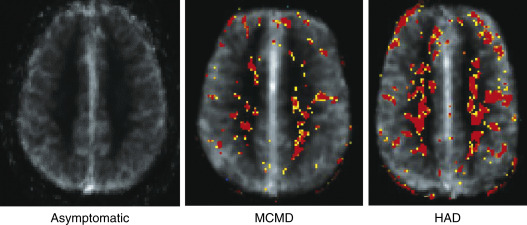
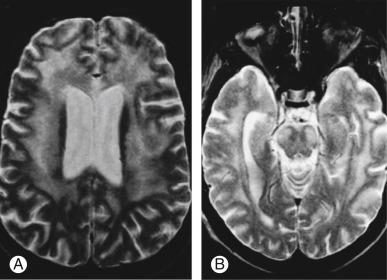
  • MRI head (Figs. E1 and E2): Classic findings are diffuse, confluent, periventricular white matter hyperintensities on T2-weighted images with cortical atrophy and enlarged ventricles. However, white matter hyperintensities are not mandatory for the diagnosis.
  • Lumbar puncture: Cerebrospinal fluid (CSF) analysis helps to rule out opportunistic infections. In HAND, the CSF may show a nonspecific increase in cell count and protein but may also be normal.
  • Subtle electrophysiologic abnormalities can be found in early HIV-1 infection (on electroencephalography, evoked potentials, nerve conduction studies), but they do not seem to have a predictive value for the later onset of HAD, which correlates most with a history of the CD4+ T-lymphocyte nadir of less than 200 cells/μL.
  • Potential causes for cognitive impairment that must be ruled out include:
    1. Opportunistic central nervous system (CNS) processes (e.g., toxoplasmosis, primary CNS lymphoma, progressive multifocal leukoencephalopathy, cytomegalovirus encephalitis, cryptococcal meningitis)
    2. HIV-mediated CD8 encephalitis
    3. General paresis due to syphilis
    4. Vitamin B12 deficiency resulting in subacute combined degeneration
    5. Substance use
    6. Alcoholism
    7. Psychiatric disorders such as depression, anxiety, bipolar disorder, or schizophrenia
    8. Side effects of prescribed medications

Figure E1 Perfusion Magnetic Resonance Imaging Maps Showing Regions of Increasing Cerebral Blood Volume (CBV) with Advancing Human Immunodeficiency Virus (HIV) Groups: Asymptomatic, Minor Cognitive-Motor Disorder (MCMD), and HIV-Associated Dementia (HAD)

Areas of red indicate >2 standard deviations elevation in CBV.

From Tucker KA et al: Neuroimaging in human immunodeficiency virus infection, J Neuroimmunol 157[1-2]:153-162, 2004.

Figure E2 Advanced human immunodeficiency virus encephalopathy: Axial T2WI.

There is diffuse confluent and symmetric abnormal high signal returned from the white matter of the cerebral hemispheres (A), which is also extending into the brain stem to involve the cerebral peduncles (B). In this patient there is also generalized atrophy. Features that help to differentiate HIV from progressive multifocal leukoencephalopathy (PML) are the symmetry of the changes and the lack of signal abnormalities on T1WI.

From Adam A et al: Grainger & Allison’s diagnostic radiology, ed 5, Philadelphia, 2007, Churchill Livingstone; and Grant LA: Grainger & Allison’s diagnostic radiology essentials, ed 2, Philadelphia, 2019, Elsevier.

Treatment ⬆ ⬇

Pearls & Considerations ⬆ ⬇

Referral

  • Upon diagnosis/clinical suspicion for HIV-associated cognitive dysfunction, referral to neurology is recommended.
  • Referral to neuropsychology may be considered.
  • Referral to infectious disease specialist to manage HIV infection.

Related Content ⬆

  1. Heaton R.K. : HIV-associated neurocognitive disorders persist in the era of potent antiretroviral therapy: CHARTER StudyNeurology. ;75(23):2087-2096, 2010.
  2. Antinori A. : Updated research nosology for HIV-associated neurocognitive disordersNeurology. ;69:1789-1799, 2007.
  3. Matchanova A. : Operationalizing and evaluating the Frascati criteria for functional decline in diagnosing HIV-associated neurocognitive disorders in adultsJ Neurovirol. ;26(2):155-167, 2020.
  4. Lescure F.X. : CD8 encephalitis in HIV-infected patients receiving cART: a treatable entityClin Infect Dis. ;57(1):101-108, 2013.
  5. Zarkali A. : CD8+ encephalitis: a severe but treatable HIV-related acute encephalopathyPract Neurol. ;17:42-46, 2017.