Author: Ajay S. Koti, MD and Emily C.B. Brown, MD, MS

Abusive head trauma (AHT) refers to a distinct form of traumatic brain injury that occurs as a consequence of inflicted injury to a child, typically under the age of 4 yr. Formerly known as "shaken baby syndrome," AHT is caused by a rotational acceleration-deceleration injury that arises from shaking, blunt impact, or a combination thereof.1 The injury pattern may not clearly differentiate between these mechanisms. AHT is a life-threatening condition, and survivors commonly suffer long-term sequelae. The constellation of findings frequently includes subdural hemorrhage, (SDH), often, but not universally accompanied by extensive retinal hemorrhages and/or encephalopathy. Children with AHT may present with or without evidence of additional cutaneous, musculoskeletal, or visceral injuries (Fig. E1). AHT is often challenging to diagnose because the clinical manifestations may be vague or nonspecific, caregivers may not report a history of trauma, and there may be no external sign of injury.
Figure E1 Abusive head trauma.
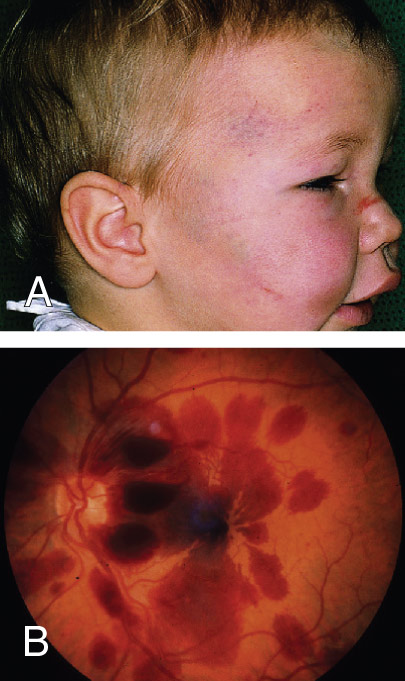
A, Facial bruising. B, Fundus hemorrhages involving different levels.
(Courtesy R. Bates. A, From Kanski JJ, Bowling B: Clinical ophthalmology, a systematic approach, ed 7, Philadelphia, 2010, Saunders. B, From Salmon JF: Kanski’s clinical ophthalmology: A systematic approach, ed 10, Philadelphia, 2024, Elsevier.)
- Shaken baby syndrome
- Infant whiplash syndrome
- Inflicted pediatric neurotrauma
- Nonaccidental head injury
- AHT
| ICD-10CM CODES | |||
| T74.4 | Shaken infant syndrome | ||
| T74.12 | Child physical abuse, confirmed | ||
| T76.12 | Child physical abuse, suspected | ||
AHT is the most common cause of fatal head injuries in children under 2 yr, accounting for 53% of serious or fatal traumatic injuries. It is the leading cause of abusive fatalities overall.2 Morbidity and mortality are higher for victims of AHT than for children injured accidentally. Approximately one in four cases are fatal.1 Long-term neurologic sequelae are common, occurring in 70% of survivors. These include visual deficits, neurocognitive problems, seizure disorders, cerebral palsy, and intellectual disability.1
Males are found to be at higher risk for AHT than females, by as much as a 2-to-1 margin.3-5
Victims of AHT are typically younger than 1 yr, with a median age of 4 mo. The peak incidence of fatal AHT occurs at 1 to 2 mo, coinciding with the peak of infantile colic/crying, which is often reported as a trigger of abusive events.2 Infants are particularly susceptible to injuries from shaking and/or impact due to their unique body proportions, neural immaturity, and neuroanatomy.3
Risk factors for AHT include prematurity, perinatal illness, multiple gestations, male sex, and excessive crying. Other psychosocial stressors, such as parental substance use or mental illness, lack of access to child care, and poverty, have been associated with AHT at the population level. Those who inflict AHT are more often males.4,5 It is important to note, however, that AHT can affect infants of every socioeconomic circumstance and caregiving environment. Clinicians should be cautious in considering psychosocial risk factors, which may bias the abuse determination.
Infants with AHT often present with nonspecific symptoms (e.g., drowsiness, lethargy, irritability, vomiting, seizures, irregular respirations, or apnea) and either no history of trauma or an inconsistent report of a low-height fall.3 Symptoms range in severity, and it is not unusual for infants to present with an unexplained coma or arrest. Examination findings include bruising, oral injuries such as a torn frenulum, macrocephaly, and/or a bulging fontanelle, but many infants have no external signs of trauma. SDH is the most common radiologic finding in AHT, and AHT is one of the most common causes of SDH in infants. Other neuroimaging findings include cerebral edema, loss of gray-white differentiation, parenchymal injury, torn/thrombosed bridging veins, cervical spine ligamentous injuries, and spinal subdural hematoma.2 Retinal hemorrhages are frequently present on a dilated fundoscopic exam. Often, these are bilateral, too numerous to count, and involve the retinal periphery, although a fraction of patients will have no retinal hemorrhages whatsoever. Retinoschisis may be present. Beyond the nervous system, patients may have other traumatic injuries, such as posterior rib fractures or classic metaphyseal lesions, fractures that are highly associated with child abuse. Despite the severity of injury, delayed diagnoses are common, and AHT is missed by medical providers approximately 30% of the time on initial presentation.6 This often leads to recurrent and escalating injuries to the child until the abuse is recognized.7 Physicians often fail to detect AHT among children of two-parent, white families, likely reflecting bias in the suspicion of abuse.6 The diagnosis of abuse should be driven by a recognizable constellation of clinical findings and not the family’s psychosocial circumstances.
AHT is thought to occur from rotational acceleration-deceleration forces, such as those generated in shaking; however, blunt impact trauma can cause overlapping findings. These forces are inconsistent with typical infant caregiving or minor accidental trauma. SDHs arise from bridging vein trauma. Children with more severe presentations may have traumatic axonal injury. Vitreoretinal traction accounts for retinal hemorrhages and retinoschisis. AHT patients frequently experience multiple episodes of trauma, highlighting the importance of diagnosis to prevent recurrent harm.


