Introduction
Using Your Inhaler
It is important to use your inhaler the right way so that the full dose of medication reaches your lungs. You can use these general directions to help you remember the right way to use your inhaler, but you will also need specific directions for the type of inhaler your doctor has prescribed. Ask your doctor or pharmacist for a copy of the manufacturer's information for the patient that comes with your inhaler and read this information carefully.
Ask your doctor or pharmacist to show you how to use your inhaler and to watch you as you use it for the first time. When you return on your next visit, ask your doctor or pharmacist to check that you are using your inhaler properly.
Most inhalers can be used alone or with a spacer (plastic tube that attaches to an inhaler and helps the medication to reach the lungs). Spacers are useful for all patients, especially children, older adults, and patients who are using inhaled corticosteroids (a type of medication used to prevent swelling of the airways in patients who have asthma). Ask your doctor if you should use your inhaler with a spacer. If you will be using a spacer, be sure you understand how to use and clean it. Ask your doctor or pharmacist if you have any questions.
You usually should prime (spray a few times into the air away from your face) your inhaler before using it for the first time or if you have not used it for several weeks. Read the manufacturer's directions for specific information about priming your inhaler.
These directions explain how to use metered-dose inhalers. If you are using a different type of inhaler such as a dry powder inhaler or breath-activated inhaler (a type of inhaler that releases the medication automatically when you breath in), you will need to follow different directions. Ask your doctor or pharmacist if you need more information or if you do not know what type of inhaler you are using.
- Remove the cap and hold the inhaler upright.
- Shake the inhaler.
- Breathe out slowly through your mouth.
- Hold your inhaler as shown in one of the pictures below or as recommended by your doctor. Do not use method C if you are using a corticosteroid inhaler.
- If you are not using a spacer, begin to breathe in slowly through your mouth. While you are breathing in, press down on your inhaler one time to release the medication. If you are using a spacer, first press down on the inhaler, then within 5 seconds, begin to breathe in slowly through your mouth.
- Continue to breathe in slowly and as deeply as you can.
- Hold your breath for 10 seconds if you can to allow the medication to reach deeply into your lungs.
- Repeat steps 2 to 7 until you have inhaled the number of puffs that your doctor prescribed. If you are using a quick-relief medication (beta2 agonists), wait at least 15 to 30 seconds between puffs. There is no need to wait between puffs of other types of medication. Ask your doctor or pharmacist if you need to wait between puffs of your medication.
- After you use a corticosteroid inhaler, rinse your mouth thoroughly with water and then spit out the water. Do not swallow.
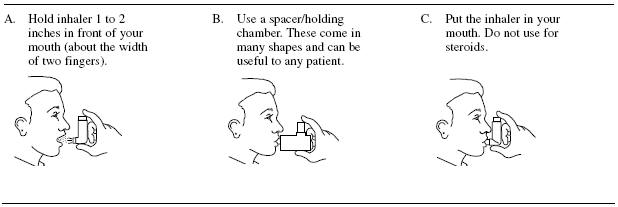
Reprinted, with permission, from the National Asthma Education and Prevention Program's Expert Panel Report 3: Guidelines for the Diagnosis and Management of Asthma and Practical Guide for the Diagnosis and Management of Asthma, National Heart, Lung, and Blood Institute, Bethesda, MD, 2007.
Cleaning Your Inhaler
You can use these general directions to clean your inhaler. However, you should always read and follow the manufacturer's specific directions for cleaning the type of inhaler that you are using. You can find these directions in the manufacturer's information for the patient.
- Clean your inhaler mouthpiece about once a week or as often as recommended by your doctor or pharmacist. In addition to your routine cleanings, clean your inhaler if little or no medication is sprayed when you activate the inhaler.
- Remove the metal canister from the L-shaped plastic mouthpiece.
- Rinse only the mouthpiece and cap with warm running water for about 30 seconds. Do not wash or put the canister in water.
- Let the mouthpiece and cap dry overnight.
- In the morning, put the canister back inside the mouthpiece and put the cap on the inhaler.
Knowing When to Replace Your Inhaler
You cannot see the medication in your inhaler, so it is hard to tell when it is empty. Some people think they can tell when their inhalers are empty by floating the canisters in water, spraying the medication into the air, or tasting the medication. However, none of these methods really work, and people who use these methods may continue to use their inhalers after the inhalers are empty.
Some inhalers come with a counter that shows the number of sprays that remain in the inhaler. If your inhaler comes with a counter, do not use the inhaler after the counter shows that there are no sprays left. If your inhaler does not come with a counter, follow the directions in the manufacturer's information or use the directions below to find out when you should replace your inhaler. Always be sure that you replace your inhaler when it is empty so that you receive your full dose of medication.
For long-term control medications that you take regularly each day:
- Multiply the number of puffs you use at a time by the number of times you use your inhaler each day. This is the total number of puffs you use each day. For example, if you use four puffs two times a day, you would multiply 4 by 2 and find that you use a total of eight puffs each day.
- Look at the label on your medication canister. The number of puffs that the canister contains should be listed on the label.
- Divide the number of puffs in the canister (the number that you found in step 2) by the number of puffs that you inhale each day (the number that you calculated in step 1). For example, if your new canister contains 200 puffs and you inhale eight puffs per day, you would divide 200 by 8 and find that your canister would last 25 days.
- Instead of following the steps above, you can use the chart below to estimate how long your canister will last.
- You should note the date that you begin using the canister and count ahead by the number of days you expect the canister to last. This will give you the date that you can expect your canister to be empty. For example, if you started using the new canister on May 1st, and the canister contains enough medication for 25 days, it should last until May 26th. Plan to refill your prescription before this date so that you will not run out of medication.
- You can write the date on your canister to help you remember when you will need to refill your prescription.
For quick-relief medications that you use as needed:
- You will need to count each puff that you use.
- When the number of puffs used is near the total number of puffs in the canister, you will need to get a new canister.
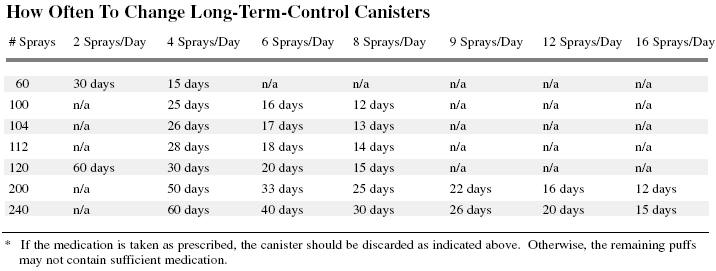
Reprinted, with permission, from the National Asthma Education and Prevention Program's Expert Panel Report 2: Guidelines for the Diagnosis and Management of Asthma and Practical Guide for the Diagnosis and Management of Asthma, National Heart, Lung, and Blood Institute, Bethesda, MD, 1997.
This report on medications is for your information only, and is not considered individual patient advice. Because of the changing nature of drug information, please consult your physician or pharmacist about specific clinical use.
The American Society of Health-System Pharmacists, Inc. represents that the information provided hereunder was formulated with a reasonable standard of care, and in conformity with professional standards in the field. The American Society of Health-System Pharmacists, Inc. makes no representations or warranties, express or implied, including, but not limited to, any implied warranty of merchantability and/or fitness for a particular purpose, with respect to such information and specifically disclaims all such warranties. Users are advised that decisions regarding drug therapy are complex medical decisions requiring the independent, informed decision of an appropriate health care professional, and the information is provided for informational purposes only. The entire monograph for a drug should be reviewed for a thorough understanding of the drug's actions, uses and side effects. The American Society of Health-System Pharmacists, Inc. does not endorse or recommend the use of any drug. The information is not a substitute for medical care.
AHFS® Patient Medication Information™ Copyright, 2025. The American Society of Health-System Pharmacists®, 4500 East-West Highway, Suite 900, Bethesda, Maryland. All Rights Reserved. Duplication for commercial use must be authorized by ASHP.
Last Reviewed: September 1, 2010.