▶Most common skin disease that is treated by physicians.
▶Affects approximately 45 million individuals in the United States, including at least 85% of all teenagers and young adults.
▶Most often self-limited and tends to remit during early adulthood but can be a continuing problem for a significant subset of young and middle-aged adults.
▶Has the potential for significant negative effect on quality of life, including poorer academic performance and higher unemployment rates.
▶Successful treatment is generally associated with improved psychologic well-being.
Pathophysiology
▶Result of a complex interaction between hormonal changes and their effects on the pilosebaceous unit (ie, specialized structures consisting of a hair follicle and sebaceous glands concentrated on the face, chest, and back).
▶Onset at puberty as a result of increased androgen production.
▶End-organ androgen hyperresponsiveness of the follicle probably also plays a role.
Multifactorial Pathogenesis
▶Disordered function of the pilosebaceous unit with atypical follicular keratinization (tendency toward increased follicular plugging).
▶Recent data suggest that inflammation of the skin is present even before comedone formation; therefore, acne is considered primarily an inflammatory disorder of the pilosebaceous unit.
▶Increased circulating androgens play a role in promoting inflammation of the sebaceous gland in addition to sebaceous gland growth resulting in increased sebum production.
▶This increased sebum milieu favors Cutibacterium (formerly Propionibacterium) acnes growth and likely contributes to the pathogenesis of acne via activation of the innate immune response via toll-like receptors, although this relationship continues to be explored.
Factors That May Exacerbate Acne
▶Trauma: scrubbing the skin too vigorously or picking of lesions.
▶Comedogenic cosmetics or other skin care products.
▶Tight-fitting sports equipment.
▶Medications: corticosteroids (topical, inhaled, and oral) and anabolic steroids, antiepileptic drugs, lithium, and progesterone-only contraceptives (eg, progesterone-only mini pill, progesterone intrauterine device, implantable progesterone).
▶Syndromes associated with hormonal dysregulation such as polycystic ovary syndrome and Cushing syndrome may be associated with more severe acne.
▶A high glycemic index diet and consumption of nonfat dairy may be associated with acne vulgaris.
Early on, acne lesions often appear on the forehead and middle third of the face (T-zone) and are obstructive (ie, comedones); inflammatory lesions tend to develop later and may occur on all areas of the face, neck, chest, and back.
▶Comedonal lesions: often the first sign of acne, appearing before other signs of puberty.
■Open comedones (blackheads): dilated follicles (Figure 7.1).
■Closed comedones (whiteheads): white or skin-colored papules without surrounding erythema (Figure 7.2).
▶Inflammatory lesions typically appear later in the course of acne vulgaris and vary from 1- to 2-mm micro-papules to nodules larger than 5 mm (Figure 7.3).
▶Large (5–15 mm) inflammatory nodules and cysts occur in the most severe cases, and such nodulocystic presentations are most likely to lead to permanent scarring.
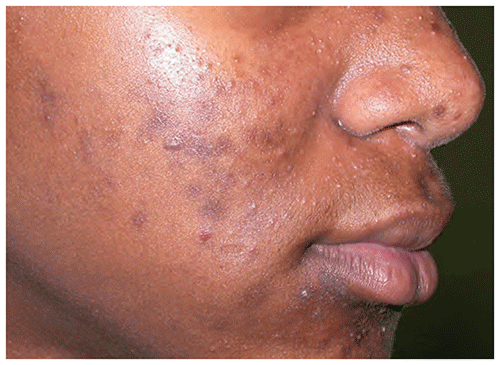
■Mild, moderate, and severe inflammatory acne can be associated with disfiguring postinflammatory discoloration, which can appear red, violaceous, or grayish brown.
■Pigmentary changes may persist for many months to years (Figure 7.4).
Figure 7.1. Open Comedones (Ie, Blackheads; Arrows) on the Forehead.
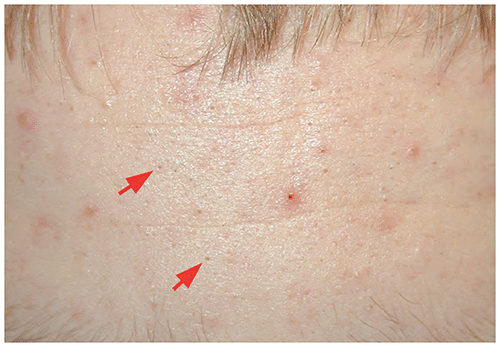
Figure 7.2. Closed Comedones (Arrows) are Small White or Skin-Colored Papules Without Surrounding Erythema. This Patient Has Mild Acne.
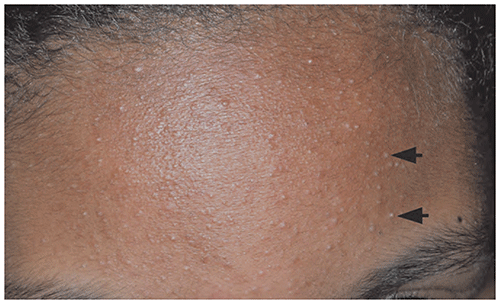
Figure 7.3. Inflammatory Lesions are Erythematous Papules, Pustules, or Nodules. This Patient Has Moderate Acne. Note Some Mild Early Scarring.
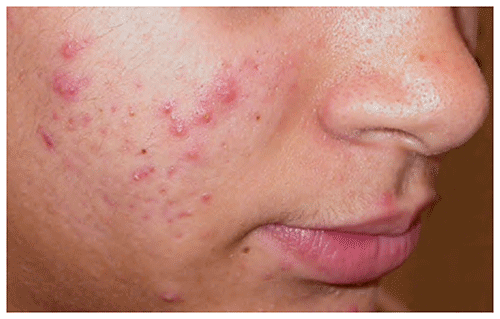
Figure 7.4. Patient with Skin of Color with Moderate Acne. As Inflammatory Lesions Resolve, Areas of Hyperpigmentation Persist. This May Appear as Violaceous to Grayish Brown Color Changes.
Look-alikes
In each of the conditions listed herein, comedones are absent.
| Disorder | Differentiating Features |
|---|
| Acne rosacea | |
| Angiofibromas (ie, adenoma sebaceum) | Appears during childhood (earlier than acne). Favors nose and medial aspect of cheeks. Associated with tuberous sclerosis or multiple endocrine neoplasia type 1.
|
| Flat warts | Skin-colored to tan papules or small, thin plaques. Koebnerization (lesions distributed in linear clusters) often present.
|
| Gram-negative folliculitis | |
| Keratosis pilaris | Presents during infancy or early childhood. Presence of a central keratin plug differentiates keratosis pilaris from acne. Favors lateral aspects of cheeks (rather than T-zone) and may also be present on the extensor surfaces of upper arms, dorsal surfaces of thighs.
|
| Miliaria rubra | |
| Molluscum contagiosum | Translucent papules, often with central umbilication. Koebnerization (lesions distributed in linear clusters) often present.
|
| Periorificial dermatitis | Concentrated around mouth; nares; or, less commonly, eyes. Often (but not always) history of preceding use of topical corticosteroids.
|
| Malassezia (Pityrosporum) folliculitis | |
| Steroid acne | Lesions have monomorphous appearance (ie, only papules without comedones). Temporal relationship between onset or worsening of acne and corticosteroid therapy.
|
Options for acne treatment based on lesion type and disease severity are summarized in Figures 7.5, 7.6, and 7.7.
▶Adolescents are anxious for improvement in their acne; however, patient education is key. Patients should be counseled that acne improvement is gradual and that 4 to 6 weeks or longer may be required to observe a benefit from treatment.
▶Acne treatment is facilitated by optimizing skin care and appropriate pharmacological intervention tailored to the lesion type and severity of disease.
■Drying of the skin by therapeutic cleansers (eg, those containing salicylic acid) may be aggravated by prescription acne medications containing a retinoid (tretinoin, adapalene, tazarotene), benzoyl peroxide, and some antibiotic formulations. If these prescription products will be used, a mild cleanser should be recommended.
■For those who develop dryness when using acne medications, judicious application of a noncomedogenic moisturizer may be useful.
▶Therapy is in 1 of 4 categories:
■Topical agents: retinoids, benzoyl peroxide, antibiotics, and fixed-dose combination products (Table 7.1) that combine 2 of these agents.
■Oral antibiotics: minocycline, doxycycline, sarecycline, tetracycline, erythromycin (latter 2 used less often in the current era); occasionally others.
■Hormonal therapy: combined oral contraceptives; oral antiandrogens, such as spironolactone; and recently developed topical androgen antagonist, clascoterone.
■Isotretinoin.
▶Treatment strategies are based on lesion type and severity of disease.
■Mild acne: approximately one-fourth of the face is involved, lesions are comedones or a mixture of comedones and few to several papules or pustules, no nodules or scarring (Figure 7.2).
– Topical retinoids or fixed-dose combination products containing a retinoid are ideal for comedonal and mild inflammatory acne, but correct use is essential to minimize problems of irritation. Benzoyl peroxide or fixed-dose combination products containing benzoyl peroxide are an alternative option.
– Retinoid pearls.
Apply to a dry face.
Apply no more than a pea-sized amount for the entire face.
If the entire face is to be treated, advise the patient to divide the pea-sized aliquot and dab equal amounts on each side of the forehead, each cheek, nose, and chin and then to rub it into the skin.
Apply to all involved areas and zones rather than spot therapy (remember that topical retinoids play a preventive as well as a therapeutic role in acne).
Use a noncomedogenic moisturizer, if needed, to counteract extreme dryness associated with topical retinoid therapy.
– Consider topical androgen antagonist (clascoterone).
■Moderate acne: approximately one-half of the face is involved, there are several to many papules or pustules and a few to several nodules, a few scars may be present (Figures 7.3 and 7.4).
– The initial combination of a retinoid, benzoyl peroxide, and an antibiotic is recommended for the synergy of addressing different aspects of disease pathogenesis. Retinoids are comedolytic and prevent development of comedones, antibiotics decrease C acnes and reduce inflammation, and benzoyl peroxide—a nonantibiotic antimicrobial—lowers the likelihood of developing antibiotic-resistant C acnes. The ultimate choice of products depends on disease severity, likelihood of patient adherence (fixed-dose combination products may increase adherence), and medication cost and access (branded fixed-dose combination products are more expensive).
– Examples of effective topical therapy for moderate acne include the following:
Fixed-dose topical combination product containing a retinoid and benzoyl peroxide.
Fixed-dose topical combination product containing a retinoid and an antibiotic, along with benzoyl peroxide (in the form of a wash or leave-on product).
Fixed-dose topical combination product containing benzoyl peroxide and an antibiotic, along with a topical retinoid.
Topical retinoid, antibiotic, and benzoyl peroxide prescribed as individual agents.
Consider topical androgen antagonist (clascoterone).
For inflammatory truncal acne, 2 antibiotic foams are available: clindamycin 1% and minocycline 4%.
– Oral antibiotics should be added if significant numbers of inflammatory lesions are present or the chest and back are significantly involved. Again, concomitant use of benzoyl peroxide is recommended because it appears to decrease the risk of developing antibiotic resistance. Systemic antibiotics are not recommended as monotherapy for acne. The duration of oral antibiotic use should be as short as feasible, with consideration for discontinuation at 3- to 6-month intervals.
– Female patients who have significant inflammatory acne, particularly those who have premenstrual or menstrual flares, may benefit from hormonal intervention, such as a combined oral contraceptive or spironolactone.
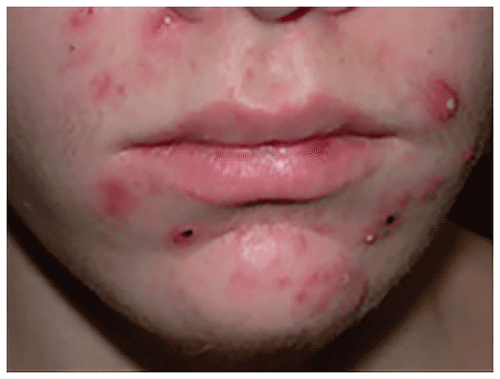
■Severe acne: approximately three-fourths or more of the face is involved; there are many papules, pustules, cysts, and nodules; scarring often is present (Figure 7.8).
– Nodulocystic acne or the presence of scarring warrants prompt consideration for isotretinoin therapy (with referral to a dermatologist).
– High-dose oral antibiotics in combination with topical therapy (eg, benzoyl peroxide and topical retinoid) are an option while considering isotretinoin.
– In female patients, hormonal or antiandrogen therapies can also be considered; however, if they fail and the patient continues to have nodulocystic or scarring lesions, isotretinoin should be strongly considered.
▶Topical retinoids or the combination of topical retinoids and benzoyl peroxide is recommended as maintenance therapy to minimize the likelihood of relapse.
Figure 7.5. Treatment Options for Mild Acne on the Basis of Lesion Type.

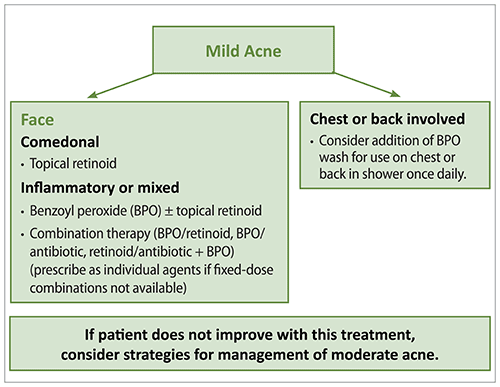
Figure 7.6. Treatment Options for Moderate Acne on the Basis of Lesion Type.
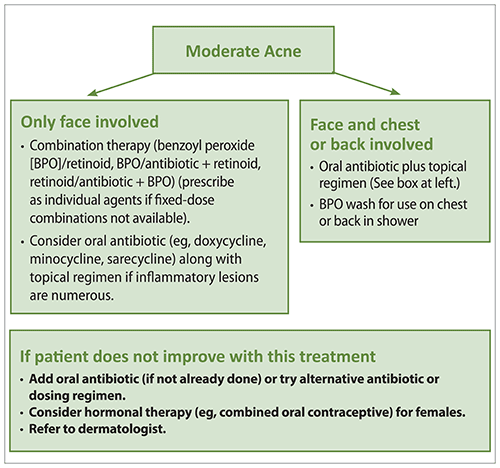
Figure 7.7. Treatment Options for Severe Acne on the Basis of Lesion Type.
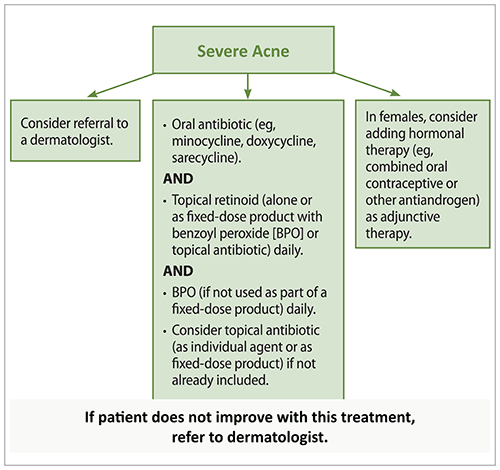
Table 7.1. Topical Retinoids and Fixed-Dose Combination Products for Acne
| Product Type/Active Ingredients | Recommended Dosing |
|---|
| Retinoids a |
|---|
| Adapalene 0.1% cream, gel/0.3% gel | Daily at bedtime |
| Tretinoin 0.025% cream, gel/0.01% gel/0.04%, 0.06%, 0.08% 0.1% micro-gel/0.05% cream, gel/0.1% cream | Daily at bedtime |
| Tazarotene 0.05% cream, gel/0.1% cream, gel/0.045% lotion/0.1% foam | Daily at bedtime |
| Trifarotene 0.005% cream | Daily at bedtime |
| Antibiotic/BPO |
|---|
| Clindamycin 1.2%/BPO 2.5% gel | Daily |
| Clindamycin 1.2%/BPO 3.75% gel | Daily |
| Clindamycin 1%/BPO 5% gel | Daily to twice daily |
| Erythromycin 3%/BPO 5% gel | Twice daily |
| Retinoid Containing |
|---|
| Clindamycin 1.2%/tretinoin 0.025% gel | Daily at bedtime |
| Adapalene 0.1%/BPO 2.5% gel, 0.3%/BPO 2.5% gel | Daily at bedtime |
| Microencapsulated tretinoin 0.1%/BPO 3% cream | Daily at bedtime |
Abbreviation: BPO, benzoyl peroxide.
If prescribing a retinoid, consider beginning with adapalene 0.1% or tretinoin cream 0.025% to reduce the potential for drying or irritation.
Figure 7.8. In Severe Acne, Nodules and Scarring are Present.
▶Acne vulgaris is often, but not always, self-limited and resolves by the late teenage or early adult years.
▶Treatment is warranted during periods of disease activity to alleviate disfigurement, enhance well-being, and prevent permanent scarring.
▶Management can be challenging because patient expectations are high, efficacy of treatment is variable, and potential medication side effects need to be weighed against benefits, with appropriate matching of therapeutic aggressiveness and severity of disease.
▶Patients require periodic clinical assessments to evaluate response to therapy and provide ongoing support and encouragement.
▶Failure of topical or oral therapies after 2 to 3 months of appropriate use.
▶Severe acne with presence of nodules, cysts, or scarring.
▶Early-onset acne at younger than 7 years (or other signs of androgen excess) warrants hormonal evaluation.