▶Confluent and reticulated papillomatosis (CARP; also known as Gougerot-Carteaud syndrome) is an uncommon disorder of unknown cause.
■In the past it has been linked to insulin resistance, disordered keratinization, UV light, and an abnormal host response to the yeast Malassezia furfur.
■Some have suggested that CARP may be the result of follicular infection with Dietzia papillomatosis, a gram-positive bacterium. This association is intriguing because the organism implicated appears to be sensitive to tetracyclines and erythromycin.
▶CARP typically has its onset during puberty, and girls are affected more often than boys.
▶Most often, CARP occurs sporadically, but familial cases have been reported.
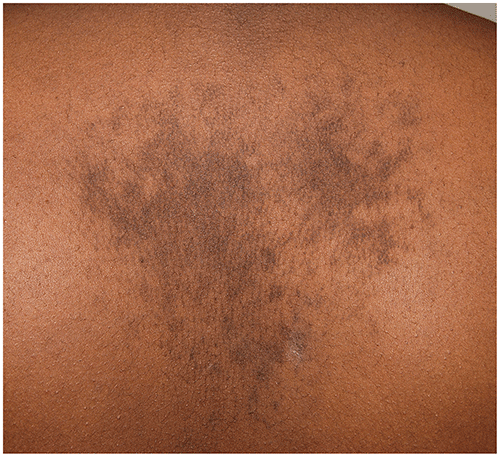
▶CARP presents as hyperpigmented patches and thin papules and plaques, most often involving the intermammary region, epigastrium, and upper back. The face, neck, and shoulders occasionally are involved.
▶Papules coalesce becoming confluent centrally and reticulated peripherally (Figures 129.1 and 129.2).
▶The eruption usually is asymptomatic, but mild pruritus may be present.
Figure 129.1. The Eruption of Confluent and Reticulated Papillomatosis is Confluent Centrally and Reticulated Peripherally.
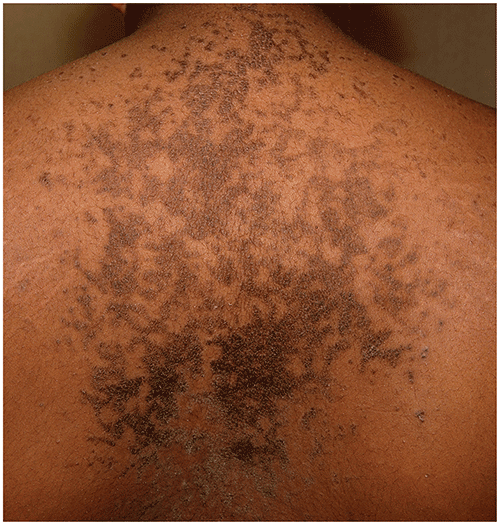
Figure 129.2. Confluent and Reticulated Papillomatosis Often Affects the Upper Back. In This Patient, There are 2 Distinct Patches (Left Larger Than Right) that are Confluent Centrally and Reticulated Peripherally.
Look-alikes
Several eruptions are concentrated on the trunk and may mimic CARP. The majority of these do not typically have central confluence and peripheral reticulation.
| Disorder | Differentiating Features |
|---|
| Acanthosis nigricans | |
| Tinea versicolor (hyperpigmented form) | |
| Pityriasis rosea | Typical lesions are thin oval plaques with long axes oriented parallel to lines of skin stress. Initial larger lesion (herald patch) presents before the secondary smaller lesions. Reticulated appearance absent.
|
| Pityriasis lichenoides chronica | Rash more generalized (not limited to the trunk). Involvement of the buttocks is common. Surface scaling with thin crusts common. Reticulated appearance absent.
|
| Prurigo pigmentosa | Recurrent crops of pruritic erythematous papules and reticulate hyperpigmentation. Similar distribution with preference for neck, chest, and back. Most common in young Asian women. Typically reported in association with ketosis (and conditions such as fasting, diabetes, ketogenic diets). Treated with dietary modification and systemic antibiotics.
|
▶The diagnosis is made clinically on the basis of the typical appearance and distribution of the rash.
▶Treating CARP may be challenging because no treatment is universally effective and the eruption may recur after withdrawal of treatment.
▶Treatment with minocycline (or doxycycline) orally for 1 to 2 months is considered the most effective option. Some clinicians recommend adding a topical emollient containing α-hydroxy acids (most commonly lactic acid or ammonium lactate) to the treatment regimen.
▶Other treatments that have variable efficacy include topical selenium sulfide, topical or oral antifungal agents, and topical keratolytics alone.
▶The prognosis generally is good, although no treatment is universally effective, and recurrences are possible.
▶Consider referral to a dermatologist when the diagnosis is in doubt or when disease does not respond to treatment.