▶Subcutaneous fat necrosis (SFN) is an uncommon, benign condition presenting as flesh-colored to erythematous, firm nodules and nodular plaques in the first few weeks after birth.
▶This condition is a self-limited form of panniculitis, characterized by underlying inflammation of the fat, with necrosis.
▶Although the exact etiology is unclear, most cases present in full-term neonates with history of perinatal stress or hypoxia.
■Perinatal factors considered in the pathogenesis include hypothermia, mechanical trauma, ischemia, infection, and maternal preeclampsia and diabetes.
■Because more saturated fatty acids are present in neonatal fat, some have proposed that this may predispose neonatal fat to crystallization at low temperatures, which may lead to inflammation and necrosis. This may account for its more common occurrence in neonates who receive cooling for hypoxic-ischemic encephalopathy.
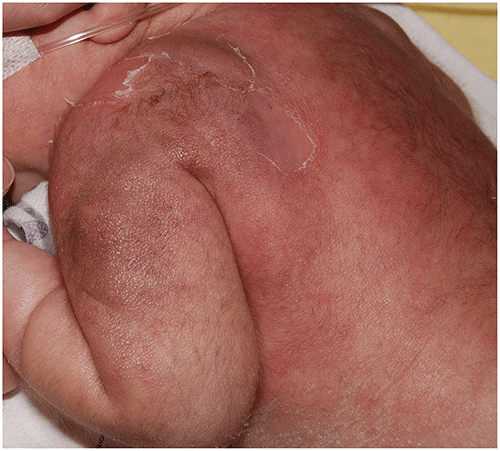
▶SFN typically presents in full-term, healthy neonates as well-demarcated, firm nodules and nodular plaques on the back, buttocks, or extremities (Figures 109.1 and 109.2). The face, particularly the cheeks, may also be involved.
▶Nodules may appear as flesh-colored to erythematous to violaceous, often coalescing into indurated, larger plaques. Pain and tenderness may be noted in some infants. Rarely, ulceration may be present.
▶Hypercalcemia is a rare associated complication; therefore, clinicians should be attentive to symptoms such as irritability, lethargy, hypotonia, poor feeding, constipation, and failure to thrive.
Figure 109.1. Subcutaneous Fat Necrosis. This 12-Day-Old Developed Red Nodules and Plaques on the Extremities on the First Day after Birth and Had Associated Hypercalcemia. The Skin Lesions and Calcium Elevation Resolved over Several Months.
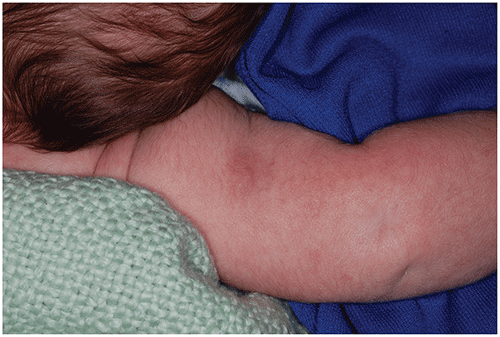
Figure 109.2. Erythematous Nodular Plaques on the Left Arm, Shoulder, and Upper Back of a Neonate with Skin of Color Who Has Subcutaneous Fat Necrosis.
Look-alikes
| Disorder | Differentiating Features |
|---|
| Cellulitis and erysipelas | These infectious conditions may present with warmth, erythema, and tenderness similar to those of subcutaneous fat necrosis (SFN). Multiple, firm indurated nodules and nodular plaques would be more suggestive of SFN. Fever and leukocytosis often present. Hypercalcemia not expected.
|
| Sclerema | Most often presents in neonates who are preterm and ill with underlying disease. Prognosis is grave, as opposed to excellent prognosis in SFN. Presents with diffuse involvement of more yellowish, waxy, firm bound-down skin.
|
| Cold panniculitis | Presents as symmetric indurated nodules and plaques with overlying erythema. Lesions tend to be reproducible, usually within a few days of repeated cold exposure, with lesions localized to areas exposed to cold.
|
| Malignancy | Sarcomas and other malignancies may present with skin nodule(s) of various colors, often non-tender and without warmth. These lesions are typically solitary, develop a few months after birth, and typically enlarge over time. Histopathologic findings are diagnostic.
|
| Myofibromatosis | Can present in the neonatal period with skin nodules; various forms exist, including the more common solitary form. Lesions may extend beyond the skin into the muscle or bone. Lesions often persist for years. Histopathologic findings are diagnostic.
|
▶A clinical diagnosis can be made in many cases. When the diagnosis is unclear, a skin biopsy that includes the subcutaneous fat is often diagnostic.
▶Histopathologic findings demonstrate fat necrosis, needle-shaped clefts, granulomatous inflammation, and possible calcification.
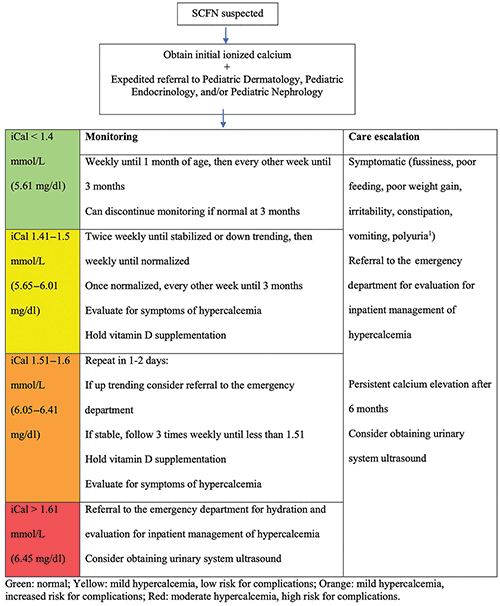
▶Screening for hypercalcemia is strongly recommended. Blood ionized calcium levels should be checked periodically for the first several months after birth (can have a delayed onset). One such monitoring algorithm is shown in Figure 109.3. Some also suggest screening for thrombocytopenia and hyperlipidemia, which are very rare associations.
▶In patients with persistent calcium elevation (>6 months), urinary system ultrasonography should be considered given risk for nephrocalcinosis.
Figure 109.3. Algorithm for Monitoring of Infants with Subcutaneous Fat Necrosis. Abbreviations: Ical, Ionized Calcium; Scfn, Subcutaneous Fat Necrosis. Adapted with Permission from: Siegel Lh, Alonso CF, Tuazon Cfr, Et Al. Subcutaneous Fat Necrosis of the Newborn: a Retrospective Study of 32 Infants and Care Algorithm. Pediatr Dermatol. 2023;40(3):413–421.
▶Because SFN is self-limited, treatment of the skin nodules is not indicated.
▶In patients with associated hypercalcemia, referral to an endocrinologist is indicated. If hypercalcemia treatment is necessary, options include intravenous fluids; diuretics; restriction of dietary calcium and vitamin D; and, rarely, systemic steroids, calcitonin, or etidronate.
▶The prognosis is excellent, and in most cases the skin lesions resolve over weeks to months.
▶Atrophy and scarring may rarely occur in some patients.
▶Significant morbidity may result if severe hypercalcemia is present and left untreated.
▶When the diagnosis is uncertain, consultation with a pediatric dermatologist is recommended.
▶In patients with hypercalcemia or other metabolic changes, referral to a pediatric endocrinologist or other specialist experienced in the management of metabolic abnormalities is recommended.