| Disease | Clinical Manifestations | Therapeutic Management/Complications | Nursing Considerations | |
|---|---|---|---|---|
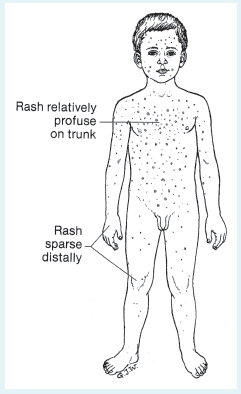 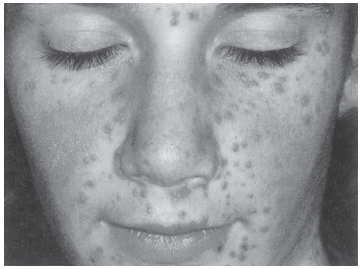 Chickenpox (varicella).(From Habif, TP: Clinical Dermatology: A Color Guide to Diagnosis and Therapy, ed 3. St. Louis, Mosby, 1996.) | Chickenpox (Varicella) Agent: Varicella-zoster virus (VZV) Source: Primary secretions of respiratory tract of person who is infected and to a lesser degree skin lesions (scabs not infectious) Transmission: Direct contact, droplet (airborne) spread, and contaminated objects Incubation period: 2–3 weeks, usually 13–17 days Period of communicability: Probably 1 day before eruption of lesions (prodromal period) to 6 days after first crop of vesicles when crusts have formed 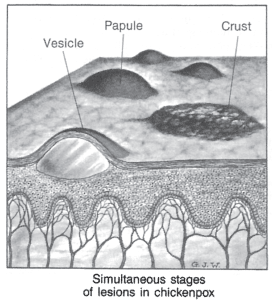 | Prodromal stage: Slight fever, malaise, and anorexia for first 24 hours; rash highly pruritic; begins as macule, rapidly progresses to papule and then vesicle (surrounded by erythematous base, becomes umbilicated and cloudy, breaks easily and forms crusts); all three stages (papule, vesicle, crust) present in varying degrees at one time. Distribution: Centripetal, spreading to face and proximal extremities but sparse on distal limbs and less on areas not exposed to heat (i.e., from clothing or sun) Constitutional signs and symptoms: Elevated temperature from lymphadenopathy, irritability from pruritus |  Specific: Antiviral agent acyclovir (Zovirax), varicella-zoster immune globulin (VZIG) after exposure in children who are high risk.Supportive: Diphenhydramine hydrochloride or antihistamines to relieve itching; skin care to prevent secondary bacterial infection Specific: Antiviral agent acyclovir (Zovirax), varicella-zoster immune globulin (VZIG) after exposure in children who are high risk.Supportive: Diphenhydramine hydrochloride or antihistamines to relieve itching; skin care to prevent secondary bacterial infectionComplications:
| Maintain strict isolation in hospital. Isolate child in home until vesicles have dried (usually 1 week after onset of disease), and isolate children who are high risk from children who are infected. Administer skin care: give bath and change clothes and linens daily; administer topical calamine lotion; keep child’s fingernails short and clean; apply mittens if child scratches. Keep child cool (may decrease number of lesions). Lessen pruritus; keep child occupied. Remove loose crusts that rub and irritate skin. Teach child to apply pressure to pruritic area rather than scratch it. If older child, reason with child regarding danger of scar formation from scratching. Avoid use of aspirin; use of acetaminophen controversial. |
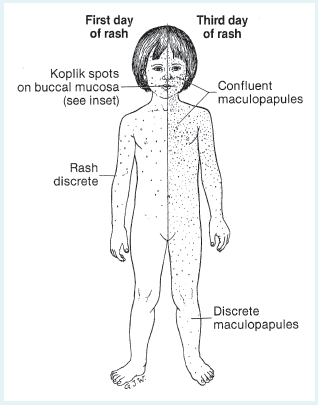 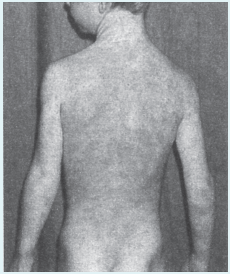 Measles (rubeola). (From Seidel, HM and others: Mosby’s Guide to Physical Examination, ed 3. St. Louis, Mosby, 1995.) | Measles (Rubeola) Agent: Virus Source: Respiratory tract secretions, blood, and urine of person who is infected Transmission: Usually by direct contact with droplets of person who is infected Incubation period: 10–20 days Period of communicability: From 4 days before to 5 days after rash appears but mainly during prodromal (catarrhal) stage 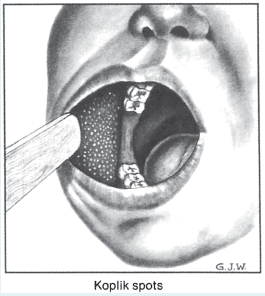 | Prodromal (catarrhal) stage: Fever and malaise, followed in 24 hours by coryza, cough, conjunctivitis, Koplik’s spots (small, irregular red spots with a minute, bluish-white center first seen on buccal mucosa opposite molars 2 days before rash); symptoms gradually increase in severity until second day after rash appears, when they begin to subside Rash: Appears 3–4 days after onset of prodromal stage; begins as erythematous maculopapular eruption on face and gradually spreads downward; more severe in earlier sites (appears confluent) and less intense in later sites (appears discrete); after 3–4 days assumes brownish appearance, and fine desquamation occurs over areas of extensive involvement Constitutional signs and symptoms: Anorexia, malaise, generalized lymphadenopathy | Vitamin A supplementation Supportive: Bedrest during febrile period Antipyretics Antibiotics to prevent secondary bacterial infection in high-risk childrenComplications:
| isolation until fifth day of rash; if hospitalized, institute respiratory precautions. Maintain bedrest during prodromal stage; provide quiet activity. Fever: Instruct parents to administer antipyretics; avoid chilling; if child is prone to seizures, institute appropriate precautions (fever spikes to 104ºF [40ºC] between fourth and fifth days).Eye care: Dim lights if photophobia present; clean eyelids with warm saline solution to remove secretions or crusts; keep child from rubbing eyes; examine cornea for signs of ulceration.  Coryza/cough: Use cool mist vaporizer; protect skin around nares with layer of petrolatum; encourage fluids and soft, bland foods. Coryza/cough: Use cool mist vaporizer; protect skin around nares with layer of petrolatum; encourage fluids and soft, bland foods.Skin care: Keep skin clean; use tepid baths as necessary. |
| Mumps Agent: Paramyxovirus Source: Saliva of people who are infected Transmission: Direct contact with or droplet spread from a person who is infected Incubation period: 14–21 days Period of communicability: Most communicable immediately before and after swelling begins | Prodromal stage: Fever, headache, malaise, and anorexia for 24 hours, followed by “earache” that is aggravated by chewing Parotitis: By third day, parotid gland(s) (either unilateral or bilateral) enlarge(s) and reach(es) maximum size in 1–3 days; accompanied by pain and tenderness Other manifestations: Submaxillary and sublingual infection, orchitis, and meningoencephalitis | Symptomatic and supportive: Analgesics for pain and antipyretics for fever Intravenous fluid may be necessary for child who refuses to drink or vomits because of meningoencephalitis Complications:
| isolation during period of communicability; institute respiratory precautions during hospitalization. Maintain bedrest during prodromal phase until swelling subsides. Give analgesics for pain; if child is unwilling to chew medication, use elixir form.Encourage fluids and soft, bland foods; avoid foods that require chewing.Apply hot or cold compresses to neck, whichever is more comforting. To relieve orchitis, provide warmth and local support with tight-fitting underpants (stretch bathing suit works well). | |
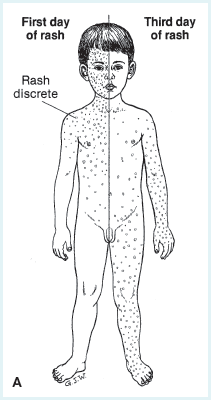 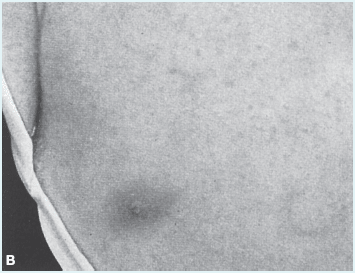 Rubella (German Measles). (A) Progression of rash. (B) Appearance of rash. (From Habif, TP: Clinical Dermatology: A Color Guide to Diagnosis and Therapy, ed 3. St. Louis, Mosby, 1996.) | Rubella (German Measles) Agent: Rubella virus Source: Primarily nasopharyngeal secretions of persons with apparent or inapparent infection; virus also present in blood, stool, and urine Transmission: Direct contact and spread via person who is infected; indirectly via articles freshly contaminated with nasopharyngeal secretions, feces, or urine Incubation period: 14–21 days Period of communicability: 7 days before to approximately 5 days after appearance of rash | Prodromal stage: Absent in children, present in adults and adolescents; consists of: low-grade fever, headache, malaise, anorexia, mild conjunctivitis, coryza, sore throat, cough, and lymphadenopathy; lasts for 1–5 days, subsides 1 day after appearance of rash Rash: First appears on face and rapidly spreads downward to neck, arms, trunk, and legs; by end of first day, body is covered with a discrete, pinkish red maculopapular exanthema; disappears in same order as it began and is usually gone by third day Constitutional signs and symptoms: Occasionally low-grade fever, headache, malaise, and lymphadenopathy | No treatment necessary other than antipyretics for low-grade fever and analgesics for discomfort Complications:
| Reassure parents of benign nature of illness in child who is affected. Use comfort measures as necessary. Isolate child from women who are pregnant. |
| Scarlet Fever Agent: Group A β-hemolytic streptococci Source: Usually from nasopharyngeal secretions of person who is infected and carriers Transmission: Direct contact with person who is infected, or droplet spread indirectly by contact with contaminated articles, ingestion of contaminated milk or other food Incubation period: 2–4 days, with range of 1–7 days Period of communicability: During incubation period and clinical illness, approximately 10 days; during first 2 weeks of carrier phase, although may persist for months 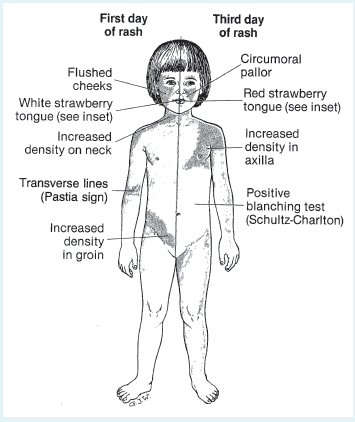 | Prodromal stage: Abrupt high fever, pulse increased out of proportion to fever, vomiting, headache, chills, malaise, abdominal pain Enanthema: Tonsils enlarged, edematous, reddened, and covered with patches of exudate; in severe cases appearance resembles membrane seen in diphtheria; pharynx is edematous and beefy red; during first 1–2 days tongue is coated and papillae become red and swollen (white strawberry tongue); by fourth or fifth day white coat sloughs off, leaving prominent papillae (red strawberry tongue); palate is covered with erythematous punctate lesions Exanthema: Rash appears within 12 hours after prodromal stage; red pinhead-sized punctate lesions rapidly become generalized but are absent on face, which becomes flushed with striking circumoral pallor; rash is more intense in folds of joints; by end of first week desquamation begins (fine, sandpaper-like on torso; sheetlike sloughing on palms and soles), which may be complete by 3 weeks or longer 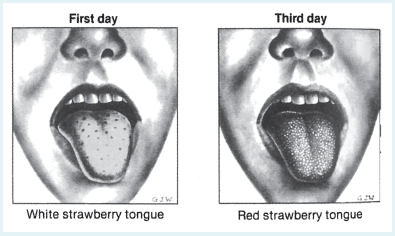 Strawberry tongue. (From Wong, D: Whaley and Wong’s Nursing Care of Infants and Children, ed 7. Mosby, St. Louis, 2003.) | Treatment of choice is a full course of penicillin (or erythromycin for children who are penicillin-sensitive); fever should subside 24 hr after beginning therapyAntibiotic therapy for newly diagnosed carriers (nose or throat cultures positive for streptococci) Supportive measures: Bedrest during febrile phase, analgesics for sore throat Complications: Supportive measures: Bedrest during febrile phase, analgesics for sore throat Complications:
| Institute respiratory precautions until 24 hours after initiation of treatment.Ensure compliance with oral antibiotic therapy (intramuscular benzathine penicillin G [Bicillin] may be given if parents’ reliability in giving oral drugs is questionable). Maintain bedrest during febrile phase; provide quiet activity during convalescent period. Relieve discomfort of sore throat with analgesics, gargles, lozenges, antiseptic throat sprays ( Chloraseptic ), and inhalation of cool mist.Encourage fluids during febrile phase; avoid irritating liquids (citrus juices) or rough foods; when child is able to eat, begin with soft diet.Advise parents to consult practitioner if fever persists after beginning therapy. Discuss procedures for preventing spread of infection. |