Health Promotion and Maintenance


15. A client, 39 weeks' gestation, gravida 2, para 1, is in active labor and reports frequent, painful uterine contractions. Which fetal monitoring pattern would require an immediate nursing intervention and why?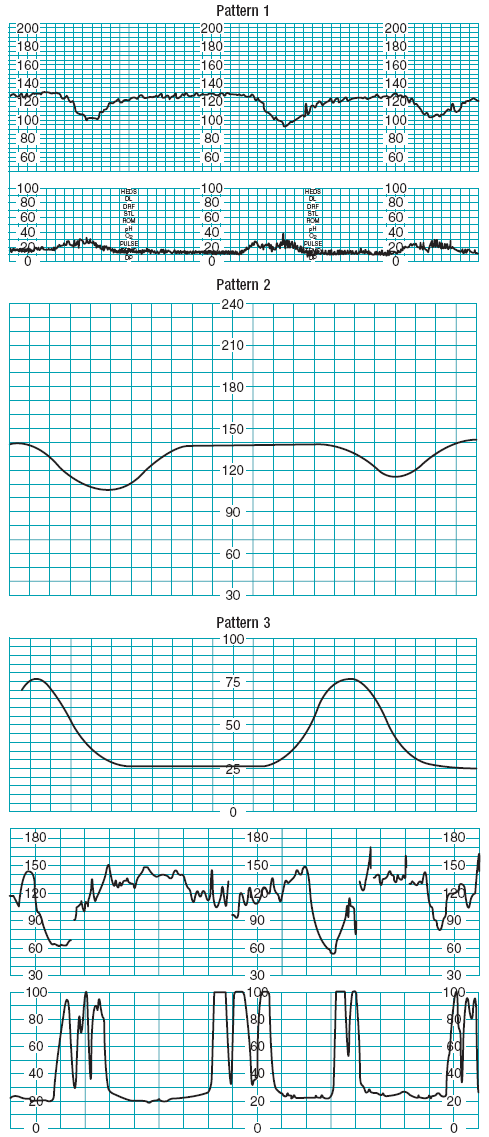
Health Promotion and Maintenance
15. A client, 39 weeks' gestation, gravida 2, para 1, is in active labor and reports frequent, painful uterine contractions. Which fetal monitoring pattern would require an immediate nursing intervention and why?
 . Pattern 1 because the tracing shows early decelerations.
 . Pattern 2 because the tracing shows late decelerations.
 . Pattern 3 because the tracing shows variable decelerations.
 . Pattern 3 because the tracing shows late decelerations.
Test-Taking Tip
To determine the type of deceleration, draw a line from the lowest part of the deceleration down to the uterine contraction to establish the relationship as early, variable, or late between the deceleration and the uterine contraction.
Content Area: Maternity, Intrapartum; Integrated Process: Nursing Process, Analysis; Cognitive Level: Analysis; Client Need/Subneed: Physiological Integrity/Physiological Adaptation/Medical Emergencies
Health Promotion and Maintenance
.
Answer 1 is incorrect because the pattern here is early decelerations and is caused by compressions of the fetal head descending through the birth canal. No nursing intervention is needed. Answer 2 is correct because the pattern is late decelerations and is caused by uteroplacental insufficiency. The fetal heart rate is tachycardic, baseline heart rate of 180 bpm with decreased baseline variability. The nurse must immediately attempt to correct the pattern by turning the client on her side and giving a fluid bolus and oxygen mask. The physician must also be notified immediately. Answer 3 is incorrect because this pattern is variable decelerations, caused by compression of the umbilical cord. The fetus demonstrates good oxygen reserve since the baseline variability is normal and the fetal heart rate rapidly returns to baseline after the deceleration. Immediate intervention in this type of pattern is not required, but continued close observation of the pattern is needed. Answer 4 is incorrect because this pattern is variable decelerations, caused by compression of the umbilical cord. The fetus demonstrates good oxygen reserve since the baseline variability is normal and the fetal heart rate rapidly returns to baseline after the deceleration. Immediate intervention in this type of pattern is not required, but continued close observation of the pattern is needed.