Pre-Test 1 and 2: Introduction to Special Questions Based on Official NCLEX-RN[®]


75. Physical assessment of a client admitted for a bronchoscopy reveals a thin, muscular man with wheezes in the left lung. Which area should a nurse identify as most likely to be partially obstructed?
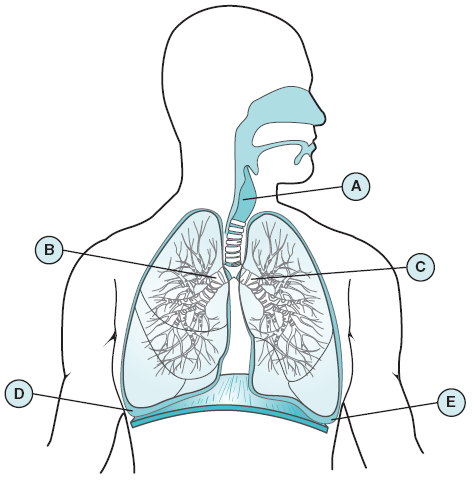
Choices
Test-Taking Tip
 The question is looking for an area of the lung that, when narrowed, would produce a sound. Think "squeeze" with a "wheeze" as the air moves through a narrow tube—the bronchus or bronchioles.
Content Area: Adult Health, Respiratory; Integrated Process: Nursing Process, Assessment; Cognitive Level: Application; Client Need/Subneed: Physiological Integrity/Reduction of Risk Potential/System Specific Assessments
Go to Choices
Pre-Test 1 and 2: Introduction to Special Questions Based on Official NCLEX-RN[®]
 .
.
Answer 1 is incorrect because the trachea is larger and a partial obstruction would most likely produce a crowing sound. Answer 2 is incorrect because the wheezing was heard in the left lung. Answer 3, left bronchus, is correct because wheezes occur when there is partial obstruction of the bronchi or bronchioles. The sound is due to increased vibration of air molecules as they pass over the area that is narrowed or partially obstructed. In this client, the wheezing was heard in the left lung. Answer 4 is incorrect because the sound produced by the pleura would be a grating sound called a friction rub. Answer 5 is incorrect because the sound produced by the pleura would be a grating sound called a friction rub.
Go to Question


