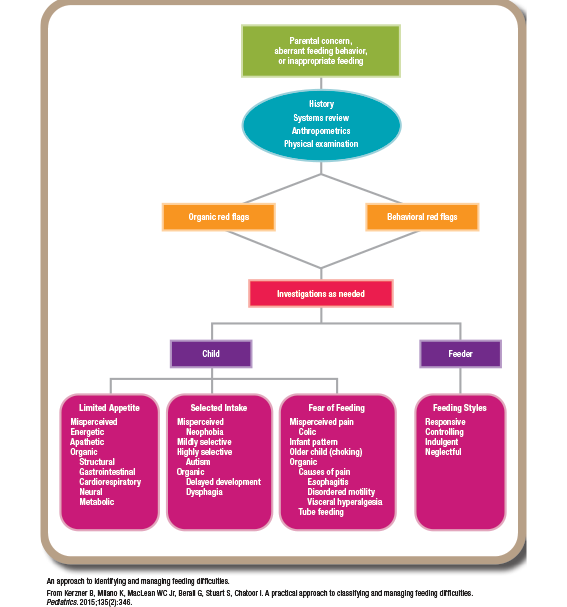
An approach to identifying and managing feeding difficulties
Presenting Features of Feeding Difficulties
Suggestive symptoms/signs | Prolonged mealtimes |
|---|---|
Food refusal lasting < 1 mo | |
Disruptive and stressful mealtimes | |
Lack of appropriate independent feeding | |
Nocturnal eating in toddler | |
Distraction to increase intake | |
Prolonged breast- or bottle-feeding | |
Failure to advance textures | |
Aspiration | |
Apparent pain with feeding | |
Vomiting and diarrhea | |
Developmental delay | |
Chronic cardio-respiratory symptoms | |
Growth failure (failure to thrive) | |
Behavioral red flagsa | Food fixation (selective, extreme dietary limitations) |
Noxious (forceful and/or persecutory) feeding | |
Abrupt cessation of feeding after a trigger event | |
Anticipatory gagging | |
Failure to thrive |
a Red flags are signs/symptoms that require prompt attention and, in many instances, referral for in-depth investigation or specialized treatment.
Adapted from Kerzner B, Milano K, MacLean WC Jr, Berall G, Stuart S, Chatoor I. A practical approach to classifying and managing feeding difficulties. Pediatrics. 2015;135(2):346.
Criteria for an “ideal” classification of feeding difficulties
Feeding difficulties can be classified based on parents’ expressed concerns about their child’s feeding/eating behavior, which fall into 3 principal categories: those not eating enough (limited appetite); those eating an inadequate variety of foods (selective intake); and those afraid to eat (fear of feeding). Each category has subcategories to acknowledge that such concerns may be a misperception on the part of the parents or primarily behavioral or organic, both with a spectrum ranging from mild to severe.
|


Adapted from Kerzner B, Milano K, MacLean WC Jr, Berall G, Stuart S, Chatoor I. A practical approach to classifying and managing feeding difficulties. Pediatrics. 2015;135(2):347.
Feeding guidelines for all children
Reviewing the following basic feeding guidelines with parents can be useful when managing a child with a limited appetite:
|
Adapted from Kerzner B, Milano K, MacLean WC Jr, Berall G, Stuart S, Chatoor I. A practical approach to classifying and managing feeding difficulties. Pediatrics. 2015;135(2):347.