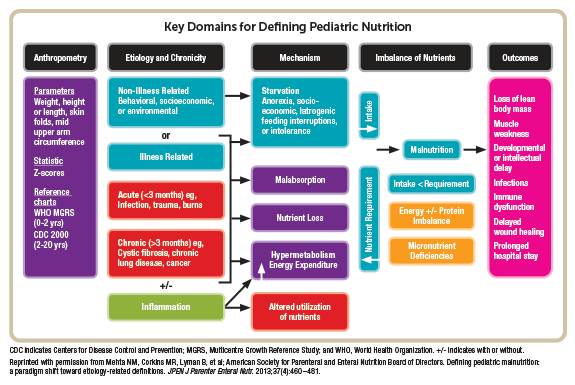
Key Domains for Defining Pediatric Nutrition
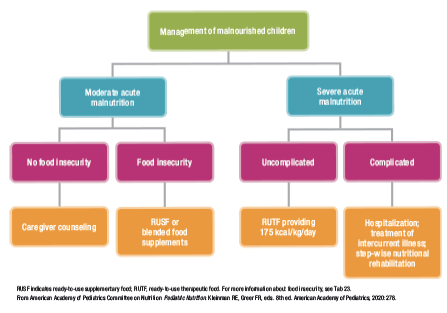
Patients at high risk for malnutrition
|
 Patients with malnutrition or evidence of
 Diagnostic Criteria for Undernutrition
Severe Acute Malnutrition | Moderate Acute Malnutrition | Stunting | Underweight | |
|---|---|---|---|---|
Weight-for-age | NA | NA | NA | Less than -2 SD |
Height-for-age (or length-for-age) | NA | NA | Less than -2 SD | NA |
Weight-for-height (or weight-for-length) | Less than -3 SD | Between -2 SD and -3 SD | NA | NA |
Mid-upper arm circumference | < 11.5 cm | Between 11.5 and 12.5 cm | NA | NA |
Edema | +/- | No | No | NA |
NA indicates not applicable. +/indicates with or without.
From American Academy of Pediatrics Committee on Nutrition. Pediatric Nutrition. Kleinman RE, Greer FR, eds. 8th ed. American Academy of Pediatrics; 2020:275.
Classification of Malnutrition in Adolescents and Young Adults With Eating Disorders ( See Tab 22 )
Mild | Moderate | Severe | |
|---|---|---|---|
BMI, median, % | 80-90 | 70-79 | < 70 |
BMI z score | -1.0 to -1.9 | -2.0 to -2.9 | >= -3.0 |
Weight loss | > 10% Body mass loss | > 15% Body mass loss | > 20% Body mass loss in 1 year or > 10% body mass loss in 6 months |
BMI indicates body mass index.
This is a proposed classification of degree of malnutrition in adolescents and young adults with eating disorders as reported in the Society for Adolescent Health and Medicine position paper on medical management of restrictive eating disorders in adolescents and young adults.
Adapted from Seetharaman S, Fields EL. Avoidant/restrictive food intake disorder. Ped Rev. 2020;41(12):617.