Positive Results on Routine Psychosocial Screenings (Family or Child)
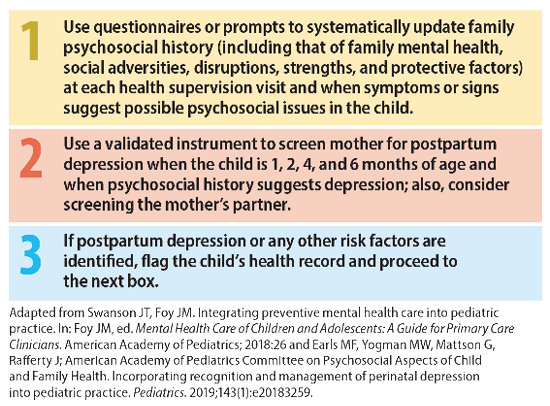
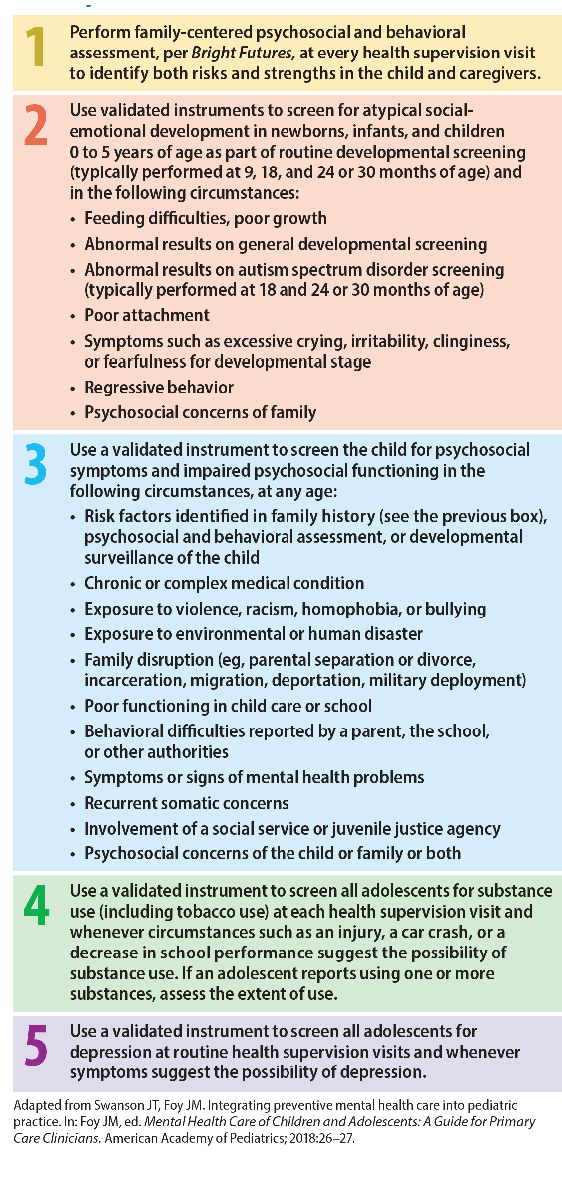
Young people and their families often do not disclose mental health concerns. In fact, they may not recognize that a problem they are experiencing is associated with a mental or emotional difficulty. This is especially true for physical symptoms (eg, headache, abdominal or chest pain, menstrual concerns, poor sleep, eating disturbance). Surveillance and periodic psychosocial screening of both the child and family are necessary components of routine pediatric care because they assist in identifying undisclosed mental health problems. The following guidance corresponds with Bright Futures, 4th Edition, recommendations and American Academy of Pediatrics policy. See the “Mental Health Tools for Pediatrics” table at https://downloads.aap.org/AAP/PDF/Mental_HealthTools_for_Pediatrics.pdf for validated instruments to perform each function.
Recommended Surveillance and Screening of Family and Social Environment for Strengths and Risk Factors
Concerning Findings at Acute and Chronic Care Visits
Manifestations of mental health problems that are likely to surface at acute and chronic care visits (in generalist or subspecialty settings) include
- Recurrent somatic concerns (See Tab 4c.)
- Frequent school absences
- Nonadherence to medical therapy
- Poor control of a chronic medical condition
- Excessive use of health services
Families with children who have chronic medical conditions are likelier than others to experience physical, emotional, and financial strain. Some (but not all) studies have suggested that parents of children with severe health conditions are at increased risk for physical and mental challenges and divorce. Children with special medical needs may experience painful procedures, frequent emergency department visits, and separation from their families during hospitalizations. Many of these children and their family members experience anxiety and depression, often unrecognized because the child’s medical condition draws immediate concern. Siblings of children with special health care needs are often left to function more independently than usual when parents’ attention is diverted to the child with special needs; they may feel jealous and sad, and they may miss out on childhood experiences as they shoulder adult responsibilities at a young age.
Pediatric generalists and subspecialists can use validated tools to screen periodically for comorbid psychosocial problems in children who are experiencing an illness and use each contact with the child and family to perform a brief mental health update, as suggested in the next box.
Mental Health Update at Acute and Chronic Care Visits: Suggested Questions by Agea
Ages 0 to 5 years | Ages 5 to 12 years | Ages 12 to 21 years |
|---|---|---|
|
|
|
a Select questions that are appropriate to the clinical circumstances and available time. If findings suggest a mental health problem, triage for emergencies (see Psychiatric or Social Emergency, later in this tab) and refer for mental health specialty care if a potential emergency is identified; otherwise, schedule the child’s return to be further assessed.
Adapted from American Academy of Pediatrics Task Force on Mental Health algorithm teams, group discussion, fall 2005, and Appendix S8: brief mental health update. In: Foy JM, Kelleher KJ, Laraque D; American Academy of Pediatrics Task Force on Mental Health. Enhancing pediatric mental health care: strategies for preparing a primary care practice. Pediatrics. 2010;125(suppl 3):S159-S160.
Social Determinants of Health That Confer Risk for Mental Health Problems
These factors may seem daunting, when uncovered by the clinician. However, by simultaneously identifying and promoting strengths and protective factors, and by developing in advance a directory of human service agencies and contact information to access their intake processes, pediatric clinicians can use techniques described under Recommending Reliable Self-help Resources, Tab 2, to help families access needed resources and potentially mitigate adversities.
- Poverty
- Food insecurity
- Unstable or poor housing
- Unemployment
- Social exclusion (eg, racism, xenophobia, homophobia, discrimination)
- Substance use
- Environmental toxins (eg, mold, lead, tobacco smoke)
- Unsafe or violent neighborhood
Adapted from Earls M. Healthy child development. In: Foy JM, ed. Promoting Mental Health in Children and Adolescents: Primary Care Practice and Advocacy. American Academy of Pediatrics; 2019:7.
Adverse (Traumatic) Childhood Experiences
A wide range of adverse childhood experiences has been associated with poor mental health outcomes and with adopted unhealthy behaviors such as smoking, promiscuity, and substance use disorder. By recognizing and noting the child’s exposure to these adversities, pediatric clinicians can heighten psychosocial surveillance and screening and take steps to optimize social supports for the child and family.
Adversity type | ACEs from original studya | |
|---|---|---|
Child-specific adversities |
|
|
Household-specific adversities |
|
|
Community-specific adversities |
|
Abbreviation: ACE, adverse childhood experience.
a Felitti VJ, Anda RF, Nordenberg D, et al. Relationship of childhood abuse and household dysfunction to many of the leading causes of death in adults. The Adverse Childhood Experiences (ACE) Study. Am J Prev Med. 1998;14(4):245-258.
b Wade R Jr, Shea JA, Rubin D, Wood J. Adverse childhood experiences of low-income urban youth. Pediatrics. 2014;134(1):e13-e20.
c Finkelhor D, Shattuck A, Turner H, Hamby S. A revised inventory of adverse childhood experiences. Child Abuse Negl. 2015;48:13-21.
Reproduced from Healthy Development and Well-Child Support Chart. American Academy of Pediatrics; 2020:38.
Symptoms Suggesting a Social-Emotional Concern by Age
There is considerable overlap between typical variations and symptoms outside the normal range. Furthermore, adult caregivers may interpret and respond to a child’s symptoms in various ways, depending on their own perception of normalcy. The following lists should be considered in this context:
Infants and young children | School-aged children | Adolescents | All age-groups |
|---|---|---|---|
|
|
|
a A sleep disturbance can be either a cause or an effect of social-emotional distress; for school-aged children and adolescents, it can also be a manifestation of a mental disorder. Furthermore, a child’s problems with sleep often stress the entire family. Parents deprived of sleep because of their child’s sleep problem may become less resilient, and their parenting may become less positive and consistent. For these reasons, the child’s sleep pattern and its effect on other family members are important areas to explore at every age.
Adapted from Appendix S13: symptoms and signs suggestive of mental health and substance abuse concerns. Pediatrics. 2010;125(suppl 3):S193-S194.
Impaired Functioning
A global functional assessment (ie, measurement of functioning at home, at school, and with peers) can serve as a sort of mental health vital sign. Measured at baseline and then periodically during the course of treatment, it can be used to assess the impact of the child’s or adolescent’s problem over time and can contribute to decision-making about resources they will require. Patients with a lesser degree of impairment can potentially be treated by the pediatric clinician. Those with greater degrees of impairment will likely require comanagement with mental health or substance use disorder specialists.
The functioning of as many as 19% of children may be impaired by symptoms that do not meet criteria for a diagnosable condition; for these children, pediatric care may be their only option because mental health specialty systems and health insurance plans typically require that a person have a diagnosable disorder to qualify for mental health services.
Certain validated psychosocial screening tools, such as the Pediatric Symptom Checklist, or PSC, may also be used, at baseline and serially, to track functioning.
Reviewing school performance (eg, academics, behavior, peer relationships) is another way to assess functioning for school-aged children.
MEASURES OF GLOBAL FUNCTIONING
Tools and description | Number of items and format | Age-group and any languages Reading level if specified | Administration and scoring time | Source |
|---|---|---|---|---|
Brief Impairment Scale (BIS)— multidimensional Assesses global functioning in domains of interpersonal relations, school/work, and self-care/self-fulfillment | 23 items Parent report | 4-17 y English Spanish | 10 min | Freely accessible Source: www.heardalliance.org/ wp-content/uploads/2011/04/ Brief-Impairment-Scale-English.pdf |
Columbia Impairment Scale (CIS)—part of the Child and Adolescent Wellness Assessment (CAWA) Assesses global functioning in domains of interpersonal relations, psychopathology, school performance, and use of leisure time; monitors progress after 6 mo of treatment | 13 items administered by a clinician. A “nonclinical version” can be administered directly by lay or clinical interviewers to parents or youths. | Children and adolescents English | 5 min | Freely accessible Sources: Youth version at www.hrcec.org/images/PDF/CIS-Y.pdf Parent version at www.hrcec.org/images/PDF/CIS-P.pdf |
Strengths and Difficulties Questionnaire (SDQ) impact scale Assesses global functioning in domains of home life, friendships, learning, and play | 5 items Parent Teacher Youths aged >=11 y | 3-17 y >40 languages | <5 min | Freely accessible Source: www.sdqinfo.org |
Psychiatric or Social Emergency
Preparation for emergencies includes a rehearsed emergency protocol to ensure that a patient is kept safe if a psychiatric or social emergency is suspected or identified, until the patient can be safely transported to an appropriate facility. The practice also needs prior knowledge of and contact information for the most appropriate community resource(s) for psychiatric and social emergencies in children and youths.
Screening for Suicidality
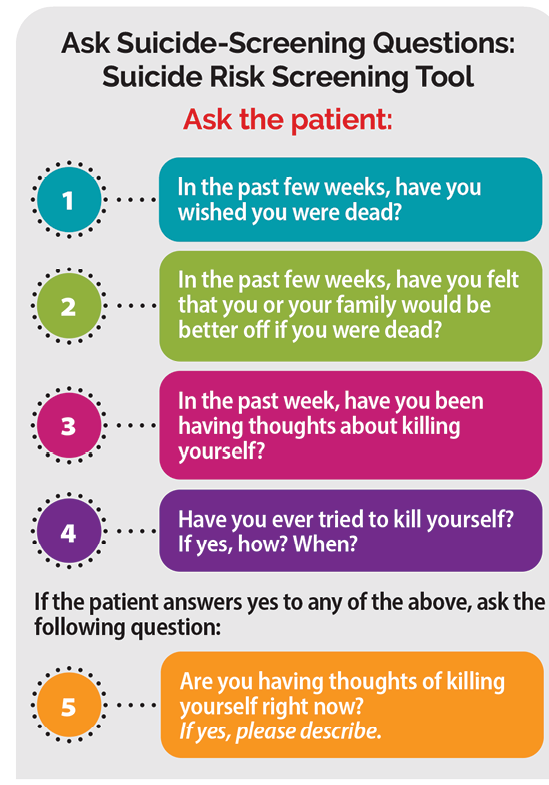
Screening for suicidality should be implemented by using a validated tool such as the Ask Suicide-Screening Questions (ASQ) below.
Next Steps
If patient answers “No” to all questions 1 through 4, screening is complete (not necessary to ask question #5). No intervention is necessary (Note: Clinical judgment can always override a negative screen).
If patient answers “Yes” to any of questions 1 through 4, or refuses to answer, they are considered a positive screen. Ask question #5 to assess acuity:
- “Yes” to question #5 = acute positive screen (imminent risk identified)
- Patient requires a STAT safety/full mental health evaluation. Patient cannot leave until evaluated for safety.
- Keep patient in sight. Remove all dangerous objects from room. Alert physician or clinician responsible for patient’s care.
- “No” to question #5 = non-acute positive screen (potential risk identified)
- Patient requires a brief suicide safety assessment (BSSA) to determine if a full mental health evaluation is needed. (See the following page.) Patient cannot leave until evaluated for safety.
- Alert physician or clinician responsible for patient’s care.
Provide Resources to All Patients
- 24/7 National Suicide Prevention Lifeline 1-800-273-TALK (8255) En Español: 1-888-628-9454
- 24/7 Crisis Text Line: Text “HOME” to 741-741
What to Do When a Pediatric Patient Screens Positive for Suicide Risk
- Conduct a BSSA by using a tool such as the ColumbiaSuicide Severity Rating Scale (C-SSRS) or the ASQ Youth Outpatient BSSA Worksheet.
Ask Suicide-Screening Questions reproduced from National Institute of Mental Health, National Institutes of Health, US Department of Health and Human Services. Suicide risk screening tool. July 1, 2020. Accessed March 13, 2021. https://www.nimh.nih.gov/research/research-conductedat-nimh/asq-toolkit-materials/asq-tool/screening_tool_asq_nimh_toolkit_155867.pdf.
Screening for Other Psychiatric Emergencies: ASK and Ask AGAIN!
ASK suicide-screening question(s) by using a validated tool such as the ASQ or the C-SSRS (see above) and ask . . .
Abuse, neglect, other trauma/loss, bullying, other adversities?
Review results of the adverse childhood experience screening and family social history, examine the patient for signs of trauma, and ask the youth and caregiver, separately,
- Have you/Has your youth or family ever had a loved one die by suicide? Have you experienced any recent losses or unusual stresses?
- Have you/Has your youth been bullied online, in school, or elsewhere?
Guardian unable or unwilling to protect the child and/or limit dangerous behavior or access to lethal means?
Review family social history and ask the caregiver,
- Has your child ever run away? Have you ever felt that your child’s behavior was dangerously out of control?
- Are there weapons in your home? Are there controlled substances or medications that might harm your child? Can they access them?
Acute state (eg, psychosis, agitation, delirium, anxiety, intoxication)?
- Observe; obtain toxicology screening results as indicated.
- Examine mental status with close attention to hallucinations, delusions, thought disorder, disorientation or confusion, rage, humiliation, anxiety, hopelessness, agitation, impulsivity, impaired communication or cognition, and impaired judgment or insight.
Imminent threat of violence, means (access to weapon), plan? Ask the youth,
- Have you ever felt bad or angry enough that you wished someone else were dead?
- Do you feel that way now? Do you have a plan for how you would fulfill your wish?
Needs to be hospitalized to protect self or others?
- Use history, observations, and answers to assess risks.
- Consult a mental health specialist if not confident of assessment.
Adapted from Earls MF, Foy JM, Green CM, eds. Addressing Mental Health Concerns in Pediatrics: A Practical Resource Toolkit for Clinicians. 2nd ed. American Academy of Pediatrics; 2021.