Decision-making About Further Care
All children with identified mental health concerns need monitoring by the pediatric clinician—a process facilitated by entering their names into a practice registry, with accompanying protocols for their care and follow-up by designated clinic team members.
- Some children and adolescents respond to one or more of the brief interventions described under Tab 2 with improved functioning and reduced distress; if they and their families are satisfied with their progress, no further immediate steps are necessary, only periodic follow-up with the pediatric clinician, rescreening, and repeated functional assessment, especially at times of transition or stress.
- Other patients do not respond to initial interventions, respond insufficiently, or respond only transiently; still others manifest a high level of impairment or another indication for further evaluation. These children need further assessment and intervention by the pediatric clinician, the specialist(s), or both, as described below. Ongoing care may include any of the following steps:
Further Pediatric Assessment
The clinician can iteratively expand the assessment over several brief pediatric visits by gathering further information from the family (including the youth, according to their developmental capacity) and from collateral sources—other caregiver(s), teacher(s), the school guidance counselor, the coach, or other health care professional(s). Goals of the iterative pediatric assessment include determining whether the child will need specialty care for diagnosis, therapy, or both; whether the child may benefit from medication; whether, how, and to whom the pediatric clinician can refer for specialty care; and what the pediatric clinician’s role will be in management or comanagement. Iterative assessment typically includes several of the following steps:
- Differentiating concerning findings from typical variations
- Determining the impact of the child’s symptoms on functioning at home, at school, and with peers (See Impaired Functioning, Tab 1.)
- Performing secondary screening, as indicated (See the “Mental Health Tools for Pediatrics” table at https://downloads.aap.org/AAP/PDF/Mental_Health_Toolsfor_Pediatrics.pdf.)
- Further questioning to elucidate positive results from the screening and to identify trauma that preceded the onset of symptoms
- Considering medical and developmental problems that may mimic or co-occur with social-emotional or behavioral problems (See Tab 4.)
- Evaluating the caregiving and school environments by keeping a diary of problem behaviors with antecedents and consequences
- Gathering school or child care reports (eg, academics, behavior, peer relationships) and validated behavioral assessment scales
- Considering the child’s response to pediatric interventions
- Periodically repeating screening and functional assessment
Further Brief Interventions
- If the child’s symptoms and impairment are mild, the pediatric clinician can provide symptomatic care, described under Tab 4.
- If the child needs to be further evaluated or referred, but the family is not yet ready to take these steps, the clinician can provide symptomatic care, as described under Tab 4, and continue to use “common factors” techniques (see Tab 2) to increase the family’s readiness for other needed care.
- If the child needs to be further evaluated or referred, but there is an extended wait for the needed mental health or developmental specialty services, the pediatric clinician can provide universal care (see Tab 2) and symptomatic care (see Tab 4) to temporarily relieve the child and family and sustain the family’s optimism while awaiting specialty care.
Referral of Family Member(s)
When needs are identified in one or more other family members—and after establishing a firm bond of trust with those family member(s) by using common factors techniques (see Tab 2)—the clinician can discuss those family members’ openness to referral for their own social or mental health problems that may be contributing to the child’s difficulties.
Full Diagnostic Evaluation of the Child and Involvement of Specialist(s)
When indicated by severity of the child’s symptoms, a high level of impairment, or persistent or worsening problems despite brief interventions, a full diagnostic evaluation is necessary. Regardless of other factors, this evaluation is necessary if the clinician is considering prescribing medication. Together, the clinician and family can consider who should perform the evaluation and whether to involve developmental or mental health specialist(s) in the child’s ongoing care. The rest of this tab assists the clinician in making these decisions.
Determining the Need for a Full Diagnostic Evaluation
The following guidance will help with decision-making about the need for full diagnostic evaluation:
Indications for a Full Diagnostic Evaluation
- Persistent, worsening, or returned symptoms despite brief therapeutic interventions
- Symptoms causing moderately to severely impaired functioning at home, at school, or with peers
- A parent’s or youth’s desire for more intensive therapeutic approaches
- Any consideration of medication
Deciding Who Will Perform the Diagnostic Evaluation
A full diagnostic assessment can be performed either by the pediatric clinician or through referral to a mental health, developmental-behavioral, or substance use disorder specialist. Considerations in making this decision include
- The pediatric clinician’s training and comfort with applying diagnostic criteria of related disorders (Diagnostic and Statistical Manual of Mental Disorders, Fifth Edition, and DC:0-5: Diagnostic Classification of Mental Health and Developmental Disorders of Infancy and Early Childhood)
- The family’s preferences and resources
- Availability and accessibility of referral sources
Criteria for Prescribing in Pediatrics
Decision-making about prescribing a psychotropic medication begins with accurately diagnosing a disorder that is responsive to medication. This ensures that children who may benefit from the medication are offered it and prevents its needless use in those who will not benefit. Further criteria include
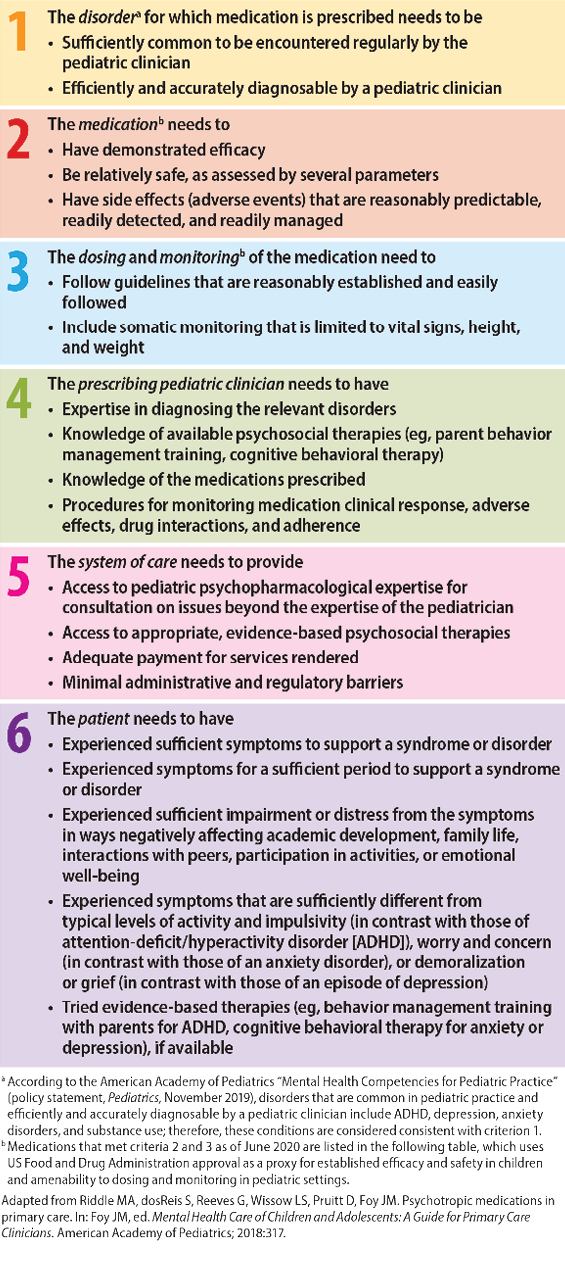
Psychotropic Medications for Use in Pediatrics
The following medications met criteria 2 and 3 in Criteria for Prescribing in Pediatrics, earlier in this tab, as of June 2020:
US FDA-Approved Medications for ADHD, Major Depressive Disorder, and Anxiety Disorders, Amenable to Use in Pediatricsa | ||
|---|---|---|
Drug (mode of action) | Indicationb | US FDA approval and approved age (y) |
ADHD | ||
Methylphenidate (stimulant) | ADHD | Yes; >=6c |
Amphetamine (stimulant) | ADHD | Yes; >=6c |
Guanfacine (alpha2-adrenergic agonist) | ADHD | Yes; >=6 |
Clonidine (alpha2-adrenergic agonist) | ADHD | Yes; >=6 |
Atomoxetine (selective norepinephrine reuptake inhibitor) | ADHD | Yes; >=6 |
Anxiety disorders | ||
Duloxetine (serotonin-norepinephrine reuptake inhibitor) | Generalized anxiety disorder | Yes; >7 |
Fluoxetine (SSRI) | Anxietyd | No |
OCD | Yes; >7 | |
Sertraline (SSRI) | Anxietyd | No |
OCD | Yes; >=6 | |
Fluvoxamine (SSRI) | Anxietyd | No |
OCD | Yes; >=10 | |
Major depressive disorder | ||
Fluoxetine | Major depressive disorder | Yes; >=8 |
Escitalopram | Major depressive disorder | Yes; >=12 |
Abbreviations: ADHD, attention-deficit/hyperactivity disorder; FDA, Food and Drug Administration; OCD, obsessive-compulsive disorder; SSRI, selective serotonin reuptake inhibitor.
a Medications are considered amenable to use in pediatrics if there is evidence of efficacy and favorable side effect (adverse event) profile and there is expectation of managing the disorder within primary care competencies; for a detailed discussion of pediatric mental health competencies for pediatrics, see Pediatrics, November 2019, at https://pediatrics.aappublications.org/content/144/5/e20192757.
b For each of these disorders, there are also evidence-based psychosocial interventions. See Evidence-Based Interventions for Common Pediatric Conditions, later in this tab.
c Approved down to the age of 3 y for some preparations.
d Generalized anxiety disorder, social phobia, and separation anxiety disorder.
Adapted from Riddle MA, dosReis S, Reeves G, Wissow LS, Pruitt D, Foy JM. Psychotropic medications in primary care. In: Foy JM, ed. Mental Health Care of Children and Adolescents: A Guide for Primary Care Clinicians. American Academy of Pediatrics; 2018;325.
Principles for Involving Mental Health and Developmental-Behavioral Specialists
Some children will not respond to brief pediatric interventions or will, for other reasons, require a full diagnostic evaluation and/or specialty care.
Deciding whether to refer a child to a mental health or developmental-behavioral specialist for diagnostic evaluation, therapy, or both is based on a number of factors: the child’s and family’s preferences, their health insurance and other financial and practical considerations, the nature of the child’s and family’s needs, their readiness to seek and receive care, and the clinician’s level of comfort.
Youths referred for mental health specialty care complete the referral process only 61% of the time. A significantly smaller number persist in care. Approaches to improving the referral process include ensuring that the family
1 Is ready for this step in care (See Tab 2.)
2 Has some idea of what the specialty care will involve (See Your Child’s Mental Health: When to Seek Help and Where to Get Help [https://patiented.solutions.aap.org].)
3 Understands what the pediatric clinician’s ongoing role may be
While the family is awaiting a specialty appointment, the pediatric clinician can help the family manage the problem in the meantime, by using approaches such as those described under Tabs 2 and 4.
The pediatric clinician can continue being involved in the patient’s care, even after a specialist is involved, much as they do in caring for other children with special health care needs. See Family-Centered Plan of Care for Children With Complex Needs, at the end of this tab, for guidance in developing a family-centered plan of care that articulates the role of each clinician and the family in this type of shared care arrangement.
Sources of Key Mental Health Services
By developing collaborative relationships with key service providers in their region, pediatric clinicians can determine which providers are well versed in trauma-informed care, make effective referrals, facilitate bidirectional communication, and coordinate respective roles in care. (See the table on the following page.)
Specialty services | Sources |
|---|---|
Psychiatric emergency services |
|
Medication consultation or treatment of patients with problems of high severity (medical doctor or doctor of osteopathy required) |
|
Services for young children |
|
| |
Grief counseling |
|
Substance use disorder counseling |
|
Psychosocial assessment |
|
Educational assessment |
|
Psychosocial treatment |
|
Specialized counseling programs (eg, domestic violence, family reunification, children of parents with alcohol use disorder, juvenile sex offender, divorce, stress management, smoking cessation) |
|
Parenting education |
|
Care coordination and case management |
|
Peer support |
|
a The term licensed mental health specialist encompasses clinical psychologists, clinical social workers, professional counselors, and others permitted by state authority to provide the particular service.
Adapted from Appendix S1: sources of specialty services for children with mental health problems and their families. Pediatrics. 2010;125(suppl 3):S126-S127. June 2010. Accessed March 13, 2021. http://pediatrics.aappublications.org/content/125/Supplement_3/S126.
Indications for Specialty Involvement: Ages Birth to 4 Years
Involving a specialist is indicated when
- A child younger than 5 years has symptoms of social-emotional problems causing functional impairment or distress. For example,
- The child has symptoms of anxiety, sadness, or irritability that limit participation in family interactions, child care experiences, or other typical experiences.
- The child has behaviors that are disruptive in the home or in out-of-home settings and limit participation in developmentally appropriate experiences.
- The child does not use the caregiver effectively for emotional support or is indiscriminate in social interactions with strangers.
- The child exhibits sleep or eating problems that are unresponsive to primary care interventions.
- The child’s symptoms followed trauma or family disruption.
- The parent is very negative toward their child, compromised by physical or mental disorder, disengaged, inconsistent in providing nurturing, or unresponsive to primary care guidance.
- The parent has difficulty allowing a child to have developmentally appropriate opportunities for exploration.
- The family is unable to maintain a calm, consistent, or safe environment. (In this instance, also consider reporting the problem to child protective services.)
Adapted from Gleason MM. Emotional or behavioral disturbance in children younger than 5 years. In: Foy JM, ed. Mental Health Care of Children and Adolescents: A Guide for Primary Care Clinicians. American Academy of Pediatrics; 2018:526-527.
Indications for Specialty Involvement: Ages 5 to 21 Years
One or more of the following circumstances typically indicate specialty referral:
- Suicidal or homicidal intent
- Severe functional impairment, regardless of symptoms or diagnosis
- Rapidly cycling mood
- Depressive symptoms in a preadolescent
- Extreme outbursts and problems with conduct
- Severe eating problems
- Psychotic thoughts or behavior
- Self-injury
- Comorbidity of substance use and mental health problems
- Losing control or compulsively using drugs
- Attention-deficit/hyperactivity disorder with comorbidities
- Behavioral or emotional symptoms in a child with history of abuse, neglect, or another trauma or loss
- Behavioral or emotional symptoms in a child with a developmental disability or physical condition
- Any other problem that the pediatric clinician does not feel prepared to address
Adapted from Foy JM. Pediatric care of children and adolescents with mental health problems. In: Foy JM, ed. Mental Health Care of Children and Adolescents: A Guide for Primary Care Clinicians. American Academy of Pediatrics; 2018:54-55.
Evidence-Based Interventions for Common Pediatric Conditions
A great deal of evidence supports the effectiveness of certain psychosocial interventions for social-emotional and mental health problems in childhood and adolescence. When mental health or developmental-behavioral specialty care is needed, referral would ideally be made to a therapist prepared to provide evidence-informed care. The pediatric clinician can identify any barriers to completing the referral; provide symptomatic care (see Tab 4) by using “common elements” of the interventions described on the following page—until the referral is complete; and participate in ongoing care of the patient with the specialist(s), as described in Family-Centered Plan of Care for Children With Complex Needs, at the end of this tab.
3a. Evidence-Based Psychosocial Interventions for Social-Emotional Problems in Children Younger Than 5 Years
The following recommended interventions are sources of common elements guidance described under Tab 4a for emotional or behavioral disturbance in children younger than 5 years:
Evidence-Based Interventions | |
|---|---|
Area of need | Interventions |
For disruptive behavioral problems |
|
For first-time pregnant women before 28 weeks’ gestation |
|
For children in foster care |
|
For parent-child relationship disturbances and high-risk parenting situations |
|
For children exposed to trauma, including sexual abuse or domestic violence |
|
Updates are available at www.aap.org/mentalhealth.
a Chaffin M, Funderburk B, Bard D, Valle LA, Gurwitch R. A combined motivation and Parent-Child Interaction Therapy package reduces child welfare recidivism in a randomized dismantling field trial. J Consult Clin Psychol. 2011;79(1):84-95.
b Cohen JA, Mannarino AP. Factors that mediate treatment outcome of sexually abused preschool children: sixand 12-month follow-up. J Am Acad Child Adolesc Psychiatry. 1998;37(1):44-51.
c Cohen JA, Mannarino AP. A treatment study for sexually abused preschool children: outcome during a one-year follow-up. J Am Acad Child Adolesc Psychiatry. 1997;36(9):1228-1235.
d Scheeringa MS, Weems CF, Cohen JA, Amaya-Jackson L, Guthrie D. Trauma-focused cognitive-behavioral therapy for posttraumatic stress disorder in three-through six year-old children: a randomized clinical trial. J Child Psychol Psychiatry. 2011;52(8):853-860.
Adapted from Gleason MM. Emotional or behavioral disturbance in children younger than 5 years. In: Foy JM, ed. Mental Health Care of Children and Adolescents: A Guide for Primary Care Clinicians. American Academy of Pediatrics; 2018:527-528.
3b. American Academy of Pediatrics Recommendations for Treating Attention-Deficit/Hyperactivity Disorder
First-line treatment of children diagnosed with attentiondeficit/hyperactivity disorder (ADHD) is parent training in behavior management (PTBM) for ADHD for 3to 5-year-olds and medication for school-aged children and adolescents 6 years and older; pediatric clinicians can comanage care with a provider of PTBM and either prescribe medication or monitor medication prescribed by a mental health specialist, with feedback from parent(s) and teacher(s). PTBM is the source of common elements guidance described under Tab 4b for children with symptoms of inattention, impulsivity, and hyperactivity.
- Recommendations for treating children and adolescents with ADHD vary depending on the patient’s age.
- For preschool-aged children (4 years to the 6th birthday), the clinician should prescribe evidence-based PTBM and/or behavioral classroom interventions as the first-line treatment, if available (grade A, strong recommendation), and may prescribe methylphenidate (grade B, strong recommendation), if the behavioral interventions do not significantly improve and moderate to severe disturbance continues in the 4to 5-year-old child’s functioning. In areas in which evidence-based behavioral treatments are unavailable, the clinician needs to weigh the risks of starting medication in the child before the age of 6 years against the harm of delaying treatment.
- For elementary and middle school-aged children (6 years to the 12th birthday), the primary care clinician should prescribe medications approved by the US Food and Drug Administration for ADHD (grade A, strong recommendation) along with PTBM and/or behavioral classroom interventions (grade A, strong recommendation) (preferably with both PTBM and behavioral classroom interventions). Educational interventions and individualized instructional supports, including school environment, class placement, instructional placement, and behavioral supports, are a necessary part of any treatment plan and often include an individualized education program or a rehabilitation plan (504 plan).
- For adolescents (aged 12 years to the 18th birthday), the clinician should prescribe medications approved by the US Food and Drug Administration for ADHD with the patient’s assent (grade A, strong recommendation). The clinician is encouraged to prescribe evidence-based training interventions and/or behavioral interventions as treatment of ADHD, if available (grade A, strong recommendation). Educational interventions and individualized instructional supports, including school environment, class placement, instructional placement, and behavioral supports, are a necessary part of any treatment plan and often include an individualized education program or a rehabilitation plan (504 plan).
- Clinicians should titrate doses of medication for ADHD to achieve maximum benefit with tolerable side effects (grade B, strong recommendation).
Adapted from Wolraich ML, Hagan JF Jr, Allan C, et al; American Academy of Pediatrics Subcommittee on Children and Adolescents With Attention-Deficit/Hyperactive Disorder. Clinical practice guideline for the diagnosis, evaluation, and treatment of attention-deficit/hyperactivity disorder in children and adolescents. Pediatrics. 2019;144(4):e20192528.
3c. Evidence-Based Psychosocial Interventions for Children With Somatic Symptoms and Related Disorders
Children with emotional problems (particularly anxiety or depression) often experience somatic symptoms, such as headache, abdominal or chest pain, menstrual irregularities, or fatigue. Some of these children can be diagnosed as having somatic symptom disorder or a related disorder. The following tablea summarizes evidence-based psychosocial interventions for these disorders, which are the source of common elements guidance described under Tab 4c for children with medically unexplained symptoms:
Intervention | Characteristics |
|---|---|
Cognitive behavioral therapy | May involve combined
|
Rehabilitative approach | Focuses on coping and improving health status |
Behavioral intervention | Approaches include
|
Self-management | Possible techniques include mindfulness, hypnosis, guided imagery, and relaxation. |
Family intervention | Involves work with the family system that may inadvertently reinforce the sick role |
Maximally treating psychiatric comorbidities | Is important to consider given the high prevalence of mental health conditions in children with medically unexplained symptoms |
Medication management | Should be considered for treating
|
a Derived from Dell ML, Campo JV. Somatoform disorders in children and adolescents. Psychiatr Clin North Am. 2011;34(3):643-660.
Adapted from Baum R, Campo J. Medically unexplained symptoms. In: Foy JM, ed. Mental Health Care of Children and Adolescents: A Guide for Primary Care Clinicians. American Academy of Pediatrics; 2018:657.
3d to 3g. Evidence-Based Psychosocial Interventions for Anxiety and Trauma-Related Distress (3d), Depressive Symptoms (3e), Disruptive Behavior and Aggression (3f), and Substance Use (3g)
The tablea on the following page was created for the period October 2020 to March 2021 by using the PracticeWise Evidence-Based Services Database, which is available at www.practicewise.com. For an explanation of how PracticeWise determines the evidence/level, please visit www.practicewise.com/aap. If this is not the most current version, please check the AAP mental health website (www.aap.org/mentalhealth) for updates. It should not be construed as being endorsed by the AAP. The AAP has endorsed 3 of the therapies under depressive symptoms and 1 under substance use (denoted with footnotes c and d).
Well-supported interventions listed in this table are sources of common elements guidance described under Tab 4d for children with symptoms of anxiety and trauma-related distress, Tab 4e for depressive symptoms, Tab 4f for disruptive behavior and aggression, and Tab 4g for substance use.
Problem area | Level 1— BEST SUPPORT | Level 2— GOOD SUPPORT | Level 3— MODERATE SUPPORT | Level 4— MINIMAL SUPPORT | Level 5b— NO SUPPORT |
|---|---|---|---|---|---|
3d Anxious or avoidant behaviors | Attention Training, CBT, CBT and Medication, CBT for Child and for Parent, CBT with Parents, Education, Exposure, Modeling | Assertiveness Training, Attention, Biofeedback, CBT and Expression, CBT and PMT, CBT with Parents Only, Cultural Storytelling, Family Psychoeducation, Hypnosis, Mindfulness, Relaxation, Stress Inoculation | CM, Group Therapy | Behavioral Activation and Exposure, Play Therapy, PMT, Psychodynamic Therapy, Rational Emotive Therapy, Social Skills | Assessment/Monitoring, Attachment Therapy, Attention Training and Exposure, Client Centered Therapy, EMDR, Peer Pairing, Problem Solving, Psychoeducation, Relationship Counseling, Teacher Psychoeducation |
3d Traumatic stress | CBT, CBT with Parents, EMDR, Exposure | Therapeutic Foster Care | None | CBT and Expression, Play Therapy, Relaxation and Expression | Advice/Encouragement, Client-Centered Therapy, CBT and Medication, CBT with Parents Only, Education, Expressive Play, Interpersonal Therapy, Problem Solving, Psychodynamic Therapy, Psychoeducation, Relaxation, Structured Listening |
3e Depressive or withdrawn behaviors | CBT,c CBT and Medication,c CBT with Parents, Client Centered Therapy, Family Therapy | Attention Training, Cognitive Behavioral Psychoeducation, Expression, Interpersonal Therapy,c MI/Engagement, MI/Engagement and CBT, Physical Exercise, Problem Solving, Relaxation | None | Behavioral Activation, Mindfulness, Self Control Training, Self Modeling, Social Skills | Attention, CBT and Anger Control, CBT and Behavioral Sleep Intervention, CBT and PMT, Goal Setting, Life Skills, Play Therapy, PMT, PMT and Emotion Regulation, Psychodynamic Therapy, Psychoeducation |
3f Delinquency and disruptive behavior | Anger Control, Assertiveness Training, CBT, CM, MI/Engagement, Multisystemic Therapy, PMT, PMT and Problem Solving, Problem Solving, Social Skills, Therapeutic Foster Care | CBT and PMT, CBT and Teacher Training, Communication Skills, Cooperative Problem Solving, Family Therapy, Functional Family Therapy, Mindfulness, PMT and Classroom Management, PMT and Medication, PMT and Social Skills, Rational Emotive Therapy, Relaxation, Self Control Training, Transactional Analysis | Client Centered Therapy, Moral Reasoning Training, Outreach Counseling, Peer Pairing | CBT and Teacher Psychoeducation, Exposure, Parent Psychoeducation, Physical Exercise, PMT and Classroom Management and CBT, PMT and Self Verbalization, Stress Inoculation | Behavioral Family Therapy, Catharsis, CBT with Parents, Education, Family Empowerment and Support, Family Systems Therapy, Group Therapy, Imagery Training, MI/Engagement and CBT, Play Therapy, PMT and Peer Support, Psychodynamic Therapy, Psychoeducation, Self Verbalization, Skill Development, Wraparound |
3g Substance use | CBT, Community Reinforcement, CM, Family Therapy, MI/Engagementd | Assertive Continuing Care, CBT and CM, Case Management, CBT and Medication, CBT with Parents, Family Systems Therapy, Functional Family Therapy, Goal Setting, Goal Setting/Monitoring, MI/Engagement and CBT, MI/Engagement and CBT and CM, MI/Engagement and Expression, Multidimensional Family Therapy, Problem Solving, Purdue Brief Family Therapy | CBT and Family Therapy, Drug Court, Drug Court and Multisystemic Therapy and CM, Eclectic Therapy | PMT, Psychoeducation | Advice/Encouragement, Assessment/Monitoring, Behavioral Family Therapy, CBT and Community Information Campaign, Client Centered Therapy, CM and Behavioral Family Therapy, CM and Parent Psychoeducation, Drug Court and Multisystemic Therapy, Drug Education, Education, Family Court, Feedback, Group Therapy, Mindfulness, MI/Engagement and CBT and CM and PMT, MI/Engagement and CBT and Family Therapy, Multisystemic Therapy, Parent Psychoeducation, Therapeutic Vocational Training |
Abbreviations: AAP, American Academy of Pediatrics; CBT, Cognitive Behavioral Therapy; CM, Contingency Management; EMDR, Eye Movement Desensitization and Reprocessing; MI, Motivational Interviewing; PMT, Parent Management Training.
a Updates and replaces the “Blue Menu” originally distributed by the Hawaii State Department of Health, Child & Adolescent Mental Health Division, Evidence-Based Services Committee, from 2002-2009.
b Refers to treatments whose study findings were unsupportive or inconclusive.
c Recommended psychosocial interventions in Guidelines for Adolescent Depression in Primary Care, endorsed by the AAP.
d Recommended by the AAP; see “Substance Use Screening, Brief Intervention, and Referral to Treatment” policy statement (https://pediatrics.aappublications.org/content/138/1/e20161210) and clinical report (https://pediatrics.aappublications.org/content/138/1/e20161211), Pediatrics, July 2016.
Adapted with permission from PracticeWise.
The recommendations in this table do not indicate an exclusive course of treatment or serve as a standard of medical care. Variations, taking into account individual circumstances, may be appropriate. Original table included as part of Addressing Mental Health Concerns in Primary Care: A Clinician’s Toolkit. © 2010 American Academy of Pediatrics. All rights reserved. The American Academy of Pediatrics (AAP) does not review or endorse any modifications made to this document and in no event shall the AAP be liable for any such changes.
How to Talk With Patients About Complementary and Integrative Therapies
Many youths and families with mental health problems self-medicate with over-the-counter remedies and/or seek out other complementary and integrative therapies. It is important to inquire about these practices as part of care planning. Some medicinal therapies interact with prescription medications and may affect safety and efficacy, while some integrative therapies can safely augment traditional approaches.
- Do talk about the different kinds of therapies families may have tried to help their children.
- Do not wait for families to bring these up.
- Do ask in an open-minded, nonjudgmental fashion. Avoid using potentially pejorative terms such as unproved, unconventional, or alternative.
- Do elicit further information with questions about specific therapies. For example, “Have you tried any herbal therapies, such as ones with Echinacea or Ginkgo?” “Have you tried any dietary therapies, such as avoiding wheat or milk?” “Have you sought care from any other health care professionals, such as acupuncturists or chiropractors?”
- Do elicit the values, beliefs, and influences that led parents to these therapies. For example, were these suggested by family members? Were they consistent with the parents’ religious, spiritual, or cultural beliefs? What is the value of natural or organic approaches? Do family members have a fear of adverse effects of mainstream treatments?
- Do join with the parents, whenever possible, and support their decision to pursue avenues that may help their child. Be an ally rather than a tyrant.
- Do ask how well the family thinks the therapies worked or did not work, before offering your opinion.
- Do offer to talk with other therapists involved in the child’s care to maintain coordinated, comprehensive care.
- Do offer to learn more to help answer the family’s questions.
- Do offer families additional information and resources to address their questions about complementary and integrative therapies.
Adapted from Hull JR. Complementary and integrative medical therapies. In: Foy JM, ed. Mental Health Care of Children and Adolescents: A Guide for Primary Care Clinicians. American Academy of Pediatrics; 2018:292.
Family-Centered Plan of Care for Children With Complex Needs
According to chronic care principles, optimal outcomes are achieved when the family, primary care team, and pediatric and mental health specialists involved in assessment and treatment collaboratively develop a comprehensive plan of care. These principles are well described in Bright Futures, 4th Edition, the chapter “Promoting Health for Children and Youth With Special Health Care Needs.” See “Box 1: Principles for Successful Use of a Shared Plan of Care,” “Table 1: Work Flow of a Family-Centered Team Approach to Care,” and “Figure 1: Example of Care Coordination Eco Map.”
Team Members (with one person designated as lead, team convener, and liaison to the family)
- Family (including the youth, with their level of participation being based on their developmental capacity)
- Involved clinicians or a representative of the practice (eg, mental health specialist, developmental-behavioral pediatrician, substance use disorder or early interventionist specialist)
- Primary care clinician
- Pediatric subspecialist
- Care coordinator or manager
- Representative(s) of the school and involved agencies (eg, school guidance counselor or nurse, department of social service worker)
Components of the Plan
- Articulates
- The patient’s and family’s strengths, goals, and priorities
- Problems to be addressed
- Elements of treatment and support (eg, home, school, primary care, specialty and subspecialty care, agency)
- Person(s) responsible for each component; the pediatric clinician may be responsible for such functions as
- Initiating medication or adjusting doses
- Monitoring response to treatment
- Monitoring adverse effects
- Engaging and encouraging the youth’s and family’s positive views of treatment
- Coordinating care provided by parents, the school, the medical home, and specialists
- Providing pediatric primary and/or subspecialty care
- Clarifies the responsibility for psychoeducation of the patient and family
- Outlines a safety and emergency plan
Implementation Steps
- Establish mechanisms for monitoring progress.
- Person responsible
- Measurement tools
- Laboratory testing, if indicated
- Develop a concrete plan and obtain permission for information exchange.
- Establish frequency of routine health supervision visits.
- Schedule periodic reassessment by the team.
- Revise the plan as needed.
- By the patient’s mid-adolescence, begin planning for future transition to independent living, further education, job training (as appropriate to the circumstances), or combined activities and for adult medical and mental health care.
Derived from Foy JM. Pediatric care of children and adolescents with mental health problems. In: Foy JM, ed. Mental Health Care of Children and Adolescents: A Guide for Primary Care Clinicians. American Academy of Pediatrics; 2018:31-70.