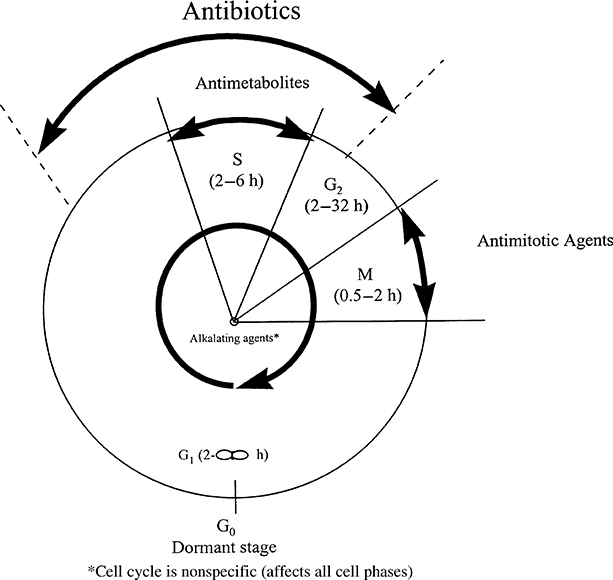
The cell cycle is a sequence of events that results in the division of a cell into two identical daughter cells (Fig. 56-1). Within the cell cycle are two main phases: interphase and mitosis. Interphase is comprised of G1 phase (the period of cell growth before the DNA is duplicated), S phase (the period when chromosomal DNA is duplicated), and G2 phase (the period when DNA duplication is complete and the cell prepares for division). Mitosis refers to the division of the parent cell into two daughter cells. Tumor cells grow as a result of deregulation between proliferation and growth suppression or cellular death. Our understanding of cancer cell kinetics and the classical cell cycle has led to the development of drugs that disrupt cell cycle progression or induce cellular death.
Figure 56-1 Phases of the Cell Cycle, Relative Time Intervals, and Sites of Action of the Various Classes of Antineoplastic Agents.
(Reprinted with permission from Trimble EL, Trimble CL. Cancer Obstetrics and Gynecology. Lippincott Williams & Wilkins; 1999:60.)
Chemotherapies are chemical compounds found to have general cytotoxic properties. Chemotherapeutic agents may be characterized by their effect on the cell cycle.
Cell cycle–specific chemotherapeutic agents depend on the proliferative capacity of the cell and the phase of the cell cycle for their mechanism of action. They are effective against tumors with relatively long S phases and rapid proliferation rates.
Cell cycle–nonspecific chemotherapeutic agents kill cells in all phases of the cell cycle; their effectiveness is not dependent on proliferative capacity. Radiation therapy is considered cell cycle nonspecific.