PCOS is the most common endocrine disorder among reproductive-age women. It affects approximately 4% to 13% of this population.
PCOS has been observed to have a higher prevalence in Middle Eastern, Mediterranean, Indian, and South Asian patients compared to those identifying as East Asian or White.
Individuals with PCOS do not have orderly follicular development. Most cycles fail to lead to the emergence of a dominant follicle or release of an oocyte leading to anovulation.
Diagnosis of Polycystic Ovary Syndrome
Patients with PCOS typically present with oligomenorrhea, amenorrhea, hirsutism, obesity, and/or infertility. Virilization is not consistent with a diagnosis.
The most used diagnostic criteria is the 2003 Rotterdam Consensus Criteria, which requires any two of the following three manifestations:
Oligomenorrhea and/or anovulation
Hyperandrogenism (clinical and/or biochemical signs)
Polycystic ovaries on ultrasound (≥20 follicles, ovarian volume ≥10 cc, or follicle number per section ≥10 in at least one ovary)
In 2023, the International PCOS Network updated evidence-based guidelines for the diagnosis of PCOS. The primary difference from the Rotterdam criteria is that anti-müllerian hormone (AMH) levels can be used in place of ultrasound findings of polycystic ovaries in adults.
PCOS is always a diagnosis of exclusion.
Insulin resistance and metabolic syndrome are often associated with PCOS, and these patients should be screened for comorbidities (see below).
Diagnosis in Adolescents
Diagnosis in adolescence can be confounded due to the association of irregular menses, acne, and mild hyperandrogenism associated with physiologic puberty.
It is not recommended to perform ultrasound and obtain AMH levels in adolescents.
If an adolescent patient does not meet the 2023 criteria for PCOS but has symptoms suggestive of the disease, reassessment is recommended at 8 years post menarche.
Pathophysiology of Polycystic Ovary Syndrome
The cause of PCOS remains unknown. Abnormalities of the hypothalamic–pituitary axis and the ovarian/adrenal steroidogenic pathway have been proposed as possible etiologies.
Figure 46-2 outlines the proposed pathophysiology of PCOS.
Figure 46-2 Pathophysiology of Polycystic Ovarian Syndrome.
FSH, follicle-stimulating hormone; GnRH, gonadotropin-releasing hormone; LH, luteinizing hormone; PCOM, polycystic ovarian morphology; SHBG, sex hormone–binding globulin.
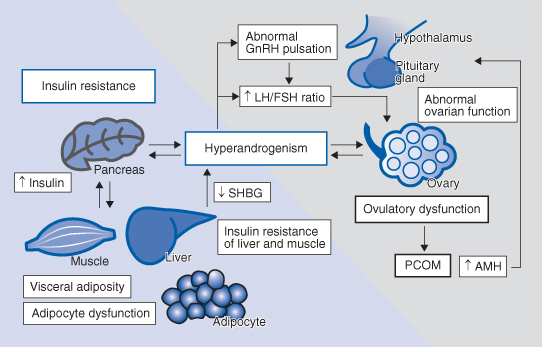
(From Harada M. Pathophysiology of polycystic ovary syndrome revisited: current understanding and perspectives regarding future research. Reprod Med Biol. 2022;21(1):e12487. Reprinted by permission of John Wiley & Sons, Inc.)
Pituitary and hypothalamus. Increases in the frequency and amplitude of LH pulses have been recorded. A ratio of serum LH:FSH >2 is typically observed in PCOS patients but is not required or diagnostic.
Ovarian androgen production. Increased secretion of androgens from the ovaries has been observed in patients with PCOS. Insulin resistance is thought to stimulate androgen secretion from both the ovaries and adrenals.
Adrenal androgen production. Some PCOS patients may have elevations of DHEA-S.
Immune dysfunction has been proposed to contribute to the pathogenesis of PCOS. The chronic inflammatory state of PCOS is thought to affect androgen synthesis, insulin resistance, and follicular development.
Treatment for Hyperandrogenism/Polycystic Ovary Syndrome
Lifestyle modifications are first line in the management of hyperandrogenism. Weight loss of even 5% can often improve symptoms related to PCOS.
OCPs reduce gonadotropin levels and increase SHBG levels—leading to decreased circulating androgens. OCPs are initial pharmacologic treatment for oligomenorrhea, hirsutism, and acne caused by PCOS. Progestins decrease androgens by reducing 5α-reductase activity. All low-dose OCP preparations have similar results.
If combination OCPs are contraindicated or not desired, medroxyprogesterone acetate may be taken every month or every other month to produce regular withdrawal bleeding. The depot formulation is associated with weight gain, which could exacerbate insulin resistance. Patients should be cautioned that pregnancy is possible with cyclic progestin therapy.
Metformin hydrochloride decreases hepatic gluconeogenesis and intestinal absorption of glucose while improving insulin sensitivity. Metformin has been shown to restore menses in approximately 50% of women with PCOS and can improve insulin sensitivity, reduce serum free testosterone, and increase high density lipoprotein (HDL) cholesterol. Patients should be started on the lowest dose daily with slow up-titration due to the gastrointestinal side effects.
Metformin appears to be unique among insulin-sensitizing agents in that it can improve weight loss, hyperandrogenism, and menstrual cycles in individuals with PCOS.
Metformin use should be considered in adults with BMI >25 kg/m2.
In adults with BMI >30 kg/m2, impaired glucose tolerance, diabetes risk factors, or are part of a high-risk ethnic group, consider combining metformin and OCP therapies.
Antiobesity medications including glucagon-like-peptide-1 (GLP-1) receptor agonists can be considered for weight management as per general population guidelines. Clinical studies demonstrate improved insulin resistance and decreased androgens in patients with PCOS taking GLP-1 agonists. Without sufficient pregnancy safety data, concurrent contraception is not recommended. Current guidelines recommend cessation 2 months prior to conception.
Inositol is a complementary therapy that has been shown to have potential for improvement in insulin resistance, with limited clinical benefits for ovulation and hirsutism.
Treatment for hirsutism may have delayed results for up to 6 months with hormone suppression. Androgen suppression will not alter previous hair growth.
OCPs: as discussed above.
Spironolactone is often initiated if OCP use is not an option or if results from OCP therapy after 6 months are not optimal. Spironolactone is an aldosterone antagonist that directly inhibits 5α-reductase and decreases the production of DHT. Due to potential adverse effects on genitalia of male fetuses, spironolactone should be used with contraception in sexually active patients. Other side effects include diuresis, orthostatic hypotension, fatigue, dysfunctional uterine bleeding, hyperkalemia, and breast enlargement.
Flutamide is a nonsteroidal antiandrogen that blocks the binding of androgen to its receptor, which can cause inhibition of new hair growth. Side effects include dry skin and, rarely, hepatotoxicity. Due to adverse fetal effects, effective contraceptive therapy is mandatory.
Finasteride inhibits 5α-reductase, decreasing DHT activity in hair follicles. Finasteride treatment prevents new hair growth and decreases the terminal hair shaft diameter. Again, due to adverse fetal effects, reliable contraception should be used.
Minoxidil is the only drug approved by the FDA for treatment of androgenic alopecia in women. It is available over the counter as a 2% and 5% topical solution.
Eflornithine hydrochloride (Vaniqa) 13.9% cream reduces unwanted facial hair. Eflornithine is an antagonist of ornithine decarboxylase, the enzyme necessary for regulation of growth of hair follicles. The benefit is usually first seen at 8 weeks.
Hair removal by mechanical methods includes shaving, waxing, depilatories, laser, and electrolysis. However, hair regrowth is common. Adverse effects (inflammation, blistering, hyperpigmentation, hypopigmentation, and scarring) are more commonly seen in darker-skinned patients.
Bariatric surgery can be considered for improvements in weight loss, hypertension, diabetes, hirsutism, and ovulation.
Comorbidities Associated with Polycystic Ovary Syndrome
Hyperinsulinemia and insulin resistance. Insulin resistance is often observed in patients with PCOS, whether or not they are obese. Insulin may cause or contribute to the hyperandrogenic state by activating insulin receptors within the ovary, augmenting androgen secretion, or by acting on insulin-like growth factor receptors. Patients with PCOS are at increased risk for impaired glucose tolerance and five- to sevenfold more likely to develop type 2 diabetes mellitus. Hispanic, Black, and Asian patients are at a higher risk of developing insulin resistance compared with White patients.
Metabolic syndrome is characterized by a cluster of conditions such as elevated blood pressure, high serum glucose, increased waist circumference, and abnormal cholesterol or triglyceride levels that, when occurring together, increase the risk of heart disease, stroke, and diabetes. The prevalence of metabolic syndrome in patients with PCOS is twice that of controls with similar age and body mass index.
Endometrial hyperplasia and malignancy. Oligoanovulation leads to unopposed estrogen and lack of progesterone withdrawal. This can lead to proliferation of the endometrium that if untreated, may progress to endometrial hyperplasia and/or endometrial carcinoma.
Nonalcoholic fatty liver disease (NAFLD) risk is increased with PCOS and can lead to abnormal liver function tests, steatohepatitis, cirrhosis, and rarely hepatocellular carcinoma.
Obstructive sleep apnea is prevalent in patients with PCOS regardless of BMI, with a 30-fold increased risk in women with PCOS compared to those without.
Depression/Anxiety. Mental health conditions such as depression and anxiety are more prevalent in women with PCOS compared to women without PCOS.
The following screenings should be performed at time of diagnosis: cholesterol panel, blood pressure measurement, fasting glucose, 2-hour oral glucose tolerance test, and hemoglobin A1c. Validated screening for anxiety/depression and sleep apnea should also be performed.
Fertility Considerations for Polycystic Ovary Syndrome
Patients often have infertility due to oligoanovulation. Once they conceive, PCOS patients are at increased risk for miscarriage, gestational diabetes, fetal growth restriction, preterm delivery, and pregnancy-induced hypertension (including preeclampsia).
Weight loss (of at least 10% of body weight) can induce ovulation-improving fertility rates.
Letrozole is an aromatase inhibitor used for ovulation induction. It prevents the conversion of androgens to estrogen in the peripheral blood stream. The reduced estrogen levels lead to negative feedback to the hypothalamus. A compensatory increase in hypothalamic gonadotropin-releasing hormone (GnRH) secretion is then triggered, and then followed by an increased release of FSH and LH. Letrozole is first line for ovulation induction for patients with PCOS. Letrozole compared to clomiphene citrate (see below) results in higher pregnancy and live birth rates with no difference in miscarriage or multiple birth rates. Letrozole is not FDA approved for ovulation induction and is contraindicated for use during pregnancy.
Clomiphene citrate (Clomid) is a selective estrogen receptor modulator that functions as an estrogen receptor antagonist in the hypothalamus, thus stimulating GnRH and subsequent FSH secretion.
Metformin is not as effective as ovulation-inducing agents letrozole and Clomid but can be used in combination. Metformin use in pregnancy does not prevent gestational diabetes, pregnancy-induced hypertension, or accelerated fetal growth.
In vitro fertilization is the next step if weight loss or ovulation inductions with oral medications are unsuccessful. Concurrent use of Metformin can help to minimize the risk of Ovarian Hyperstimulation Syndrome.
Laparoscopic ovarian drilling and wedge resection used to be a standard treatment prior to ovulation-inducing agents. However, because of the high incidence of pelvic adhesions and risk of decreased ovarian reserve, this approach is rarely used today.
Polycystic Ovary Syndrome in Transmasculine Patients
PCOS may be underdiagnosed in transmasculine patients on hormone therapy. The true prevalence of PCOS in the transgender and nonbinary community is unknown, as previous studies have used inconsistent criteria for diagnosing PCOS.
Later diagnosis of PCOS in transmasculine patients puts them at risk for the metabolic and cardiovascular risks of PCOS.
Regardless of the hyperandrogenic symptoms in PCOS patients, there does not appear to be an association between PCOS and transgender/nonbinary identity.