TL;DR
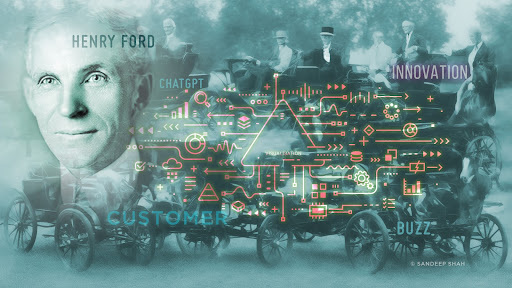
In this article, I explore the intersection of innovation, customer input, and AI technology, notably ChatGPT. Drawing on Henry Ford’s quote about “faster horses,” it looks at the value of drawing on past knowledge and customer needs while forging into the unknown. We highlight how the current technology works and raise questions about its reliance on historical data. Discussing the unprecedented challenges of the COVID-19 era and the lessons from Skyscape’s Buzz platform, we highlight the need to balance prior knowledge with agile anticipation of the future. Buzz, incorporating customer input and ChatGPT’s capabilities, shows how customer-focused innovation and unseen technological refinements create a successful product.
While history is valuable, it’s also a prologue to an ongoing story, a balance of listening, understanding, refining, and innovating.
The Background
One of the famous and oft-quoted phrases attributed to Henry Ford goes, “If I had asked people what they wanted, they would have said faster horses.” As the Harvard Business Review notes, it has been a polarizing argument about the merits of innovation versus customer involvement. In an era of rapid technological advancement, the ability to innovate and adapt has become paramount for businesses.
What’s the Connection Between ChatGPT and Henry Ford?
You might wonder what ChatGPT has to do with this. Before I show the connection, let me digress to explain how ChatGPT works.
ChatGPT and similar AI technologies, like Bard, are machine learning models known as large language models. GPT in ChatGPT stands for Generative Pretrained Transformer, an advanced language model developed by OpenAI. It’s trained using a machine learning technique known as transformer neural networks. The model’s training relies on a large corpus of text data, learning the patterns and structures of human language. During training, it learns to predict the next word in a sentence, which helps it generate human-like text. When a user inputs a question or prompt, the model uses its learned knowledge to produce a contextually appropriate and coherent response.
The bottom line is that these AI engines do not possess consciousness or understanding; they mimic knowledge by drawing on patterns learned during training. The answers are generated purely from patterns in the training data, not from any vision or predictive capability. Additionally, the technology cannot access or retrieve personal data from users unless it is shared during the conversation (by entering it in the ‘prompt’). We expect the technology to honor user privacy and confidentiality. However, developers could overzealously mix this private information into the training data, which would make it treacherous.
Let’s get back to Henry Ford. His quote implies the danger of using customers as input: you may lose the chance at disruptive innovation if you rely too much on current information and knowledge. Does ChatGPT’s reliance on “known history” relegate it to the same fate as the customer who only knows about the proverbial horse carriage, leaving us with a regurgitated future? This dilemma of the known versus the unknown is why I mention Henry Ford and ChatGPT in the same breath.
Enter COVID and Innovation
The last few years of COVID have taught us that it is better to be aware of the past and yet agile enough to anticipate the future. The pandemic underscored the importance of this agility, posing unanticipated challenges that required swift and innovative solutions. Whatever the solution, whether technology to connect people or vaccines to save lives, it was the combination of prior knowledge and the acute need to manage the unknown that ultimately led to success.
In this context, the role of customer input in driving innovation has gained renewed significance.
Skyscape’s Innovation in Home Health
Many challenges addressed during the pandemic relate to “remote” connectivity. The challenges, the gaps in existing solutions, and the opportunities for new ones correlate directly with patient care and management in the home health environment. Skyscape’s Buzz platform focused on the latter, which merits a brief preview.
The collaboration platform has proven the pivotal role of customer input in driving innovation. When face-to-face interactions were limited, Buzz filled the communication gap with secure, HIPAA-compliant phone and video to address its healthcare clients’ needs. This process led to solutions tailored to the unique challenges the pandemic brought on.
Additionally, the Buzz team implemented AI capabilities with CloudLink™ for evidence-based medical references and literature, augmented with generative documentation through ChatGPT, in response to the challenges our clients’ medical teams face every day. These healthcare staffing challenges were brewing well before the COVID-19 pandemic and continued to worsen during and after it.
The innovation story of Buzz doesn’t end with customer input. The team also shows the value of technical nuances that make the product easier to use, even when they did not originate from customer suggestions. A great example is proactively anonymizing the identities of our providers and creating secure tunnels to external services like ChatGPT to prevent the leakage of HIPAA-sensitive data to such AI engines. Integrating documentation steps into the normal workflow, and dispatching the information directly through Buzz, phone, SMS or fax, reduces the repetitive and mundane tasks that lead to exhaustion, burnout, anxiety and stress among healthcare providers.
While not always visible to the end user, these behind-the-scenes enhancements are crucial for a smooth and efficient user experience. They include improvements in processing speed, system stability, data security, and user interface design. The Buzz team continuously refines these aspects of the product, keeping it reliable, secure, and easy to use.
Squashing the Innovator’s Dilemma
The journey of Buzz serves as an example for all businesses. In the dynamic and fast-paced world of technology, innovation is not just about creating the next big thing. It’s about listening to your customers, understanding their challenges, and continually refining your product. This balance will allow businesses to thrive in the post-pandemic world.
Harvard professor Clayton M. Christensen outlined the concept of “disruptive innovation” in his famous book The Innovator’s Dilemma. The dual approach of focusing on both customer input and needs and on internal technological enhancements has let the Buzz team stay ahead of the curve and keep the platform relevant, user-friendly, and advanced, proving that the “faster horse” analogy is, at best, an oversimplification. This lesson could help established companies as well as smaller upstarts.
Tie the Historical with the Contemporary
In conclusion, customer input and preemptive advancements are not mutually exclusive sources of innovation. They complement each other in creating products and solutions that are faster, more efficient, and aligned with customers’ changing needs.
Finally, I can’t stop without remembering my favorite phrase, “What’s past is prologue,” from Shakespeare’s The Tempest. In a broader sense, it signifies that history influences and shapes current events and the future. The past is not something to be dismissed or frowned upon; it is a prologue to a story still being written. The connection between Henry Ford’s apparent musing and ChatGPT’s capabilities ties the historical with the contemporary in an intriguing way!
PS: If you’d like to see responsible AI in action, book a demo of Buzz.