section name header

Basic Information ⬇

Author: Fred F. Ferri, MD

Definition

Prostatitis refers to inflammation of the prostate gland. There are four major categories (Table 1 ):

  • •Acute bacterial prostatitis (type I)
  • •Chronic bacterial prostatitis (type II)
  • •Chronic prostatitis/pelvic pain syndrome (CP/CPPS) (type III): Subdivided into type IIIA (inflammatory) and IIIB (noninflammatory)
  • •Asymptomatic inflammatory prostatitis (type IV)

TABLE 1 Classification System for the Prostatitis Syndromes

TraditionalNational Institutes of HealthDescription
Acute bacterial prostatitisCategory IAcute infection of the prostate gland
Chronic bacterial prostatitisCategory IIChronic infection of the prostate gland
N/ACategory III Chronic pelvic pain syndrome (CPPS)Chronic genitourinary pain in the absence of uropathogenic bacteria localized to the prostate gland employing standard methodology
Nonbacterial prostatitisCategory IIIA Inflammatory CPPSSignificant number of white blood cells in expressed prostatic secretions, postprostatic massage urine sediment (VB3), or semen
ProstatodyniaCategory IIIB Noninflammatory CPPSInsignificant number of white blood cells in expressed prostatic secretions, postprostatic massage urine sediment (VB3), or semen
N/ACategory IV Asymptomatic inflammatory prostatitis (AIP)White blood cells (and/or bacteria) in expressed prostatic secretions, postprostatic massage urine sediment (VB3), semen, or histologic specimens of prostate gland

From Wein AJ et al: Campbell-Walsh urology, ed 11, Philadelphia, 2016, Elsevier.

ICD-10cm Codes

ICD-10CM CODES
N41.0Acute prostatitis
N41.1Chronic prostatitis
Epidemiology & Demographics

  • •50% of men will have symptoms of prostatitis in their lifetime.
  • •Prostatitis accounts for >8% of visits to urologists and 1% of visits to primary care physicians.
  • •The prevalence of chronic bacterial prostatitis is 5% to 10%.
  • •CP/CPPS is the most common of the clinically defined prostatitis syndromes, with prevalence ranging from 9% to 12% of men.
  • •Acute bacterial prostatitis accounts for 10% of all cases of prostatitis.
Physical Findings & Clinical Presentation

  • •Acute bacterial prostatitis:
    1. 1.Sudden or rapidly progressive onset of:
      1. a.Dysuria
      2. b.Frequency
      3. c.Urgency
      4. d.Nocturia
      5. e.Perineal pain that may radiate to the back, rectum, or penis
    2. 2.Hematuria or a purulent urethral discharge may occur.
    3. 3.Occasionally urinary retention complicates the course.
    4. 4.Fever, chills, and signs of sepsis can also be part of the clinical picture.
    5. 5.On rectal examination the prostate is typically tender.
  • •Chronic bacterial prostatitis:
    1. 1.Characterized by positive culture of expressed prostatic secretions. May cause symptoms such as suprapubic, low back, or perineal pain; mild urgency, frequency, and dysuria with urination; and possibly recurrent urinary tract infections.
    2. 2.May be asymptomatic when the infection is confined to the prostate.
    3. 3.May present as an increase in severity of baseline symptoms of benign prostatic hypertrophy (BPH).
    4. 4.When cystitis is also present, urinary frequency, urgency, and burning may be reported.
    5. 5.Hematuria may be a presenting complaint.
    6. 6.In elderly men, new onset of urinary incontinence may be noted.
  • •CP/CPPS:
    1. 1.Presents similarly with pain in the pelvic region lasting >3 mo. Symptoms also can include pain in the suprapubic region, low back, penis, testes, or scrotum.
    2. 2.The symptoms can be of variable severity and may include lower urinary tract symptoms, sexual dysfunction, and reduced quality of life.
Etiology

  • •Acute bacterial prostatitis:
    1. 1.Acute, usually gram-negative infection of the prostate gland. Escherichia coli is the most commonly isolated organism.
    2. 2.Generally associated with cystitis.
    3. 3.Results from the ascent of bacteria into the urethra.
    4. 4.Occasionally the route of infection is hematogenous or a lymphatogenous spread of rectal bacteria.
    5. 5.Consider Neisseria gonorrhoeae or Chlamydia trachomatis in young patients (age <35 yr) with risk of sexually transmitted disease (STD).
  • •Chronic bacterial prostatitis:
    1. 1.Often asymptomatic. E. coli is the most commonly isolated organism.
    2. 2.Exacerbation of symptoms of BPH caused by the same mechanism as in acute bacterial prostatitis.
  • •CP/CPPS:
    1. 1.Type IIIA: Refers to symptoms of prostatic inflammation associated with the presence of white blood cells in prostatic secretions with no identifiable bacterial organism.
    2. 2.Chlamydia infection may be etiologically implicated in some cases.
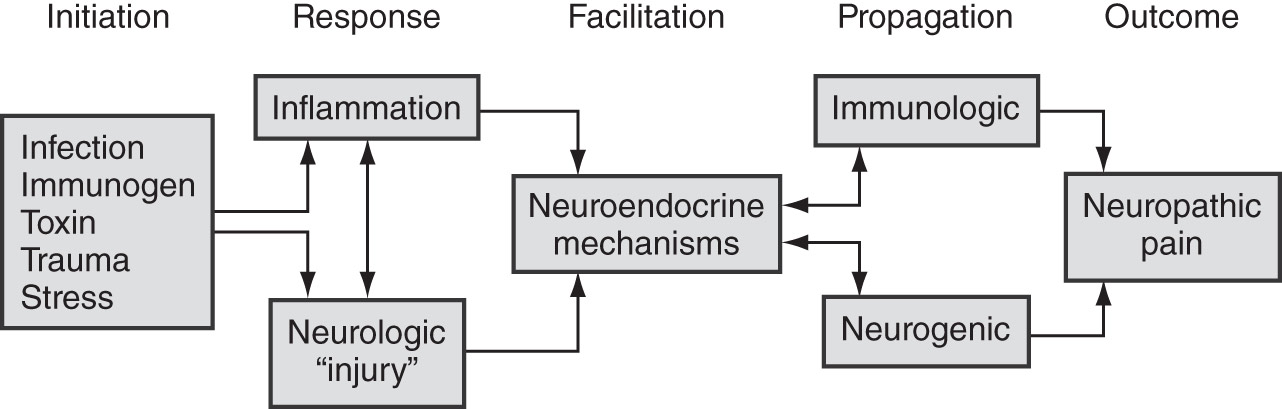
    3. 3.Type IIIB: Refers to symptoms of prostatic inflammation with no or few white blood cells in the prostatic secretion. Its cause is multifactorial (Fig. 1 ).

Figure 1 The Cause and Pathogenesis of Chronic Prostatitis/Chronic Pelvic Pain Syndrome (Category III Chronic Pelvic Pain Syndrome) Appear to Involve a Pluricausal, Multifactorial Mechanism

!!flowchart!!

An initiating stimulus, such as infection, reflux of some toxic or immunogenic urine substance, or perineal or pelvic trauma, starts a cascade of events in an anatomically or genetically susceptible man, resulting in a local response of inflammation or neurogenic injury or both. Further interrelated immunologic, neuropathic, endocrinologic, and psychologic mechanisms propagate or sustain the chronicity of the initial (or ongoing) event. The final outcome is the clinical manifestation of chronic perineal or pelvic pain and associated symptoms with local and central neuropathic mechanisms involving areas outside the prostate or pelvic area.

(From Ritchey ML et al: Campbell-Walsh-Wein urology, ed 12, Philadelphia, 2021, Elsevier.)

Diagnosis ⬆ ⬇

Differential Diagnosis

  • •BPH with lower urinary tract symptoms
  • •Prostate cancer
  • •Interstitial cystitis/bladder pain syndrome
  • •Pelvic floor dysfunction
  • •Bladder cancer
  • •Urolithiasis
  • •Urinary tract infection
  • •Proctitis
Workup

  • •Rectal examination:
    1. 1.Tender prostate most suggestive of acute bacterial prostatitis
    2. 2.Enlarged prostate common in chronic bacterial prostatitis
    3. 3.Normal prostate is consistent with chronic bacterial prostatitis and CP/CPPS
  • •Expression of prostatic secretions by prostate massage is contraindicated in acute bacterial prostatitis but is appropriate in the other three situations.
Laboratory Tests

  • •Urinalysis.
  • •Urine culture and sensitivity.
  • •Bacterial localization studies can be performed but are cumbersome and impractical in most clinical settings.
  • •Cell count and culture of expressed prostatic secretions.
  • •Prostate-specific antigen (PSA) is not used to diagnose prostatitis and is not recommended unless a nodule is present on digital examination. A rapid rise over baseline should raise the possibility of prostatitis even in the absence of symptoms. In such cases, a follow-up PSA after treatment of prostatitis is appropriate.
  • •CBC and blood cultures if fever, chills, or signs of sepsis exist.

Treatment ⬆

BOX 1 Suggested Therapies for Chronic Prostatitis and Chronic Pelvic Pain Syndrome (National Institutes of Health Category III)

Recommended

  1. 1.α-Blocker therapy as part of a multimodal treatment strategy for newly diagnosed, α-blocker–naive patients who have voiding symptoms
  2. 2.Antimicrobial therapy trial for selected newly diagnosed, antimicrobial-naive patients
  3. 3.Selected phytotherapies: Cernilton and quercetin
  4. 4.Multimodal therapy directed by clinical phenotype
  5. 5.Directed physiotherapy. Although level 1 evidence is not available, evidence from multiple weak trials and vast clinical experience strongly suggests benefit for selected patients
Not Recommended

  1. 1.α-Blocker monotherapy, particularly in patients previously treated with α-blockers
  2. 2.Antiinflammatory monotherapy
  3. 3.Antimicrobial therapy as primary therapy, particularly for patients in whom treatment with antibiotics has previously failed
  4. 4.5α-Reductase inhibitor monotherapy; can be considered in older patients with coexisting benign prostatic hyperplasia
  5. 5.Most minimally invasive therapies such as transurethral needle ablation (TUNA), laser therapies
  6. 6.Invasive surgical therapies such as transurethral resection of the prostate (TURP) and radical prostatectomy
Requiring Further Evaluation

  1. 1.Low-intensity shock wave treatment
  2. 2.Acupuncture
  3. 3.Biofeedback
  4. 4.Invasive neuromodulation (e.g., pudendal nerve modulation)
  5. 5.Electromagnetic stimulation
  6. 6.Botulinum toxin A injection
  7. 7.Medical therapies including mepartricin, muscle relaxants, neuromodulators, and immunomodulators

Modified from Nickel JC et al: Male chronic pelvic pain syndrome (CPPS). In Chapple C, Abrams P (eds): Male lower urinary tract symptoms (LUTS): an international consultation on male LUTS, Fukuoka, Japan, Sept 30-Oct 4, 2012, Montreal, 2013, Société Internationale d’Urologie. From Wein AJ et al: Campbell-Walsh urology, ed 11, Philadelphia, 2016, Elsevier.

Related Content

  • Prostatitis (Patient Information)