Author: Maria Camila Velez Florez, MD and Richard O. Bido-Medina, MD, PhD

Formerly known as "Dementia, Delirium, Amnestic, and Other Cognitive Disorders," the now-named "Neurocognitive Disorders (NCDs)" include three conditions: Delirium, major neurocognitive disorder, and mild neurocognitive disorder. According to the Diagnostic and Statistical Manual of Mental Disorders, Fifth Edition, Text Revision (DSM-5-TR), substance/medication-induced major or mild neurocognitive disorder (SMNCD), a subtype of NCDs, is associated with several neurocognitive impairments caused by excessive substance consumption or medication abuse and not explained by delirium, episodes of intoxication or withdrawal, or another co-occurring medical or mental health condition.1
The most well-studied examples of SMNCD are alcohol-induced major NCD or alcohol-related dementia (ARD), among which Wernicke-Korsakoff syndrome (WKS) and Marchiafava-Bignami syndrome are two examples. Some have speculated that alcohol-induced psychosis, formerly known as alcoholic hallucinosis, may also be an example of an ARD presenting with prominent neuropsychiatric symptoms. Other substances and medications known to cause SMNCD are inhalants, anticholinergic agents, and benzodiazepines.
- SMNCD
- Substance-induced persisting dementia and amnestic disorder
- Alcohol-induced persisting dementia and amnestic disorder
- ARD
- Wernicke-Korsakoff syndrome (WKS)
| ICD 11 CODES | |||
| 6D84.0 | Dementia due to use of alcohol | ||
| 6D84.1 | Dementia due to use of sedatives, hypnotics or anxiolytics | ||
| 6D84.2 | Dementia due to use of volatile inhalants | ||
| 6D84.Y | Dementia due to other specified psychoactive substance | ||
| DSM-5-TR CODES | |||
| F06.70 | Mild Neurocognitive Disorder without behavioral disturbance | ||
| F06.71 | Mild Neurocognitive Disorder with behavioral disturbance | ||
| Major Neurocognitive Disorder without behavioral disturbance | |||
| Note: No additional medical code is used. The ICD codes can be used and, in addition, the Substance Use Disorder (if comorbid) at the time of diagnosis can be coded. | Substance/Medication-Induced Neurocognitive Disorder major or mild (Specify severity: mild, moderate, or severe) | ||
- •Alcohol use disorder with ARD and other SMNCDs are largely overlooked or seen as a comorbid factor in most NCDs.
- •Heavy use of alcohol accounts for 24% of cases of dementia.2
- •The prevalence rate estimates for WKS based on postmortem studies are 1% to 2% of the general population and 10% of alcohol consumers. WKS cases are estimated to be approximately 0.05% (Korsakoff) and 0.03% (Wernicke) of all hospital admissions.4
- •Substance use disorder: Substance use can start in adolescent years (Table E1) and typically persists for years to decades before diagnosis, though it varies by the substance. Inhalants may result in SMNCDs over much shorter periods.
- •Individuals over 50 yr old taking anticholinergics, antidepressants, antiparkinsonian drugs, antipsychotics, bladder antimuscarinic drugs, and antiepileptic drugs.5
- •Increasing age, given risk of neurodegenerative and cerebrovascular diseases.
- •Single, socially isolated individuals.
- •Alcohol use (Table E2): Older alcohol users show greater cognitive dysfunction and less recovery once abstinent.
- •Poor education is associated with poorer recovery.
- •Males with comorbid mental and physical conditions.
- •Females are more vulnerable to poor recovery despite less alcohol intake.
- •Demanding occupational activity increases risk of cognitive decline.
- •Physical and mentally stimulating activities have been associated with decreased risk.
- •Poor nutritional intake leading to thiamine deficiency related to alcohol abuse, GI disorders, and systemic diseases contributes to WKS risk. Use of benzodiazepines in individuals over 65 yr old is associated with cognitive decline and prolonged use is associated with major neurocognitive disorder.6
TABLE E1 Stages of Adolescent Substance Use
| Stage | Description | ||
| 1 | |||
| 2 | |||
| 3 | |||
| 4 | |||
| 5 |
From Kliegman, RM et al: Nelson textbook of pediatrics, ed 22, Philadelphia, 2025, Elsevier.
- •Genetic mutations, polygenic risk factors, vascular risk factors (e.g., stroke, atrial fibrillation, and hypertension), and family history are other risk factors for several NCD subtypes.
- •Genetic vulnerabilities for alcoholism and substance use disorder must be considered and may contribute to a polygenic risk factor effect in NCD.
Persons with major NCD experience a substantial decline in function (loss of independence) as a result of profound cognitive impairment, whereas individuals with mild NCD experience only a modest cognitive decline and, as a result, function relatively independently. Clinical diagnosis of NCDs, in general, requires significant cognitive impairment (representing a change from baseline) in one or more domains of cognitive functions (i.e., attention, memory, language, executive, social cognition) which is typically reported as a concern by either the patient, an informant, or a clinician. In addition, this impairment is supported by objective testing (i.e., neuropsychologic evaluation or quantitative bedside assessment). It is important to rule out transient causes of cognitive clouding, such as delirium or acute intoxication or withdrawal. For the NCD to be causally associated with the use of a substance or medication, said substance/medication should be capable of producing such significant decline; this also implies a timeline relationship in which the substance use initiated before the decline and, frequently, a period of abstinence from the substance, results in improvement. In addition, for diagnostic accuracy, other potential confounders of cognitive decline, such as some medical or mental conditions, should be ruled out. For diagnostic purposes, the clinician should also specify if there is a comorbid substance use disorder, whether or not there is the presence of behavioral disturbances, and the severity in terms of the impact on functioning (i.e., mild, moderate, severe), as these diagnostic specifiers will help guide the level of support, management, and evolution of the natural course of the disorder: Mild (impairment only in instrumental activities of daily living), moderate (impairment in basic day-to-day functions such as clothing and feeding), and severe (completely dependent on others).
- •Patients with NCDs often experience neuropsychiatric symptoms (NPSs) at some point in their illness.
- •NCD etiology plays a role in frequency of different clinical manifestations of NPSs. Apathy and agitation become more prevalent with progression of NCDs, especially when the frontal network is affected. Affective symptoms tend to decrease in severity as NCDs progress whereas delusions, hallucinations, agitation, anxiety, apathy, disinhibition, irritability, and aberrant motor behavior tend to be more severe with disease progression.
- •Alcohol withdrawal can result in tremor, fluctuating alertness, hallucinations, seizures, and agitation. Patients with ARD are unlikely to demonstrate as much language impairment as in other dementia syndromes.2
- •ARD patients show poorer performance on visuospatial measures, including clock drawing and copying tasks. Deficits in working memory, motor speed, and executive function (verbal abstract reasoning and letter fluency) have also been observed in ARD patients.
- •Clinical profile of ARD reflects both cortical and subcortical pathology.7
- •Patients with WKS suffer with anterograde and retrograde amnesia, have poor working memory, and show impaired executive functions and visuoperceptual changes. These deficits may reflect damaged frontocortico-cerebellar circuit functions.8
- •Wernicke encephalopathy classically presents with a triad of cognitive disturbance, gait instability, and ophthalmoplegia, though only 18% of patients will have the full triad of signs.6 Catatonic signs are often described in the setting of acute Wernicke encephalopathy.
- •Korsakoff psychosis classically involves confabulation, which can be spontaneous or provoked. The string test can be used to test for confabulation. In this test, the patient is asked if they can "see" an imaginary string and then asked to name the color of the string. Finally, they are asked to take the string and tie it in a knot. A confabulating patient will generally acknowledge the string, report a color, and mimic tying the string in a knot.
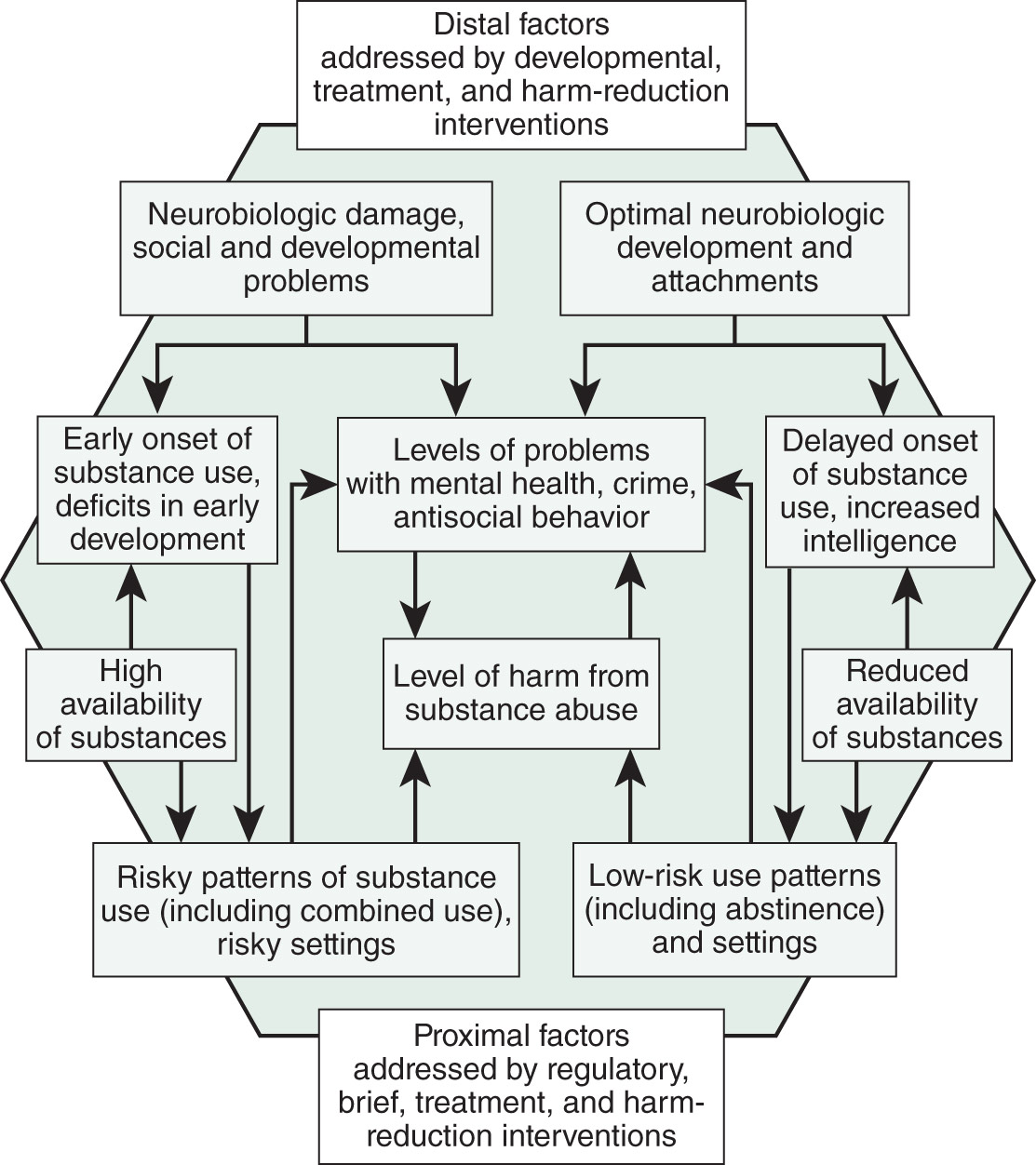
- •Substance use disorder has multifactorial origins (Fig. E1).
- •DSM-5-TR lists substance/medication-induced as one of the 10 major etiologies of mild or major NCDs.
- •Direct alcohol neurotoxicity and nutritional deficiencies (i.e., thiamine deficit or malabsorption) are implicated in ARD.
- •Confounding factors include neurodegeneration, vascular (i.e., hypertension), psychiatric, substance comorbidities, and head trauma.
- •Medications with anticholinergic activity can cause SMNCD. Opioids (meperidine, codeine), first-generation antihistamines (diphenhydramine, hydroxyzine), antispasmodics, antinausea medications, histamine (H2)-receptor blockers (ranitidine), psychoactive medicines (tricyclic antidepressants, lithium), sedative-hypnotics such as benzodiazepines and barbiturates, fluoroquinolone antibiotics, chemotherapeutic agents, cardiovascular drugs including digoxin and beta-blockers, and corticosteroids all have been associated with SMNCD.