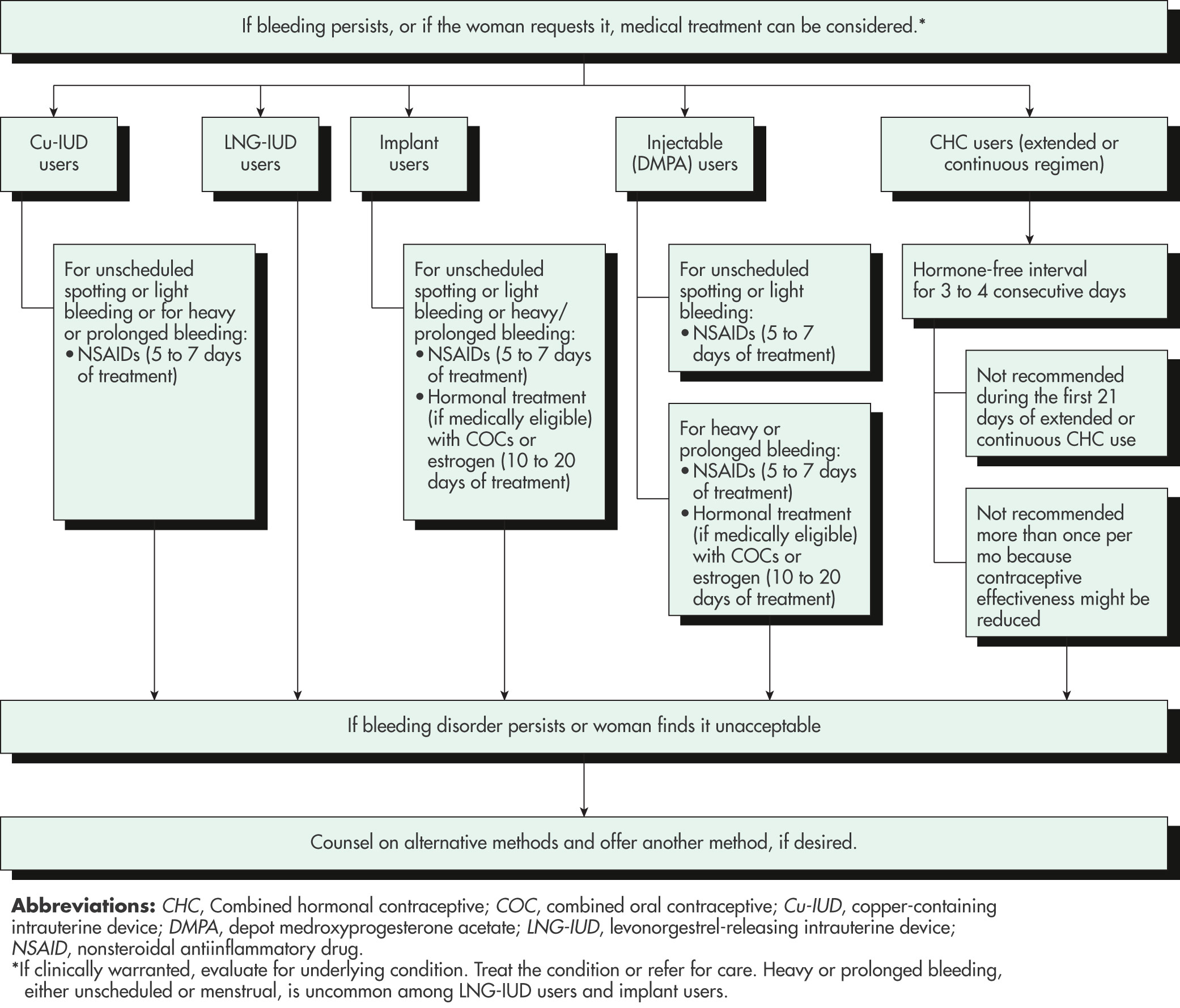
Acute General Rx
- •Combination oral contraceptives
- 1.Standard administration: Taken daily for 21 to 24 days, placebo or pill-free interval of 4 to 7 days
- 2.Alternative regimen: Extended or continuous administration of active pills
- 3.Less than 50 mcg ethinyl estradiol in most common combination oral contraceptives; progestins most commonly used in combination pills are norethindrone, levonorgestrel, norgestrel, norethindrone acetate, ethynodiol diacetate, norgestimate, or desogestrel
- 4.Triphasic combination oral contraceptives (give varying doses of progestin and estrogens throughout cycle), monophasic oral contraceptives (offer same dose of progestin and estrogen throughout cycle), estrophasic pill (constant progesterone with variation of estrogen throughout the cycle)
- 5.If pill taken with antibiotics, efficacy is affected by inadequate GI absorption in most cases; only rifampin truly reduces pill’s effectiveness
- 6.Increased body weight decreases effectiveness
- a.Table E6 describes oral contraceptive formulations available in the U.S. Guidelines for use of combination estrogen-progestin contraceptives in women 35 yr of age and older are described in Table E7.
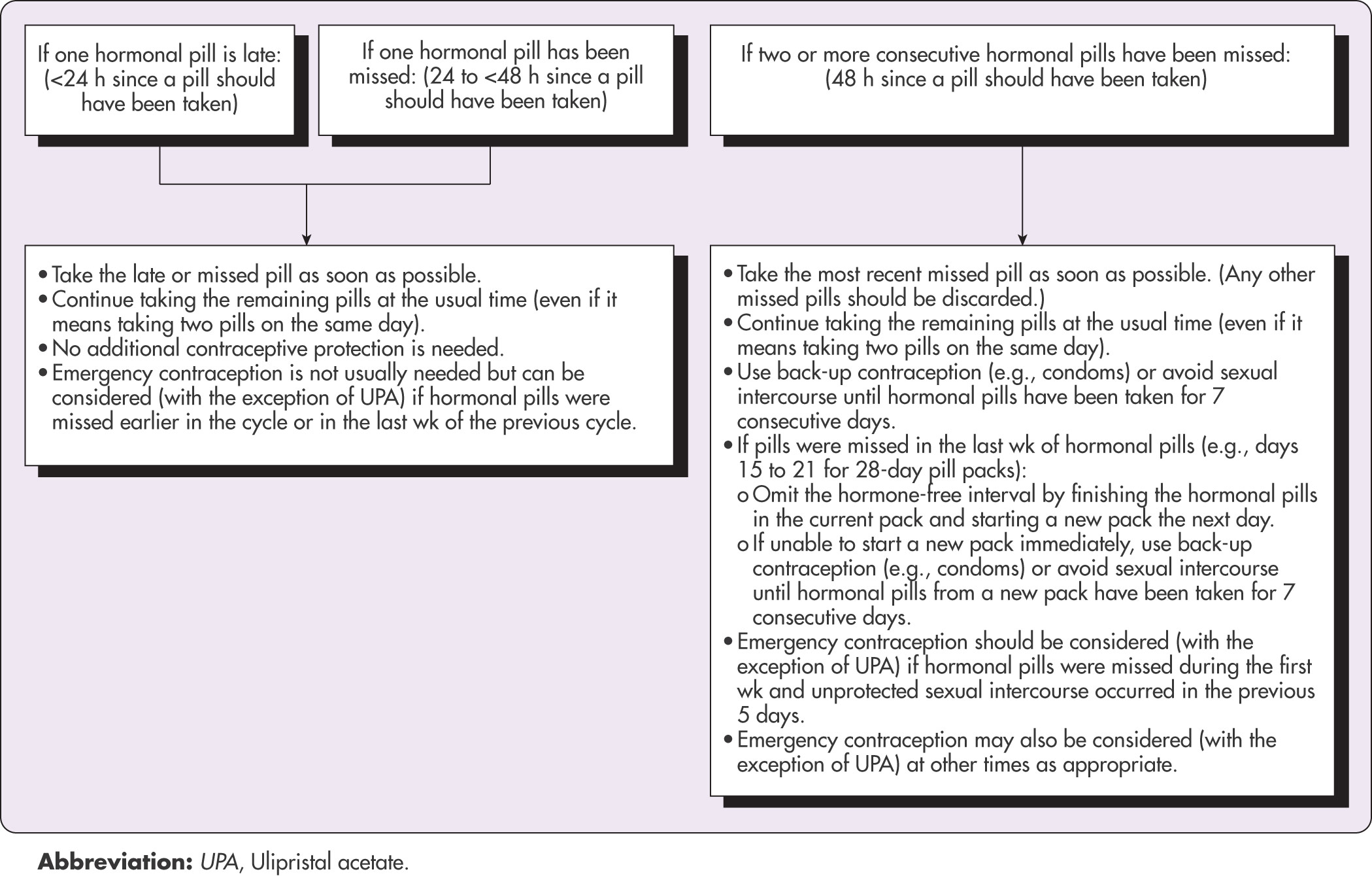
- b.Fig. E1 and Table E3 describes recommended actions after late or missed combined oral contraceptives.
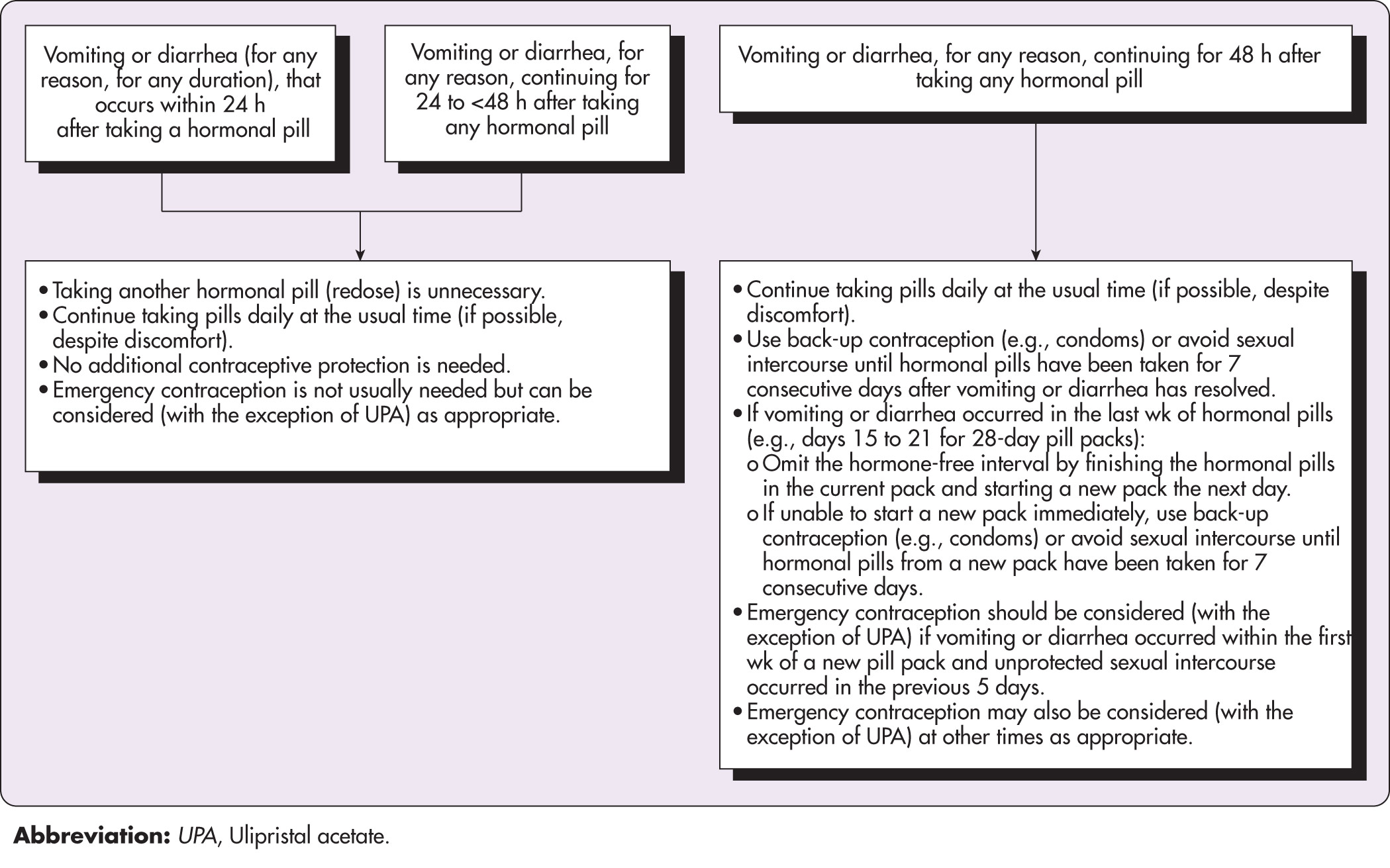
- c.Recommended actions after vomiting or diarrhea while using combined oral contraceptives are described in Fig. E2.
- d.Medical disorders with contraindicated contraceptive options are described in Table E8.
- e.Table E9 summarizes absolute and relative contraindications to combined hormonal contraceptives.
- •Mini pill
- 1.Progestin only; no placebo pills or pill-free intervals
- 2.May cause irregular bleeding because of the lack of estrogen effect on the lining of the uterus
- 3.Table E10 provides a summary and recommendations for progestin-only oral contraceptive use
- •Hormonal implants and injectables
- 1.Nexplanon
- a.Single etonogestrel-secreting device that is inserted underneath the skin
- b.The most effective contraceptive available
- c.Approved by FDA in 2006 and effective over 3-yr period
- 2.Depo-Provera
- a.Medroxyprogesterone acetate given every 3 mo in IM injection form
- b.Major side effect: Irregular bleeding; can also affect bone density
- c.Fertility return possibly delayed up to 1 yr or longer after last injection
- d.Table E11 provides a summary and recommendations for depot medroxyprogesterone acetate (DMPA) use
- •Emergency contraception (EC) (Table E12)
- 1.Done on emergency basis, if no contraceptive method used or failure of birth control (e.g., condom breakage or missed doses)
- 2.Methods:
- a.Hormonal methods:
- (1)Levonorgestrel is available either as two 0.75-mg tablets taken 12 h apart (next choice) or as a 1.5-mg tablet taken once (Plan B, one step). It is indicated for emergency contraception to be used within 72 h after unexpected intercourse. It can be obtained OTC by women >15 yr of age and by prescription by younger patients. May be less effective in overweight and obese women.
- (2)Ulipristal (Ella) is a progesterone-receptor agonist/antagonist available by prescription only. It is a 30-mg, single-dose tablet and can be taken up to 5 days after unexpected intercourse. More effective than Plan B. Requires a prescription.
- (3)Combined estrogen-progesterone pills (Yuzpe regimen): In general, involves a first dose of 4 to 6 tablets (to achieve a dose of 100 to 120 mcg of ethinyl estradiol and 0.5 to 0.6 mg of levonorgestrel), followed by a second dose of 4 to 6 tablets 12 h later. Less effective option.
- b.Nonhormonal method: Copper IUD inserted within 5 days of coitus. Requires an office visit and insertion by trained provider.
- •IUD
- 1.Device inserted into uterus to prevent sperm and ovum from uniting in fallopian tube, thickens cervical mucous
- 2.Types available in the U.S. (Table E13):
- a.ParaGard (Copper T/380-A): A polyethylene T wrapped with a fine copper wire effective for 10 yr
- b.Mirena LNG IUD: A T-shaped system with a chamber that contains levonorgestrel. Releases 20 mcg/day. Recently approved for 8 yr
- c.Liletta LNG IUD: Lower cost. Releases 18.6 mcg/day. Recently approved for 8 yr
- d.Kyleena LNG IUD: Releases 9.8 mcg/day. Approved for 5 yr
- e.Skyla LNG IUD: Slightly smaller device and lowest dose of levonorgestrel (may cause more irregular bleeding). Releases 8 mcg/day. Approved for 3 yr
- •Vaginal ring
- 1.Types available in the U.S.:
- a.NuvaRing
- (1)Provides daily dose of 120 mcg of etonogestrel and 15 mcg ethinyl estradiol
- (2)Stays in vagina 3 wk and is removed the fourth for a contraceptive-free interval analogous to the placebo pills in combined oral contraceptive pills
- (3)1 ring used per menstrual cycle
- (4)Increased body weight decreases effectiveness/combination oral contraceptive, but may have higher risk of DVT
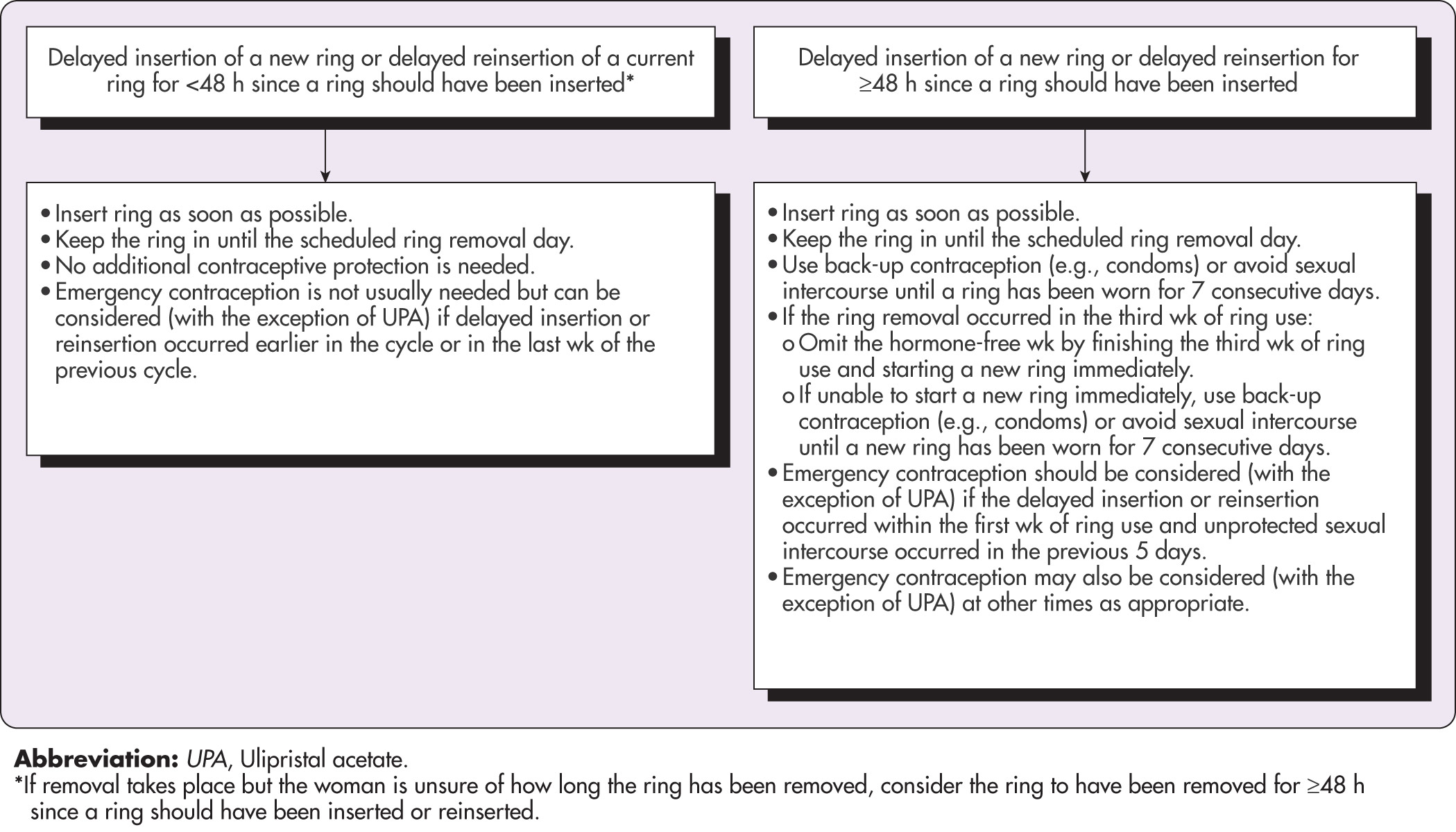
- 2.Recommended actions after delayed insertion or reinsertion with combined vaginal ring are described in Fig. E3
- a.Annovera
- (1)Provides daily dose of 150 mcg segesterone acetate and 13 mcg ethinyl estradiol
- (2)Stays in vagina 3 wk (21 days) and is removed the fourth for a contraceptive-free interval analogous to the placebo pills in combined oral contraceptive pills
- (3)1 ring used for 13 menstrual cycles; on average, 1 yr per user
- b.Increased body weight decreases effectiveness/combination oral contraceptive, but may have higher risk of DVT
- •Contraceptive patch
- 1.Each patch contains 6 mg norelgestromin and delivers an estimated continuous systemic dose of 150 mcg norelgestromin and 15 mcg of ethinyl estradiol daily
- 2.Worn 3 out of 4 wk
- 3.Increased body weight (specifically, weight >90 kg) associated with decreased effectiveness
- 4.Concern for increased risk of thromboembolic events
- 5.Ortho Evra brand discontinued; Xulane (generic) available in the U.S.
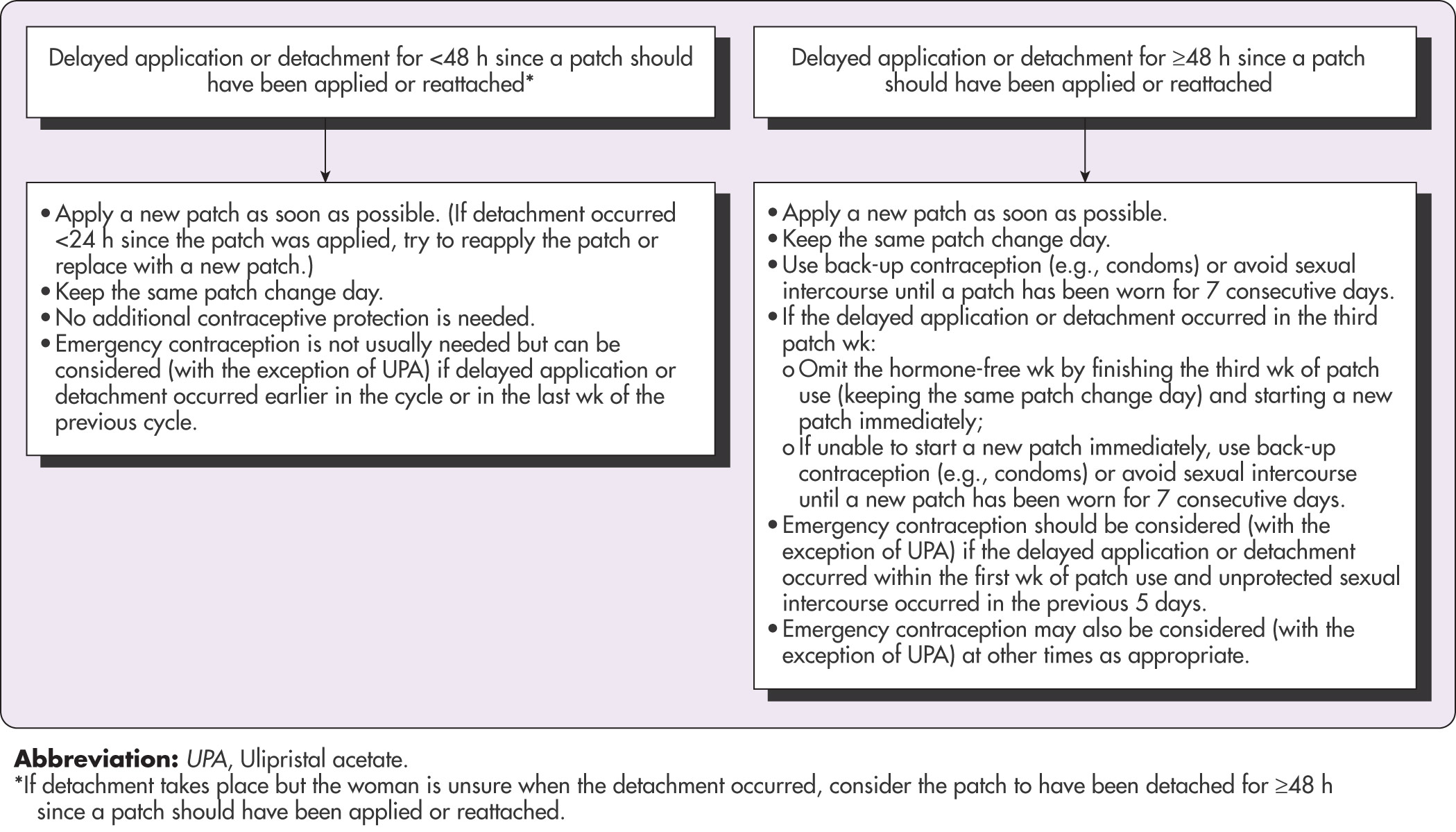
- 6.Recommended actions after delayed application or detachment with combined hormonal patch are described in Fig. E4
TABLE E6 Oral Contraceptive Formulations Available in the U.S.
| Name | Estrogen | Progestin | Progestin Dose (mg) |
| EE, 50 μg monophasic | Ovcon 50a | EE | Norethindrone | 1.0 |
| Ortho-Novum 1/50a | Mestranol | Norethindrone | 1.0 |
| Norinyl 1 + 50a | Mestranol | Norethindrone | 1.0 |
| EE, 35 μg monophasic | Femcon Feb | EE | Norethindrone | 0.4 |
| Modicona | EE | Norethindrone | 0.5 |
| Brevicona | EE | Norethindrone | 0.5 |
| Ovcon 35a | EE | Norethindrone | 0.4 |
| Ortho-Cyclena | EE | Norgestimate | 0.25 |
| Demulen 1/35a | EE | Ethynodiol diacetate | 1.0 |
| Ortho-Novum 1/35a | EE | Norethindrone | 1.0 |
| Norinyl 1 + 35a | EE | Norethindrone | 1.0 |
| EE, 35 μg biphasic | Ortho-Novum 10/11a | EE | Norethindrone | 0.5/1.0 |
| EE, 35 μg triphasic | Ortho-Novum 7/7/7i | EE | Norethindrone | 0.5/0.75/1.0 |
| Ortho Tri-Cyclena,c | EE | Norgestimate | 0.18/0.215/0.25 |
| Tri-Norinyla | EE | Norethindrone | 0.5/1.0/0.5 |
| Estrostepa,c | EE (20/30/35) | Norethindrone acetate | 1.0 |
| EE, 30 μg monophasic | Loestrin 1.5/30a | EE | Norethindrone acetate | 1.5 |
| Ortho-Cepta | EE | Desogestrel | 0.15 |
| Desogena | EE | Desogestrel | 0.15 |
| Lo-Ovrala | EE | Norgestrel | 0.3 |
| Nordettea | EE | Levonorgestrel | 0.15 |
| Levlena | EE | Levonorgestrel | 0.15 |
| Yasmina | EE | Drospirenone | 3.0 |
| EE, 30 μg triphasic | Triphasila | EE (30/40/30) | Levonorgestrel | 0.05/0.075/0.125 |
| Tri-Levlena | EE (30/40/30) | Levonorgestrel | 0.05/0.075/0.125 |
| Extended cycle (84 active tablets) | Seasonalea | EE | Levonorgestrel | 0.150 |
| Extended cycle (84 estrogen/progestin tablets, 7 tablets 10 μg EE) | Seasonique | EE | Levonorgestrel | 0.150 |
| EE, 25 μg | Cyclessaa | EE | Desogestrel | 0.10/0.125/0.150 |
| Ortho Tri-Cyclen Lo | EE | Norgestimate | 0.18/0.215/0.25 |
| EE, 20 μg monophasic | Loestrin 1/20a | EE | Norethindrone acetate | 1.0 |
| Levlitea | EE | Levonorgestrel | 0.1 |
| Alessea | EE | Levonorgestrel | 0.1 |
| 21 Hormonally active tablets (2 inert tablets, 5 tablets 10 μg EE) | Mircettea | EE | Desogestrel | 0.15 |
| 24 Hormonally active tablets | Yaz | EE | Drospirenone | 3.0 |
| Loestrin 24Fe | EE | Norethindrone acetate | 1.0 |
| Extended cycle (84 estrogen/progestin tablets, 7 tablets 10 μg EE) | LoSeasonique | EE | Levonorgestrel | 0.1 |
| 28 Hormonally active tablets | Lybrel | EE | Levonorgestrel | 0.09 |
| Progestin-only | Micronora | | Norethindrone | 0.35 |
EE, Ethinyl estradiol.
From Melmed S et al: Williams textbook of endocrinology, ed 15, Philadelphia, 2025, Elsevier.
TABLE E7 World Health Organization (WHO) and American College of Obstetrics and Gynecology (ACOG) Guidelines Regarding Use of Combination Estrogen-Progestin Contraceptives (Oral Contraception, Ring, and Patch) in Women 35 Yr of Age and Older
| Variable | ACOG Guidelines | WHO Guidelines |
| Obesity | Progestin-only or intrauterine contraceptiona may be safer | Benefit usually outweighs risksb |
| Smoker | Progestin-only or intrauterine contraceptiona should be used | Risk unacceptable |
| Hypertension | Progestin-only or intrauterine contraceptiona should be used | Risk unacceptable |
| Diabetes | Progestin-only or intrauterine contraceptiona should be used | Risk unacceptable |
| Migraine | Progestin-only or intrauterine contraceptiona should be used | Risk unacceptable |
| None of the above risk factors | Healthy, nonsmoking women doing well on a combination contraceptive can continue their method until age 50-55 yr after weighing the risks and benefits. | For women ≥40 yr of age, the risk of cardiovascular disease increases with age and also may increase with use of combined hormonal contraceptives. In the absence of other adverse clinical conditions, combined hormonal contraceptives may be used until menopause. |
From Melmed S et al: Williams textbook of endocrinology, ed 15, Philadelphia, 2025, Elsevier.
TABLE E3 Conditions Classified as Category 3 and 4 for Combined Hormonal Contraceptive Use
| Category 4 (a condition that represents an unacceptable health risk if the contraceptive method is used) |
| Complicated valvular heart disease |
| Current breast cancer |
| Severe decompensated cirrhosis |
| Deep venous thrombosis/pulmonary embolism (acute; history, not on anticoagulation or on established therapy for at least 3 mo with higher risk recurrence; major surgery with prolonged immobilization) |
| Complicated diabetes with nephropathy, retinopathy, neuropathy, or other vascular disease or duration of diabetes >20 yr |
| Migraine with aura |
| Poorly controlled hypertension (blood pressure >160/100 mm Hg) or hypertension with vascular disease |
| Ischemic heart disease (history of or current) |
| Hepatocellular adenoma |
| Malignant liver tumor |
| Peripartum cardiomyopathy (diagnosed <6 mo before or with moderately or severely impaired cardiac function) |
| Postpartum <21 days |
| History of cerebrovascular accident |
| Systemic lupus erythematosus with positive antiphospholipid antibodies |
| Thrombogenic pathogenic variants |
| Viral hepatitis (acute or flare) |
| Category 3 (a condition for which the theoretical or proven risks usually outweigh the advantages of using the method) |
| Past breast cancer with no evidence of disease for 5 yr |
| Breastfeeding and <1 mo postpartum |
| Deep venous thrombosis/pulmonary embolism (history of DVT/PE with lower risk recurrence) |
| Gallbladder disease (current, medically treated) |
| History of malabsorptive bariatric surgery |
| History of cholestasis and past combined oral contraceptive-related |
| Hypertension (adequately controlled or blood pressure <160/100 mm Hg) |
| Peripartum cardiomyopathy with mild impairment or >6 mo |
| Postpartum 21-42 days with other risk factors for venous thromboembolism |
| Drug interactions (ritonavir-boosted protease inhibitors; certain anticonvulsants; rifampin or rifabutin) |
| First-degree family member with a history of a blood clot/clotting disorder/thromboembolic event |
From Curtis KM et al: U.S. medical eligibility criteria for contraceptive use, 2016, MMWR Recomm Rep 65(RR-3):1-104, 2016.
Figure E1 Recommended actions after late or missed combined oral contraceptives.

(From Curtis KM et al: U.S. selected practice recommendations for contraceptive use, 2016, MMWR Recomm Rep 65[4]:1-66, 2016.)
Figure E2 Recommended Actions after Delayed Application or Detachment with Combined Hormonal Patch
(From Curtis KM et al: U.S. selected practice recommendations for contraceptive use, 2016, MMWR Recomm Rep 65[4]:1-66, 2016.)
TABLE E8 Medical Disorders With Contraindicated Contraceptive Options
| Medical Disorder | Contraindicated Contraception | Rationale/Complication |
| Systemic lupus erythematosus with antiphospholipid antibodies or thrombosis | Estrogen-containing contraceptiona (ECC) | Increased venous thrombosis (VTE) risk |
| Crohn disease | Any oral contraception | Decreased absorption |
| ECCb | Increased VTE risk |
| Severe dyslipidemia | ECC | Increased VTE risk |
| Hypertension with risk factorsc | ECC | Increased VTE, stroke, and myocardial infarction risk |
| Renal transplant | ECC | Increased VTE risk |
| | Increased metabolism |
| Thrombophilias | ECC | Increased VTE risk |
| Diabetes with risk factorsd | ECC | Increased VTE risk |
| Malabsorptive bariatric surgery | Any oral contraception | Decreased absorption |
| Migraine with aura | ECC | Increased VTE |
| Epilepsy on enzyme-inducing antiepileptic drugs | - Progesterone-only oral contraception
- Progesterone implant
| Increased metabolism |
Modified from Centers for Disease Control and Prevention: U S. medical eligibility criteria for contraceptive use, 2010, MMWR Recomm Rep 59 (RR-4):1-86, 2010.
TABLE E9 Absolute and Relative Contraindications to Combined Hormonal Contraceptives
| Absolute Contraindications (Category 4) | Relative Contraindications (Category 3) |
| Smoker age >35 yr and >15 cigarettes/day | Smoker age >35 yr and <15 cigarettes/day |
- Hypertension:>160 systolic or >100 diastolic
| - Hypertension: Controlled or 140-159 systolic or 90-99 diastolic
|
- Cardiac: Ischemic heart disease, complicated valvular heart disease, atrial fibrillation, peripartum cardiomyopathy <6 mo
| - Cardiac: Multiple risk factors for arterial cardiovascular disease, peripartum cardiomyopathy >6 mo with no/mild impaired function
|
- Vascular: Vascular disease, venous thromboembolic (VTE) disease: Acute or high recurrence risk (e.g., thrombophilia), systemic lupus with antiphospholipid antibodies, complicated solid organ transplant
| - Vascular: VTE on treatment or past history and low recurrence risk, diabetes with end-organ damage (nephropathy, retinopathy, neuropathy)
|
- Neurologic: Migraines with focal neurologic symptoms, stroke history
| - Neurologic: Migraine without neurologic symptoms and age >35 yr
|
- Breast: Current cancer, postpartum <4 wk + breast-feeding (BF), postpartum <3 wk no BF
| - Breast: Cancer disease-free history >5 yr, postpartum 4-6 wk + BF + other VTE risks, postpartum 3-6 wk + no BF + other VTE risks
|
- Gastrointestinal (GI): Liver failure, hepatocellular adenoma, malignant hepatoma, severe cirrhosis
| - GI: Acute viral hepatitis (oral contraceptive pill [OCP] only), symptomatic gallbladder disease, history of combined hormonal contraceptive (CHC)-related cholestasis, malabsorptive bariatric procedures (OCP only)
|
- Immobilization (prolonged): Major surgery
| - Immobilization (prolonged): Multiple sclerosis
|
- Drug interactions: Certain anticonvulsants, rifampicin, rifabutin, certain antiretroviral therapies
|
Modified from Centers for Disease Control and Prevention: Classifications for combined hormonal contraceptives. Available at https://www.cdc.gov/reproductivehealth/contraception/mmwr/mec/appendixd.html. Accessed July 26, 2021.
TABLE E10 Summary and Recommendations for Progestin-Only Oral Contraceptive Use
- 1.Progestin-only contraception is an option for women in whom an estrogen-containing contraceptive is either contraindicated or causes additional health. Ovulation is not consistently suppressed; the main contraceptive actions of progestin-only oral contraception are effects on cervical mucus and the endometrium.
- 2.The typical user failure rate with progestin-only oral contraception is estimated to be >8%. Women choosing progestin-only oral contraception are often subfertile as a result of breastfeeding or older reproductive age, so the failure rate in these populations may be lower than that in more fertile populations.
- 3.It is essential that the pill be taken at the same time each day to maximize contraceptive efficacy.
- 4.Menstrual irregularities are common in users of progestin-only oral contraception and represent the most frequent cause for contraceptive discontinuation.
|
From Melmed S et al: Williams textbook of endocrinology, ed 15, Philadelphia, 2025, Elsevier.
TABLE E11 Summary and Recommendations for Depot Medroxyprogesterone Acetate (DMPA) Use
- 1.DMPA is an excellent method for women who desire a long-term, reversible contraceptive.
- 2.DMPA primarily acts by inhibiting follicular maturation and ovulation through inhibition of gonadotropin secretion. It also affects cervical mucus.
- 3.DMPA is available in two formulations: 150 mg/1 ml for IM injection and 104 mg/0.65 ml for SC injection.
- 4.The ideal time to initiate DMPA is within 5 days of the onset of menses to ensure absence of pregnancy. The dose is repeated every 3 mo, with a 2-wk grace period.
- 5.Although DMPA does not permanently affect endocrine function, return of fertility may be delayed.
- 6.Thorough, candid counseling about side effects is important. Women who are well informed when they choose this method of contraception are much more likely to become highly satisfied users with high continuation rates.
- 7.Menstrual changes occur in all women using DMPA and are the most frequent cause for discontinuation.
- 8.Because DMPA induces amenorrhea, it can be used for managing a variety of gynecologic and nongynecologic disorders such as menorrhagia, dysmenorrhea, and iron-deficiency anemia.
- 9.There is no high-quality evidence that use of DMPA increases the risk of developing cancer, cardiovascular disease, or sexually transmitted infection. DMPA use significantly reduces the risk of developing endometrial cancer.
- 10.There is an association between current DMPA use and decreased bone mineral density; losses in bone mineral density are temporary, reverse after discontinuation of DMPA, and have not been linked to postmenopausal osteoporosis or fractures.
|
IM, Intramuscular; SC, subcutaneous.
From Melmed S et al: Williams textbook of endocrinology, ed 15, Philadelphia, 2025, Elsevier.
TABLE E12 Possible Indications for Emergency Contraception
| SEXUAL ASSAULT |
| HIGH-RISK SEXUAL ACTIVITY |
| No contraception during intercourse |
| Intoxication (alcohol, drugs) |
| Coitus interruptus |
| CONTRACEPTION FAILURES |
| Condom breaking, spillage, leaks, intentional removal |
| Dislodgement and/or breaking of diaphragm, female condom, cervical cap |
| Expulsion of IUD |
| Spermicide failure to melt before coitus |
| DELAYED OR MISSED CONTRACEPTION |
| 2 consecutive missed days of combined oral contraceptive |
| 1 missed day of progestin-only oral contraceptives |
| >2-wk late injection of depot medroxyprogesterone |
| ≥2 days late start of vaginal ring or patch cycle |
| Incorrect timing of spermicide/gel before sexual activity |
| OTHER |
| Exposure to teratogens in the absence of contraception |
IUD, Intrauterine device.
From Kliegman, RM et al: Nelson textbook of pediatrics, ed 22, Philadelphia, 2025, Elsevier.
TABLE E13 Hormonal Intrauterine Devices
| Mirena | Kyleena | Liletta | Skyla |
| Duration of use | FDA approved 8 yr | FDA approved 5 yr | FDA approved 8 yr | FDA approved 3 yr |
| Daily hormone delivery over time | 20 mcg LNG/day → 9 mcg/day (52 mcg total) | 17.5 mcg LNG/day → 7.4 mcg/day (19.5 mcg total) | 19.5 mcg LNG/day → 9.8 mcg/day (52 mcg total) | 14 mcg LNG/day → 5 mcg/day (13.5 mcg total) |
| Device size | 32 mm × 32 mm | 28 mm × 30 mm | 32 mm × 32 mm | 28 mm × 30 mm |
| Diameter of insertion rod | 4.4 mm | 3.8 mm diameter | 4.4 mm diameter | 3.8 mm diameter |
FDA, Food and Drug Administration; LNG, levonorgestrel.
From Kliegman, RM et al: Nelson textbook of pediatrics, ed 22, Philadelphia, 2025, Elsevier.
Figure E3 Recommended Actions after Delayed Insertion or Reinsertion with Combined Vaginal Ring
(From Curtis KM et al: U.S. selected practice recommendations for contraceptive use, 2016, MMWR Recomm Rep 65[4]:1-66, 2016.)
Figure E4 Recommended Actions after Vomiting or Diarrhea While Using Combined Oral Contraceptives
(From Curtis KM et al: U.S. selected practice recommendations for contraceptive use, 2016, MMWR Recomm Rep 65(4):1-66, 2016.)