Author: Fred F. Ferri, MD


Severe and invasive diseases are caused by Candida infection. More than 15 different Candida spp. cause disease in humans, but at least 95% of invasive disease is caused by C. albicans, C. glabrata, C. tropicalis, C. parapsilosis, and C. krusei. These organisms cause serious disease referred to as invasive candidiasis. Invasive candidiasis embodies a variety of diseases caused by hematogenous spread of Candida to multiple viscera (e.g., kidney, brain, heart). These diseases include candidemia, disseminated candidiasis, meningitis, and endophthalmitis. Invasive candidiasis is a significant cause of morbidity and mortality for certain groups of patients. Further, invasive candidiasis is a very common fungus in patients with COVID-19. This coinfection can be associated with severe illness and death.
| ICD-10CM CODES | |||
| B37.89 | Other sites of candidiasis | ||
| B37.1 | Pulmonary candidiasis | ||
| B37.2 | Candidiasis of skin and nail | ||
| B37.5 | Candidal meningitis | ||
| B37.6 | Candidal endocarditis | ||
| B37.7 | Candidal sepsis | ||
| B37.9 | Candidiasis unspecified | ||
- •Invasive candidiasis is the most common fungal disease among hospitalized patients in the developed world. It is an important nosocomial infection. It affects over 250,000 people worldwide each year and causes more than 50,000 deaths.
- •In the U.S., Candida spp. cause 8% to 10% of nosocomial bloodstream infections (fourth most common bloodstream infection). C. albicans is the most common cause of candidemia, but other non-albicans spp. have been implicated in recent years. These include C. glabrata, C. parapsilosis, C. tropicalis, and C. krusei. Incidence rates of candidemia are between 2 and 14 cases per 100,000 persons.
- •Candida auris cases and transmission have seen a dramatic increase in the U.S. since it was first reported in 2016. The rise in echinocandin-resistant cases and evidence of transmission is significant because echinocandins are first-line therapy for invasive Candida infections, including C. auris.1
Prolonged hospitalization and intensive care unit (ICU) stay, use of broad-spectrum antibiotics, prolonged indwelling of catheters (especially central venous catheters), acute and chronic renal failure, surgery requiring general anesthesia, cancer (e.g., solid neoplasms), transplantation (bone marrow or solid organ), recent chemotherapy/radiation therapy, use of immunosuppressive drugs, parenteral alimentation, use of internal prosthetic devices, organ transplant, hemodialysis, mechanical, surgical procedures
- •History
- •Physical findings (general)
- •Specific diseases
- 1.Candidemia
- a.A positive blood culture is the gold standard for the diagnosis of candidemia. Obtain blood cultures in patients suspected to have candidemia. Candida spp. must be isolated from at least one blood culture. A positive culture for Candida should be investigated thoroughly because of the increased risk of morbidity and mortality. Attributable mortality to candidemia in adults is 15% to 20%.
- b.Most common manifestation of invasive candidiasis.
- c.Physical examination may include fever, macronodular skin lesions, septic shock, Candida endophthalmitis.
- 2.Disseminated candidiasis
- a.Seen in patients with neutropenia who have undergone cytotoxic chemotherapy for a hematologic malignancy
- b.Associated with multiple deep-organ infections or failure
- c.Blood culture positive
- d.Fever not responding to broad-spectrum antibiotics
- e.Physical examination: Discrete erythematous or palpable rash, sepsis/septic shock
- 3.Endophthalmitis
- a.Iatrogenic/accidental or traumatic fungal infection of the eye (exogenous) or hematogenous seeding of the eye (endogenous); C. albicans accounts for about 90% of cases of endogenous endophthalmitis.
- b.Starts as choroidal lesion, progresses to vitreitis and endophthalmitis and eventually blindness.
- c.Physical examination shows fever. An early funduscopic examination by an ophthalmologist should be performed in all patients with candidemia. Funduscopic examination may show large and off-white cotton ball-like lesions with indistinct borders. Patients usually present with decreased visual acuity and occasional pain.
- 4.Candida infection of the central nervous system
- a.Meningitis: Candida can spread hematogenously to the meninges during craniotomy or through ventriculoatrial/peritoneal shunts. Culture cerebrovascular fluid to establish diagnosis.
- b.Commonly found in long-term ICU patients.
- c.May manifest as meningitis, mycotic aneurysms, change in mental status.
- d.Physical examination reveals fever, neck rigidity, confusion, headache, and coma.
- 5.Candidal musculoskeletal infections
- a.Candida infects the skeletal system, especially the joints as a result of trauma, joint injections, and other surgical interventions, such as IV drug use (hematogenous seeding).
- b.Previously uncommon; now relatively common probably because of increased frequency of candidemia and disseminated candidiasis.
- c.Knee and vertebral column (especially lumbosacral vertebral disks and vertebral bodies, which can lead to vertebral osteomyelitis, with or without diskitis) are involved.
- d.Physical examination is usually unremarkable but may show tenderness over involved area, fever, erythema, bone deformity, weight loss, and sometimes a draining fistulous tract.
- 6.Candidal infections of the heart
- a.Usually found in patients with artificial heart valves, IV drug users, and patients with an indwelling central venous catheter
- b.May manifest as infective endocarditis, myocarditis, or pericarditis
- c.Physical examination reveals fever, hypotension, tachycardia, new or changing murmur, and signs and symptoms of heart failure
- 7.Hepatosplenic candidiasis (chronic systemic candidiasis)
- a.Seen in patients with hematologic malignancy and neutropenia; usually develops during recovery from a neutropenic state (normally after undergoing myeloablative chemotherapy).
- b.On examination, patients have low-grade fever, right upper quadrant pain, palpable/tender liver, splenomegaly, and rarely jaundice.
- c.MRI/ultrasound (US)/computed tomography (CT) may reveal multiple focal abnormalities in the liver, spleen, and kidneys.
- 8.Candida peritonitis
- a.Associated with GI surgery: Perforations, acute necrotizing pancreatitis, peritoneal dialysis. Pancreatic abscess, gangrenous cholecystitis, and common bile duct obstruction are other GI manifestations of Candida infection. C. albicans is the commonly isolated species in intraabdominal Candida infection.
- b.Clinical manifestations include fever, chills, abdominal pain; nausea, vomiting, constipation.
- c.Physical examination reveals abdominal distention, abdominal pain, absent bowel sounds.
- 9.Other forms of invasive candidiasis
- 1.Candidemia
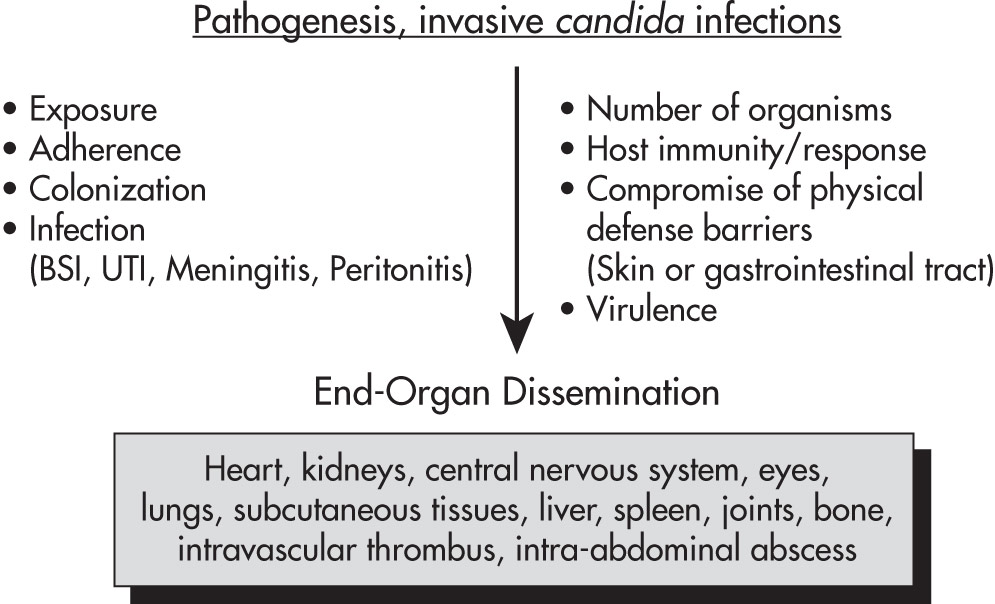
- •Fig. 1 illustrates the pathogenesis of invasive candidiasis.
- •Several species of Candida exist in nature.
- •Medically significant include:
- 1.C. albicans: Together with C. glabrata, they account for 70% to 80% of Candida in invasive candidiasis
- 2.C. glabrata: Together with C. albicans, they account for 70% to 80% of Candida in invasive candidiasis
- 3.C. parapsilosis: Associated with indwelling vascular catheters and prosthetic devices
- 4.C. tropicalis: Especially in leukemic patients
- 5.C. krusei: Resistant to fluconazole and ketoconazole