Glucocorticoid therapy can result in dramatic improvement in survival in carefully selected patients with severe alcohol-associated hepatitis. Three factors limit its usefulness: (1) a number of patients are not candidates for therapy because of obvious contraindications; (2) a significant number of patients fail to respond; and (3) glucocorticoids have limited efficacy in patients with chronic kidney disease or acute kidney injury and do not appear to prevent the development of hepatorenal syndrome. Therefore in patients who have contraindications to glucocorticoid therapy or any degree of renal disease, aggressive standard medical care with attention to factors such as nutrition, infection, and adequate perfusion should be pursued, and opportunities for clinical trials of LT should be considered. Table 1 lists the factors that should be taken into account in the approach to patients with suspected severe alcohol-associated hepatitis.1 An algorithm for the management of patients with suspected alcohol-associated hepatitis is described in Fig. 1.
TABLE 1 Factors to Consider in the Approach to the Patient With Suspected Severe Alcohol-Associated Hepatitis
| Initial Findings That Support a Diagnosis of Alcohol-Associated Hepatitis |
| Clinical presentation | Prolonged heavy alcohol intake, recent-onset jaundice, malaise, ascites, edema, pruritus, fever, confusion/lethargy/agitation, asterixis, tender hepatomegaly, splenomegaly, pedal edema |
| Laboratory features | Abrupt rise in serum total bilirubin (>3 mg/dl), AST > ALT (usually >2X ULN), GGTP >100 U/ml, albumin<3.0 g/L, INR >1.5, leukocyte count >12,000/mm3 |
| Exclusion of Other Causes of Jaundice |
| Autoimmune hepatitis | Exclude severe autoimmune hepatitis if first episode and/or clinical suspicion |
| DILI | |
| Ischemic hepatitis | Suspect if hypotension, septic shock, massive bleeding, or recent cocaine use |
| Mechanical obstruction | - Rule out HCC, biliary obstruction, Budd-Chiari syndrome
- Perform Doppler abdominal US and, if indicated, MRI
|
| Viral hepatitis | Rule out acute hepatitis A, B, C, or E, especially if first episode or high clinical suspicion |
| Treatment of Alcohol Abuse and Liver-Related Complications |
| Alcoholism | - Consult addiction specialist
- Moderate withdrawal symptoms: Baclofen
- Severe withdrawal symptoms: Benzodiazepines, phenobarbital
|
| Hepatic encephalopathy | - Assess for precipitant: GI bleed, infection, medication nonadherence
- Treat underlying precipitant, add lactulose, rifaximin, zinc
|
| Infection | - Rule out pneumonia, cellulitis, SBP, urinary tract infection, meningitis
- Obtain chest film
- Broad-spectrum antibiotics, if indicated
|
| Renal insufficiency | - Early detection and close monitoring
- Volume expansion with albumin
- Consider IV albumin plus a vasoconstrictor if progressive hepatorenal syndrome
|
ULN, Upper limit of normal.
Feldman M et al: Sleisenger and Fordtran’s gastrointestinal and liver disease, ed 11, Philadelphia, 2021, Elsevier.
Figure 1 Algorithm for the Management of a Patient with Suspected Alcohol-Associated Hepatitis

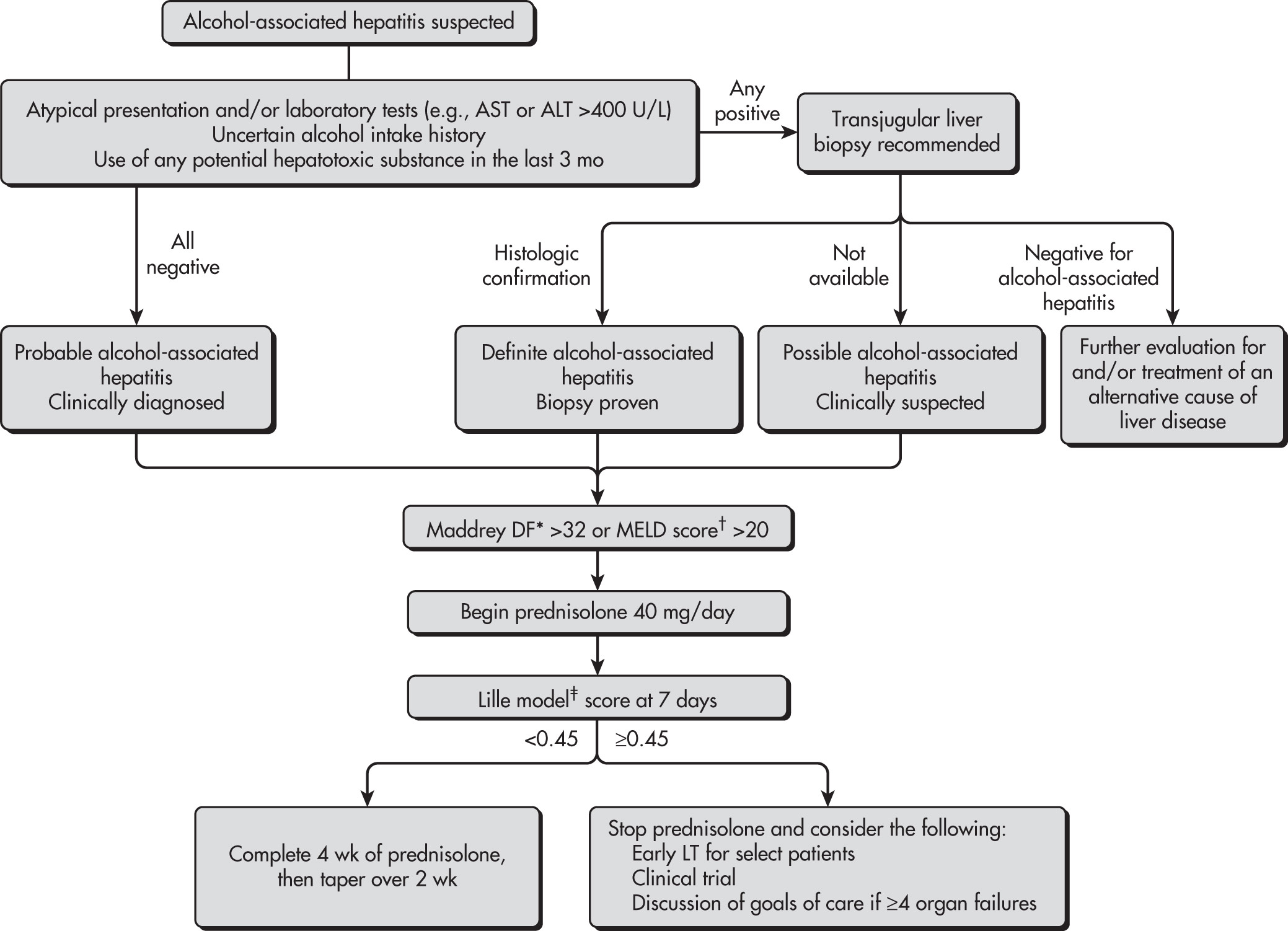
*The Maddrey discriminant function (DF) is calculated as follows: 4.6 (prothrombin time of patient – prothrombin time of control) + serum bilirubin level (in mg/dl). †The MELD score is based on the serum bilirubin level, international normalization ratio, and serum creatinine level. ‡The Lille model score is based on the patient’s age, serum albumin, serum bilirubin, serum creatinine, and prothrombin time. Online calculators for these various models are available at http://www.lillemodel.com.
(From Feldman M et al: Sleisenger and Fordtran’s gastrointestinal and liver disease, ed 11, Philadelphia, 2021, Elsevier.)
Treatment can be divided into three main components:
- 1.Determining the severity of the disease using Maddrey Discriminant Function (DF) and Model for End Stage Liver Disease (MELD)
- 2.Supportive care that includes lifestyle modifications and nutritional support
- 3.Pharmacologic therapy
Lifestyle Modifications
- •Abstinence, together with adequate nutritional support, is the cornerstone of management.
- •Abstinence from alcohol (this improves both short- and long-term survival).
- •Nonpharmacologic methods to promote abstinence include cognitive-behavioral therapy (CBT), Alcoholics Anonymous (AA) attendance, and motivational interviewing.
- •Pharmacologic aids include using naltrexone, acamprosate, or baclofen.
- •Monitor abstinence with breath test or urine drug screen (for use in past 3 days) or hair sample analysis for ethyl glucuronide (test alcohol intake within the last few months).
- •Smoking cessation (to decrease oxidative stress).
- •Treatment of substance abuse.
Nutritional Support
- •Good nutrition is an essential part of treatment because many patients with ALD have severe protein-calorie malnutrition as well as deficiencies of trace minerals and several vitamins.
- •Nutritional support includes:
- 1.Liberal vitamin supplementation (especially thiamine, folic acid, vitamin K)
- 2.Mineral supplementation (but not iron)
- 3.Calorie counting is essential. A high calorie intake (1.2 to 1.4 times the normal resting intake) may be required
- 4.Protein intake of 1.2 to 1.5 g/kg of ideal body weight per day will provide adequate support. Exception: In patients with severe encephalopathy, protein restriction may be required
- 5.Fluid management
Pharmacologic TherapySevere ALD may require treatment. Severity can be assessed by calculating the MELD score or MDF score or the Glasgow score.
- •An MDF score ≥32 indicates significant or severe ALD (30-day mortality of 50%).
- •MELD score can easily be calculated (visit https://optn.transplant.hrsa.gov/resources/allocation-calculators/meld-calculator/). This score predicts short-term survival in patients with cirrhosis. A score >20 predicts increased short-term mortality.
- •Glasgow score: Contains four variables (BUN, PT, WBC count, and bilirubin). A score ≥9 indicates increased mortality.
Indications for hospitalization include:
- •MDF ≥32
- •MELD >20
- •Glasgow score >8
- •Hepatic encephalopathy
Patients with severe ALD may be treated with glucocorticosteroids (prednisolone 40 mg/day for 28 days with a 2-wk taper). Glucocorticosteroids reduce hepatic injury, suppress inflammation, and promote liver regeneration. However, not all studies have demonstrated consistent therapeutic benefits for steroids, even in high-risk patients.4 Prednisolone should be discontinued if bilirubin does not decrease by day 17. An alternative agent for patients with contraindications to corticosteroids is pentoxifylline. Pentoxifylline is not effective in patients who do not respond to prednisone, and data supporting its use is weak.
Liver Transplantation
- •Liver transplantation could be considered for patients with MELD >26 and unresponsive to steroids.
- •Usually reserved for patients with end-stage liver disease. Patients whose hepatitis is not responding to medical therapy have a 6-mo survival rate of approximately 30%. Since most hepatitis deaths occur within 2 mo, early liver transplantation is attractive and associated with higher than 80% survival at 3 yr.
- •Patients with ALD must be sober for at least 6 mo before they can be eligible for consideration for liver transplantation. However, transplantation candidates should not be based solely on 6 mo abstinence, and other factors, such as social support and need for rehabilitation, should be considered.
ReferralSevere acute ALD may require intensive care unit (ICU) care and referral to different subspecialists:
- •GI/hepatology (for patients with evidence of GI hemorrhage)
- •Nutritional services
- •Nephrology (for acute renal failure, hepatorenal syndrome)
- •Neurology (for change in mental status, seizures)
- •Infectious disease (for fever/leukocytosis)
Prognosis
- •Three prospective studies demonstrated that patients with mDF values of 32 or greater have a poor prognosis, with 1-mo mortality rates of 35% to 50% (Table 2). As a result, the MDF has been incorporated into the selection criteria for most therapeutic trials of patients with alcohol-associated hepatitis. The prognosis of patients with MDF values greater than or equal to 32 can be further stratified by the presence of encephalopathy and development of acute kidney injury. Three other prognostic models, the MELD score, the Glasgow alcohol-associated hepatitis score, and the ABIC score, have been shown to predict survival in patients with severe alcohol-associated hepatitis (Tables 3-5). Although none is perfect, each of these models appears to be effective in selecting patients for medical therapy. The short-term survival of patients with MDF values less than 32 have ranged from 83% to 100% in various studies. To determine the prognosis of all patients with alcohol-associated hepatitis more accurately, a scoring system (ABIC) has been proposed that separates patients into three groups with predicted 3-mo survival rates of 25%, 70%, and 100% based on the patient’s age, bilirubin, INR, and creatinine, respectively1 (see Table 4).
TABLE 2 Correlation of the Maddrey Discriminant Function (DF)* With Prognosis in Alcohol-Associated Hepatitis
| Nonsevere Disease | Severe Disease |
| Score | <32 | ≥32 |
| Short-term mortality rate (%) | 10 | 30-60 |
| Glucocorticoid therapy indicated | No | Yes |
From Feldman M et al: Sleisenger and Fordtran’s gastrointestinal and liver disease, ed 11, Philadelphia, 2021, Elsevier.
TABLE 3 Correlation of the MELD Score* With 3-mo Mortality Rate in Alcohol-Associated Hepatitis
| Score | 3-Mo Mortality (%) |
| 22 | 10 |
| 29 | 30 |
| 33 | 50 |
| 38 | 80 |
From Feldman M et al: Sleisenger and Fordtran’s gastrointestinal and liver disease, ed 11, Philadelphia, 2021, Elsevier.
TABLE 4 Correlation of the ABIC Score* and the 90-Day Mortality Rate in Alcohol-Associated Hepatitis
| Severity | 90-Day Mortality (%) |
| Low (<6.71) | 0 |
| Intermediate (6.71-8.99) | 30 |
| High (≥9.0) | 75 |
From Feldman M et al: Sleisenger and Fordtran’s gastrointestinal and liver disease, ed 11, Philadelphia, 2021, Elsevier.
TABLE 5 The Glasgow Alcohol-Associated Hepatitis Score
| POINTS |
| Parameters | 1 | 2 | 3 |
| Age (yr) | <50 | ≥50 | – |
| WBC count (109/L) | <15 | ≥15 | – |
| Blood urea nitrogen (mmol/L) | <5 | ≥5 | – |
| Serum bilirubin level (μmol/L) | <125 | 125-250 | >250 |
| INR | <1.5 | 1.5-2.0 | >2.0 |
| The total score ranges from 5 to 12. A score ≥ 9 indicates a poor prognosis. |
INR, International normalization ratio; WBC, white blood cell.
From Feldman M et al: Sleisenger and Fordtran’s gastrointestinal and liver disease, ed 11, Philadelphia, 2021, Elsevier.


