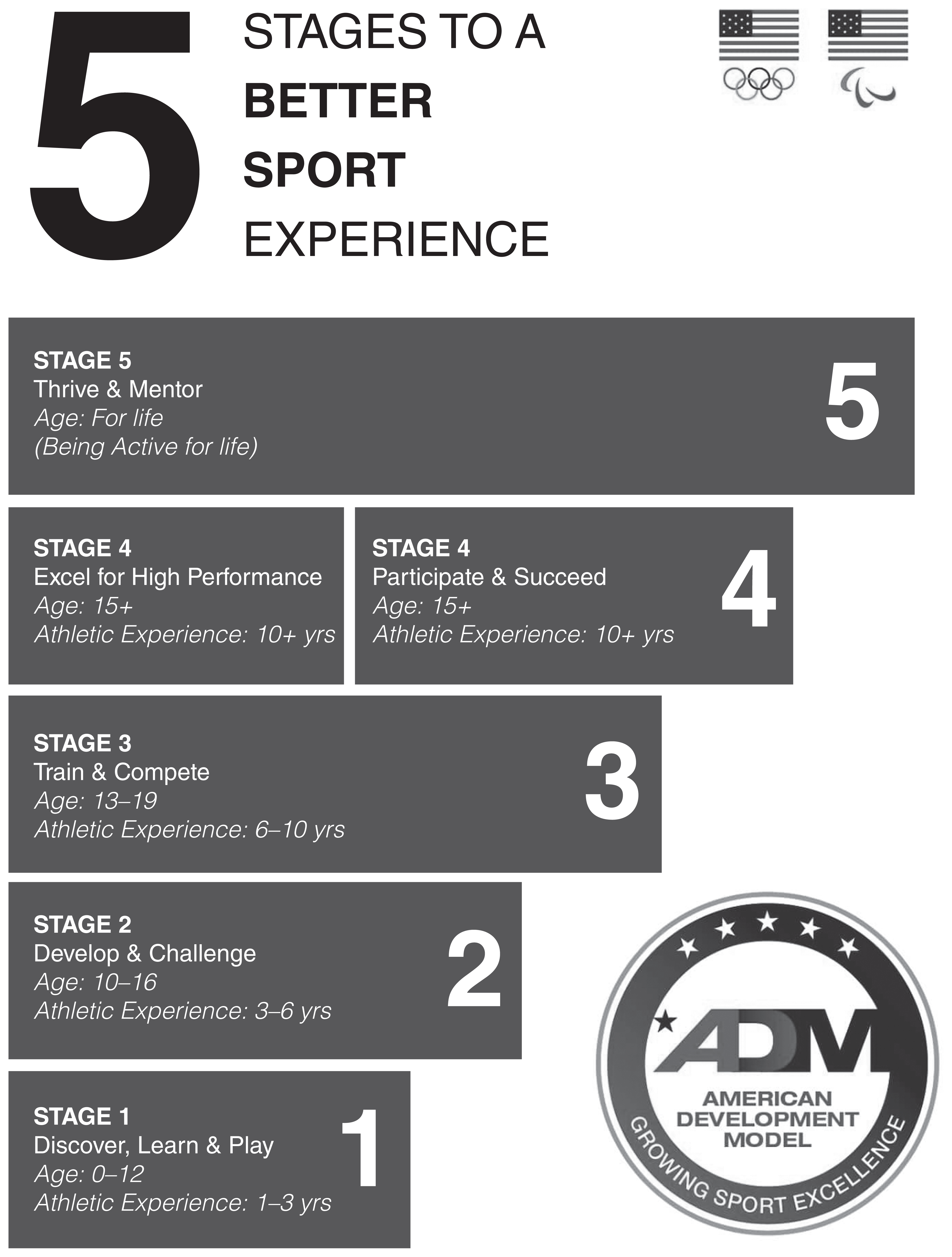
Many children, adolescents, and parents seek guidance on how to improve athletic performance and strength. While optimal nutrition is an important component of a healthy lifestyle, young athletes should focus on physical training and skill development to promote optimal sports performance. The United States Olympic Committee (USOC) created the 5-stage American Development Model to encourage healthy, age-appropriate sports performance for children and adolescents (Fig 12.1).16
Fig 12.1. United States Olympic Committee Developmental Model
Reproduced from United States Olympic & Paralympic Committee. The American Development Model (ADM). Available at https://www.usopc.org/ADM. © 2024 United States Olympic & Paralympic Committee. All rights reserved.
This model highlights having fun with unstructured play and learning basic sports movements, such as throwing, kicking, and balancing, for preschool and elementary school-age children. Sports training for middle school-aged children should still promote fun and socialization while adding skill development. The Olympic model emphasizes that training and competition can become the focus of training for adolescents. Some adolescents will choose to pursue a higher level of sport-specific training. The USOC stress that the goal of training is to encourage physical activity across the life span by teaching children how to make physical activity a part of their lifestyle.16
In the United States, less than one-quarter of high school students meet the recommended daily guidelines of at least 60 minutes of moderate to vigorous physical activity. Approximately half of high school students meet resistance training recommendations.17 While some children do participate in an adequate amount of physical activity, others overtrain and do not have adequate time away from sports. Overtraining can lead to burnout and overuse injuries.18
The American Academy of Pediatrics (AAP) recommends that children and adolescents who participate in sports have one to 2 days off per week and have at least 1 month free of organized sports activities 3 times per year.18
Sports specialization refers to committing to a single sport while ceasing participation in other sports with the goal of pursuing excellence in one's chosen activity. Early specialization, prior to mid-to-late adolescence, increases an athlete's chances of attrition, burnout, and injury.18 Athletes who specialize later may be more likely to achieve success as an elite competitor.18
AAP Recommendations for Intensive Training and Sports Specialization in Young Athletes
When a pediatrician encounters athletes younger than 18 years who are considering specialization or have already specialized, the following guidance for the athlete, parents, and coaches can be helpful.
The primary focus of sports for young athletes should be to have fun and learn lifelong physical activity skills.
Participating in multiple sports, at least until puberty, decreases the chances of injuries, stress, and burnout in young athletes.
For most sports, specializing in a sport later (ie, late adolescence) may lead to a higher chance of the young athlete accomplishing his or her athletic goals.
Early diversification and later specialization provides for a greater chance of lifetime sports involvement, lifetime physical fitness, and possibly elite participation.
If a young athlete has decided to specialize in a single sport, discussing his or her goals to determine whether they are appropriate and realistic is important. This discussion may involve helping the young athlete distinguish these goals from those of the parents and/or coaches.
It is important for parents to closely monitor the training and coaching environment of "elite" youth sports programs19 and be aware of best practices for their children's sports.
Having at least a total of 3 months off throughout the year, in increments of 1 month, from their particular sport of interest will allow for athletes' physical and psychological recovery. Young athletes can still remain active in other activities to meet physical activity guidelines during the time off.
Young athletes having at least 1 to 2 days off per week from their particular sport of interest can decrease the chance for injuries.
Closely monitoring young athletes who pursue intensive training for physical and psychological growth and maturation as well as nutritional status is an important parameter for health and well-being.
To promote achievement in sports and to reduce the risk of injury, athletes should participate in a variety of activity types including aerobic activity and resistance training.20 Young athletes also need to incorporate interval training with different levels of intensity. For example, a cross country runner might alternate practices with high volume and low intensity (eg, running at a moderate pace for 4 miles) with low volume, high intensity practices (eg, fast 200-m runs). Children and adolescents should increase the volume and intensity of their workouts gradually, to allow the body time to adapt. The intensity and volume of exercise will influence an individual's nutritional needs before, during, and after exercise.
Adequate recovery after exercise is also essential to decrease the risk of injury and burnout and to promote increased strength. Nutritional replenishment with foods and fluids is necessary to optimize metabolic and soft tissue adaptations from training.