Nutrigenetics is the study of the relationship between DNA sequence variants and nutrition. Aside from identical (monozygotic) twins, no two human beings have the exact same genomes. The human genome has 46 chromosomes that contribute more than 3 billion base pairs of DNA sequence. Each base pair has the potential to be different (polymorphic) between individuals. Genetic sequences determine cellular function and overall health of the individual and are transmitted from parent to child through genetic inheritance. Advances in sequencing technology, data curation, and bioinformatics approaches are allowing scientists to identify differences in the genetic sequences between individuals that regulate responses to nutrition.7 These gene × nutrient (gene-nutrient) interactions regulate how the body recognizes and uses nutrients. For this reason, individuals can exhibit completely different physiological responses to the same diet. Therefore, in making nutrition recommendations for optimal health of all human beings, we must understand the variations in individual gene-nutrient interactions and find effective ways to take into account these differences.
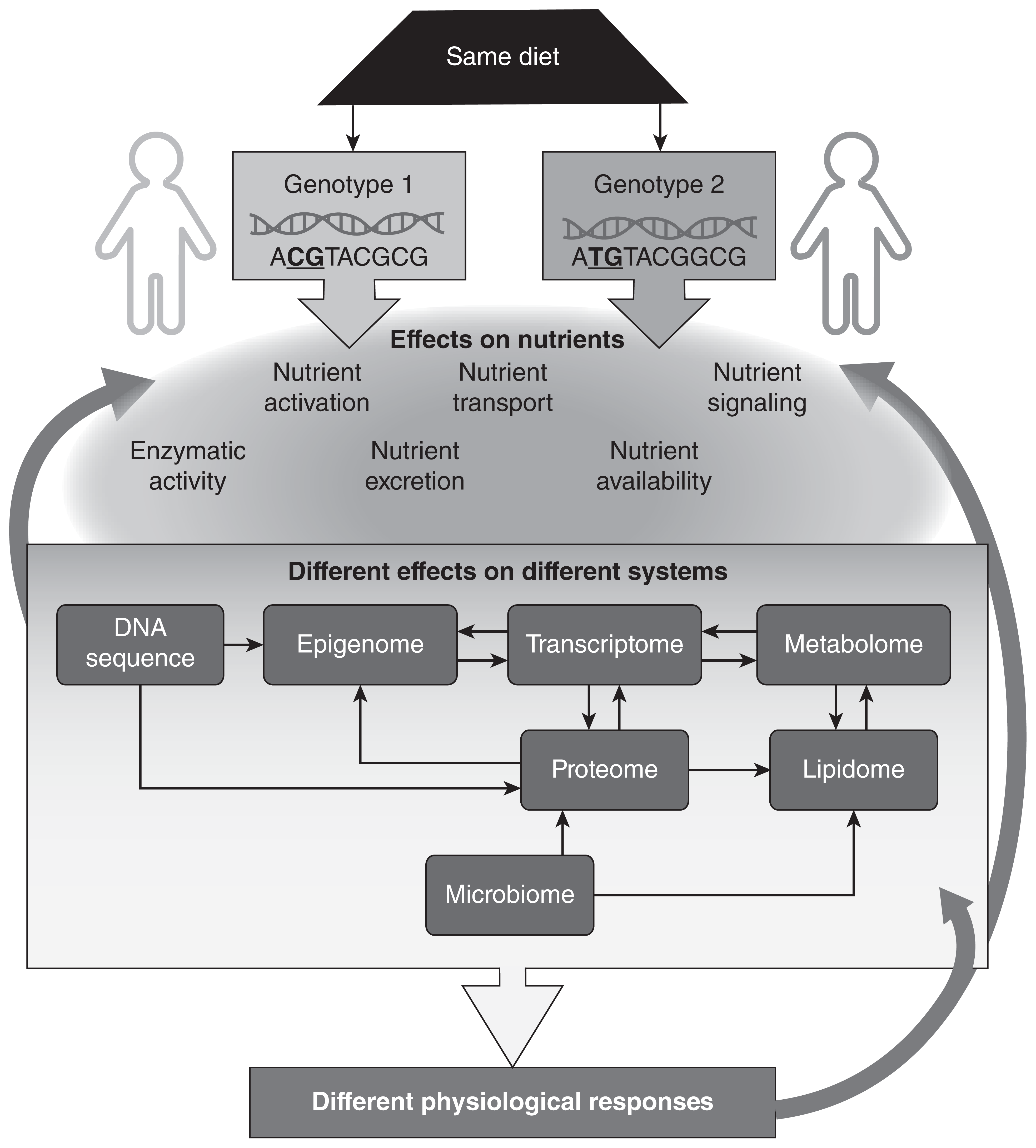
Gene-nutrient interactions occur via many different molecular pathways. They affect both macronutrient and micronutrient needs, and they usually require the collaborative role of multiple systems in the body as opposed to just being regulated by one system independently. Fig 1.2 provides an example of some of the complex ways in which gene-nutrient interactions affect health via different pathways in the body. There are many examples of how gene-nutrient interactions affect health.8 Following are a few well-described examples:
One of the most well-known gene-nutrient interactions is that which contributes to the disease phenylketonuria. Phenylketonuria is characterized by a defective phenylalanine hydroxylase enzyme that results in the accumulation of phenylalanine in the blood, which drastically increases the risk of neurologic damage. Galactosemia, a similar disease, is caused by a rare recessive trait in the galactose-1-phosphate uridyltransferase gene, which leads to the accumulation of galactose in the blood. In each of these disorders, a single-gene mutation results in the inability to metabolically process an essential nutrient. These inborn errors in metabolism can lead to severe and irreversible mental challenges, but when detected early, the effects of the diseases can be mitigated with dietary interventions-a low-phenylalanine (for phenylketonuria) or low-galactose diet (for galactosemia).
The regulation of folate metabolism by the 5,10-methylenetetrahydrofolate reductase (MTHFR) gene is another well-characterized gene-nutrient interaction. Individuals with deleterious mutations in the MTHFR gene that determines the MTHFR enzyme, cannot properly convert folate to nutrient metabolites that are required for many different cellular functions. This genetic difference leads to MTHFR enzyme variants that are associated with the development of blood clots, increased risk of pregnancy loss, and birth defects. Women who are homozygous for this polymorphism have low folate concentrations when not pregnant, which decrease even further if they become pregnant.9 Dietary intervention with supplementation of 5-methyltetrahydrofolate has been used as a way to bypass the effects caused by the defects in the MTHFR enzyme (particularly during pregnancy).
Intestinal fatty acid binding protein (IFABP) is exclusively expressed in the small intestine. IFABP is believed to bind and transport long-chain fatty acids in the cytoplasm of columnar absorptive epithelial cells of the small intestine.10 A polymorphism at codon 54 of the FABP2 gene (Ala54Thr), resulting in a change from alanine to threonine, has been associated with a heightened affinity to bind long-chain fatty acids with increased secretion into circulation. The Ala54Thr allele has been associated with impaired insulin action and increased fat oxidation in several populations. Healthy Pima Indian people homozygous for the AlaThr54 have higher plasma concentrations of nonesterified fatty acids and an increased insulin response after the consumption of a meal with high fat content.11 This finding suggests that the effects of FABP2 genetic polymorphisms on long-chain fatty acid transport may compromise health by altering the bioavailability of dietary components.
Fig 1.2. Illustration of How Genetic Sequence Differences Can Lead to Different Physiological Responses to the Same Diet Via Different Molecular Pathways
Most of the well-described gene-nutrient effects on health are single-gene (monogenic) effects. Single-gene variants, with large effect sizes, are easier to detect using traditional genetic mapping methods and also easier to manipulate in animal models to test causality. However, single-gene disorders tend to be relatively rare, with incidences of less than 1 in 1000 births. On the other hand, most common disorders (eg, obesity, coronary heart disease, diabetes, various cancers, autoimmune diseases) are polygenic-they require more powerful and strategically designed genome-wide methodologies to detect effects caused by multiple interacting genes. The high variability between populations in the associated or causal genetic variants emphasizes the fact that there is no such thing as a population standard with respect to nutrient requirements. Thus, dietary intake recommendations that take a one-size-fits-all approach are not just unhelpful but may, in some cases, be harmful. Furthermore, dietary recommendations must take into account the fact that some disorders or diseases caused by gene-nutrient interactions are not reversible and require early or preventive nutrition interventions. Dietary intervention to prevent the onset of such diseases is complex and will require knowledge of not only how a single nutrient may affect a biological system but also how a complex mixture of nutrients (ie, diet) will interact to affect biological functions.6,12