A. Epidemiology
1. Prevalence
In 2021, the prevalence of alcohol use in the United States was 47.5% among individuals >12 years of age, with roughly half of current drinkers reporting binge alcohol use and 12.3% reporting heavy alcohol use (NSDUH 2021). The prevalence of alcohol use disorder (AUD) was 12.1% (NSDUH 2021), a higher rate than pre-DSM-5 epidemiologic data that reported 8.5% of adults experienced a DSM-IV diagnosis of alcohol abuse (4.7%) or alcohol dependence (3.8%) in the preceding 12 months (Figure 17–1) using data from the National Epidemiological Survey of Alcohol and Related Conditions (NESARC). The lifetime prevalence for an AUD has consistently been reported as ~30% (Grant et al. 2015).
Figure 17–1. 12-month prevalence of alcohol use, binge use, heavy use, and alcohol use disorder compared to other substance use disorders in the general population, as per the NSDUH 2021.
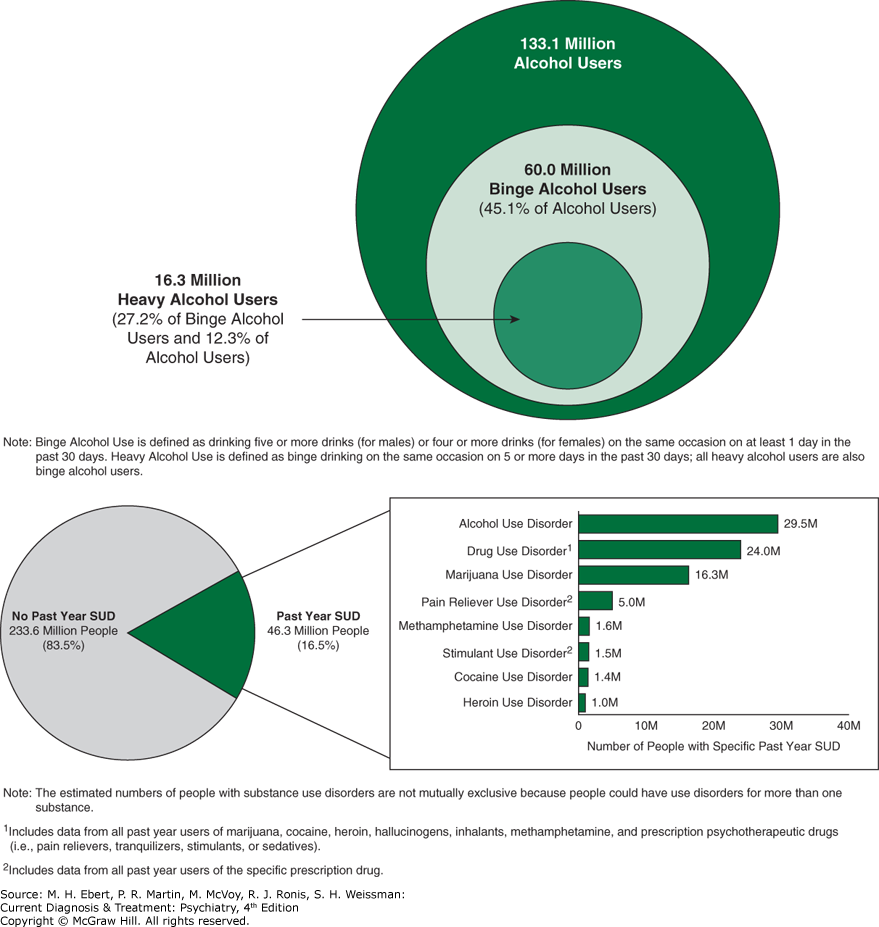 An infographic compares the 12-month prevalence of alcohol use, binge use, heavy use, and alcohol use disorder with other substance use disorders in 2021.
Alcohol-related deaths have increased steadily at a rate of 2.2% per year across preceding decades, with a more recent abrupt increase by 25.5% during the COVID-19 pandemic. This translates into >100,000 alcohol-related deaths in 2021, rising from ~79,000 in 2019 (CDC 2023; White et al. 2022). This follows an unprecedented increase in alcohol sales during the pandemic, likely associated with increased alcohol consumption by vulnerable individuals with preexisting comorbidity, as well as a marked increase in alcohol-related traffic deaths (Slater et al. 2022; Acuff et al. 2022; USDOT 2022).
2. Demographics
There has been a noteworthy decline in underage alcohol use from 28.8% of 12- to 20-year-olds in 2002 to 15.1% in 2021 (NSDUH 2021). However, the young adult population has consistently demonstrated the greatest AUD prevalence across epidemiologic studies, with 26.7% of 18- to 29-year-olds meeting DSM-5 AUD criteria in the 2012–13 NESARC-III cohort, compared to only 2.3% of those aged > 65 years (Grant et al. 2015).
Recent epidemiologic findings also suggest a closing “gender gap” between men and women with AUD, driven by increasing rates of young women (aged 12–20 years) with binge alcohol use now exceeding the rate of male peers (9.3% vs. 7.4%, respectively; NSDUH 2021). This increase is especially concerning given the risk for negative health and reproductive/perinatal outcomes for women at lower doses of alcohol compared to men, including hepatic, cardiovascular, and cancer-related disease (White 2020).
There are also variations in prevalence of alcohol use by race and ethnicity (Table 17–1). Native American populations have experienced elevated rates of AUD compared with the general population; Asian American populations experienced lower rates; and Black, Latinx, native Hawaiians, and Pacific Islander Americans have rates comparable to national averages (NSDUH 2016). However, even for populations with relatively similar rates of AUD, there are disparities in medical and psychiatric sequelae. For example, Black Americans experience higher mortality from AUD than White Americans despite similar prevalence, with socioeconomic factors and other social determinants of health possibly contributing to this disparity (Jackson et al. 2015).
Table 17–1 12-Month Prevalence of Alcohol Use Disorder Among Individuals Aged 12 Years or Older by Race–Ethnicity, as per NSDUH 2021
| Race–Ethnicity | Alcohol Use Disorder (Standard Error) |
|---|---|
General population | 10.6% (0.24) |
American Indian or Alaskan native | 15.6% (2.55) |
Native Hawaiian or other Pacific Islander | 14% (3.65) |
White | 11% (0.31) |
Hispanic or Latinx | 10.3% (0.57) |
Black or African American | 10.1% (0.61) |
Asian | 6% (0.75) |
Multiracial | 14.7% (1.87) |
Individuals immigrating to the United States generally have lower risk of any substance use disorder (SUD) than native-born Americans, though this risk increases to match the general population over 10 years of residence (Breslau et al. 2007). However, among disadvantaged immigrant populations (undocumented Mexican groups being most frequently studied), alcohol use is elevated compared to control populations in the home country. In one sample, 42.3% of Mexican migrants reported at-risk alcohol use (Zhang et al. 2015).
Cultural norms for low-risk alcohol use also differ internationally, leading to geographic differences in reported AUD prevalence despite standardized diagnostic criteria. Among European countries, estimated prevalence of AUD in 2010 ranged between <1% in Italy and Spain and >12% in Latvia—though per capita consumption only varied threefold. Further, reported use in countries with religious prohibition against alcohol consumption leads to markedly elevated per capita consumption rates, most likely representing underreporting of individual use (Rehm 2017).
3. Risk of psychiatric comorbidity
Results from NESARC showed that 1.1% of adults reported SUD and AUD combined, whereas 7.35% and 0.9% reported AUD alone and other substance use disorder alone, respectively. Yet individuals using a combination of drugs and alcohol had a much higher rate of treatment seeking than those using drugs or alcohol alone, which may indicate a need for more integrated alcohol and other substance treatment services. There is also a strong association between having an AUD and any psychiatric disorder (most commonly mood and anxiety disorders, but also posttraumatic stress disorder and attention deficit disorder). In addition, rates of personality disorders, most commonly antisocial personality disorder and borderline personality disorder, are higher among those with AUD (Castillo-Carniglia et al. 2019).
B. Etiology
1. Neurobiology
The neurobiological basis of AUD remains an ongoing area of research, which involves multiple neuronal pathway systems. Alcohol causes direct activation and excitation of neurons in the ventral tegmental area (VTA). It does this via direct release of dopamine in the mesolimbic pathway, which is associated with positive reinforcement and reward following alcohol consumption. Animal studies show that there is a dose-dependent release of dopamine in the nucleus accumbens following alcohol self-administration. However, dopamine denervation within the nucleus accumbens does not abolish alcohol consumption, indicating involvement of other pathways. Opioid mechanisms have also been implicated in the development of AUD. Alcohol ingestion causes release of endorphins from the nucleus accumbens. Direct inhibition of this action could explain the attenuating effect of naltrexone, an opioid antagonist, on alcohol consumption.
Other biochemical systems that have been studied are N-methyl-D-aspartate (NMDA), gamma-aminobutyric acid (GABA), serotonin, and endocannabinoids, as well as neuropeptide Y. Manipulation of these systems has been shown to have some degree of effect on alcohol-seeking behavior in animal models and possible AUD in humans. Acamprosate, another pharmacologic intervention for preventing AUD relapse, modulates NMDA-receptor transmission and may indirectly affect GABA-receptor transmission (Kalk et al. 2014).
2. Environmental
Multiple environmental risk factors are associated with the development of AUD.
i. Early age onset
Early age (adolescent) onset of drinking is associated with higher risk of development of AUD and its consequences later in life. Poor parental monitoring may contribute to early onset of drinking. There may also be a genetic vulnerability for early-onset drinking (Prescott & Kendler 1999).
ii. Availability
There is a higher prevalence of AUD in societies, cultures, and neighborhoods where alcohol is more readily available, related to social norms or fewer legal or zoning restrictions. In families where alcohol is readily available, children are more likely to model alcohol use behavior from their parents and are more likely to develop an AUD (Hawkins et al. 1992).
iii. Societal conflict, trauma, and economic deprivation
Lack of structure, housing, and basic needs has been associated with higher rates of crime, delinquency, and conduct/antisocial disorder. There is a higher rate of alcohol use among individuals within this population. Trauma history is also a risk factor.
iv. Peer pressure
There is a higher risk of development of AUD in children who associate with peers who drink.
3. Personality traits
i. Personality disorders
AUDs are more prevalent in individuals diagnosed with any personality disorders, most especially conduct/antisocial, histrionic, and dependent personality disorders.
ii. Impulsivity and risk-taking behavior
Impulsivity, as defined by acting in an unplanned manner without thinking through possible consequences of one’s actions, is associated with higher rates of aggression, anger outbursts, suicide, and addictive behavior. These individuals are more likely to try alcohol at an earlier age, have more frequent relapses, and suffer more alcohol-related consequences.
C. Genetics
Genetics heavily influence the risk of alcoholism in individuals. Heritability and family studies have shown that genetic factors account for about 40–60% of the risk of developing an AUD. Hundreds of genetic markers have been associated with AUD, though as with other substance use disorders AUD is polygenic and non-Mendelian with multiple contributing genetic alleles, each with relatively small effect size on the phenotype (Prom-Wormley et al. 2017). Polygenic risk scores bundling multiple at-risk genetic markers into a single construct have been associated with development of AUD in genome-wide association studies studies, though also with relatively small effect size.
Specific genotypes associated with risk and protection have been identified, the most noteworthy being polymorphisms of genes involved in alcohol metabolism. The genetic polymorphisms of the two liver enzymes alcohol dehydrogenase (ADH2) and the mitochondrial acetaldehyde dehydrogenase (ALDH2) system remain the most clearly understood. There are six different isoenzymes of ALDH, with ADLDH2 being found in the mitochondria. The ALDH2-1 allele produces the active form of the enzyme, whereas ALDH2-2 produces the inactive form. Individuals with a homozygous ALDH2-2 are unable to break down acetaldehyde and experience aversive reactions (facial flushing, nausea, and autonomic dysregulation) after consumption of small amounts of alcohol. As a result, they are less likely to drink or to drink heavily. This homozygous ALDH2-2 or its milder heterozygous allele is more common in some east Asian populations, which may account for a lower prevalence of AUD (Prom-Wormley et al. 2017). Regarding ADH, a homozygous ADH2 or a milder heterozygous form could possibly lead to higher conversion of alcohol to acetaldehyde, which would eventually lead to aversive responses to alcohol and thus protection against AUD.
AcuffSF, StricklandJC, TuckerJA,et al: Changes in alcohol use during COVID-19 and associations with contextual and individual difference variables: a systematic review and meta-analysis. Psychol Addict Behav2022 Feb;36(1):1-19. 34807630
BreslauJ, Aguilar-GaxiolaS, BorgesG,et al: Risk for psychiatric disorder among immigrants and their US-born descendants: evidence from the National Comorbidity Survey Replication. J Nerv Ment Dis2007;195(3):189-195.
Castillo-CarnigliaA, KeyesKM, HasinDS,et al: Psychiatric comorbidities in alcohol use disorder. Lancet Psychiatry2019;6(12):1068-1080. doi:10.1016/S2215-0366(19)30222-6
GrantBF, GoldsteinRB, SahaTD,et al: Epidemiology of DSM-5 alcohol use disorder. JAMA Psychiatry2015;72(8):757-766. doi:10.1001/jamapsychiatry.2015.0584
HawkinsJD, CatalanoRF, MillerJY: Risk and protective factors for alcohol and other drug problems in adolescence and early adulthood: implications for substance abuse prevention. Psychol Bull1992;112(1):64-105.
JacksonCL, HuFB, KawachiI,et al: Black-White differences in the relationship between alcohol drinking patterns and mortality among US men and women. Am J Public Health2015;105 Suppl 3(Suppl 3):S534-543. doi:10.2105/AJPH.2015.302615
KalkNJ, Lingford-HughesAR: The clinical pharmacology of acamprosate. Br J Clin Pharmacol February 2014;77(2):315-323. https://doi.org/10.1111/bcp.12070.
National Center for Statistics and Analysis, National Highway Traffic Safety Administration: Overview of motor vehicle crashes in 2020 [Internet]. Washington: U.S. Department of Transportation; 2020 Mar [cited 2022 June 20]. 43 pp. Available from: https://crashstats.nhtsa.dot.gov/Api/Public/ViewPublication/813266
PrescottCA, KendlerKS: Age at first drink and risk for alcoholism: a noncausal association. Alcohol Clin Exp Res. 1999;23(1):101-107.
Prom-Wormley,Elizabeth C, EbejerJ,et al: The genetic epidemiology of substance use disorder: a review. Drug Alcohol Depend November 1, 2017;180:241-259. https://doi.org/10.1016/j.drugalcdep.2017.06.040.
RehmJ, RoomR: The cultural aspect: how to measure and interpret epidemiological data on alcohol-use disorders across cultures. Nordic Stud Alcohol Drugs. 2017;34(4):330-341.
SAMHSA, Center for Behavioral Health Statistics and Quality: 2021National Survey on Drug Use and Health. Table 5.6A—Alcohol use disorder in past year: among people aged 12 or older; by age group and demographic characteristics, numbers in thousands, 2021. [cited 2023 Jan 11]. Available from: https://www.samhsa.gov/data/sites/default/files/reports/rpt39441/NSDUHDetailedTabs2021/NSDUHDetailedTabs2021/NSDUHDetTabsSect5pe2021.htm#tab5.6a
SlaterME, AlpertHF, Surveillance Report #119: Apparent per capita alcohol consumption: national, state, and regional trends, 1977–2020. Sterling (VA): NIAAA, Division of Epidemiology and Prevention Research; 2022 Apr. 66 p. Contract No.: HHSN275201800004C. https://pubs.niaaa.nih.gov/publications/surveillance119/CONS20.htm
U.S. Department of Health and Human Services, Centers for Disease Control and Prevention (CDC) [Internet]. National Center for Health Statistics Mortality Data on CDC WONDER. Multiple cause of death, 2018–2021. 2023. Available from: https://wonder.cdc.gov/controller/saved/D157/D324F825
WhiteA: Gender differences in the epidemiology of alcohol use and related harms in the United States. ARCR2020;40(2):01. doi:10.35946/arcr.v40.2.01
WhiteAM, CastleIP, PowellPA,et al: Alcohol-related deaths during the COVID-19 pandemic. JAMA2022 May 3;327(17):1704-1706. 35302593
ZhangX, Martinez-DonateAP, NoblesJ,et al: Substance use across different phases of the migration process: a survey of Mexican migrants flows. J Immigr Minor Health2015;17(6):1746-1757.