Knowledge of the sensory, motor, and autonomic distributions of spinal nerves will help the anesthetist determine the correct segmental level required for a particular operation and anticipate the potential physiologic effects of producing a sensory block to that level. Figure 20.1 illustrates the dermatomal distribution of the spinal nerves.
FIGURE 20.1 Skin dermatomes corresponding to respective sensory innervation by spinal nerves.
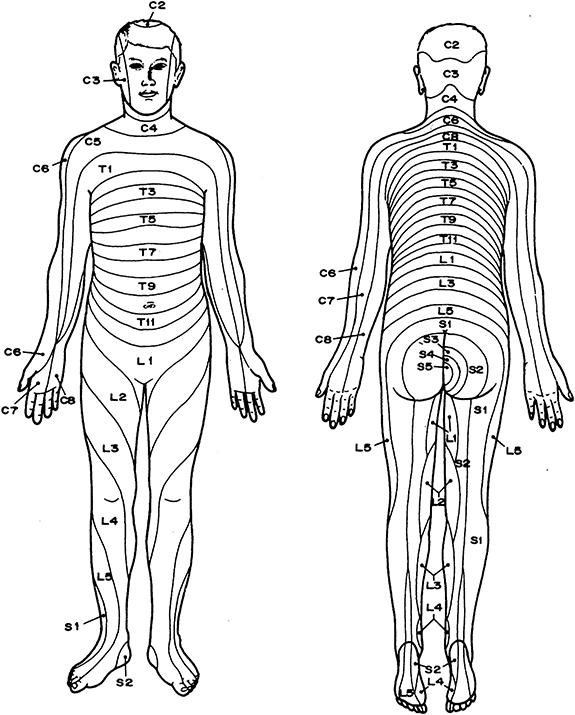
Diagram of dermatomes. Front and back views of a figure with areas of skin labeled with spinal nerve segments (C2-S5). Black and white illustration.
Afferent autonomic nerves innervate visceral sensation and viscerosomatic reflexes at spinal segmental levels much higher than would be predicted from skin dermatomes.
Minimal suggested levels for common surgical procedures are listed in Table 20.1.
TABLE 20.1 Suggested Minimum Cutaneous Levels for Spinal AnesthesiaOperative Site Level Lower extremities T12 Hip T10 Vagina, uterus T10 Bladder, prostate T10 Lower extremities with tourniquet T8 Testis, ovaries T8 Lower intra-abdominal T6 Other intra-abdominal T4