▶Acute febrile illness caused by measles virus, an RNA virus of the genus Morbillivirus in the Paramyxoviridae family.
▶Humans are the only natural host.
▶Transmitted by direct contact with infectious droplets or, less commonly, by airborne spread.
▶Immunization program in the United States, started in 1963, resulted in more than 99% decrease in reported incidence. Two vaccine doses are needed to ensure protection.
▶Noteworthy increase in measles cases occurred in the United States from 1989 to 1991 as a result of low immunization rates in preschool-aged children, especially in urban areas.
▶Indigenous cases became markedly less common until recently, when increasing numbers of cases began to be observed; 222 cases were reported to the Centers for Disease Control and Prevention in 2011, and 1,282 cases were reported in 2019. Case numbers decreased during the COVID-19 pandemic, likely related to decreased travel.
▶Because of several significant outbreaks, the first 9 months of 2019 saw the highest number of measles cases in the United States recorded since 1992. Most cases occurred in persons who were unvaccinated.
▶Vaccine failure occurs in up to 5% of children who receive a single dose of vaccine at 12 months or older.
▶Patients are contagious from 1 to 2 days before the onset of symptoms (3–5 days before the rash) and up to 4 days after the appearance of the rash.
▶Incubation period is 10 to 14 days from exposure to onset of symptoms.
▶Classically occurs in the winter and spring; sporadic cases can occur year-round.
▶Prodrome of high fever, cough, coryza, conjunctivitis, and enanthem precedes the exanthem by 2 to 4 days.
▶Characteristic enanthem: Koplik spots.
■Appear during the prodromal phase and fade 2 to 3 days after onset of exanthem.
■White or bluish gray punctate papules superimposed on an erythematous base, located on buccal mucosa, often adjacent to molars (Figure 17.1).
▶Exanthem begins behind the ears and at the scalp margin, rapidly spreading downward to involve most of the body (cephalocaudal spread).
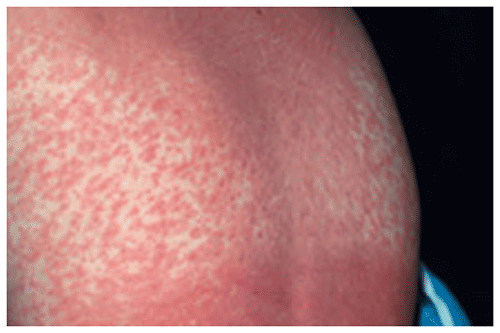
▶Discrete erythematous papules and macules appear and gradually become confluent (Figure 17.2).
▶Pruritus is uncommon.
▶Eruption lasts 4 to 7 days before fading, often with fine desquamation.
▶Generalized adenopathy and splenomegaly may occur with the exanthem.
▶Modified measles may occur in infants with residual maternal antibody or in individuals who were previously vaccinated.
■Less severe illness.
■Shortened prodrome.
■Exanthem less confluent.
■Koplik spots may be absent.
▶Atypical measles previously occurred in those who received killed measles vaccine (which has not been used for many years) and then were exposed to wild-type measles virus. It presents as a syndrome with high fever; abdominal pain; nodular pulmonary lesions; severe headache; and an acral (ie, distal extremities, hands, feet) eruption with vesicular, vesiculopustular, or purpuric lesions.
Figure 17.1. Koplik Spots (Arrows): Punctate Whitish Gray Papules on an Erythematous Base that Appear on the Buccal Mucosa.
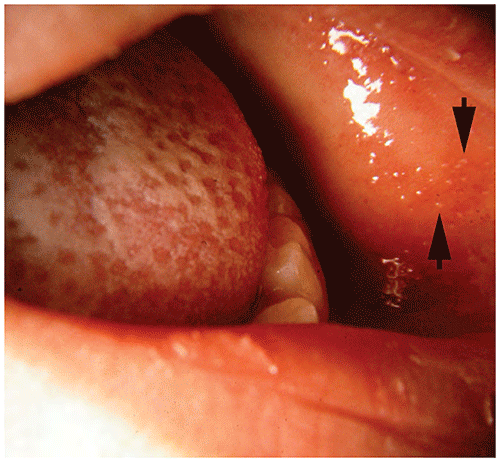
Figure 17.2. Measles Produces an Erythematous Macular and Papular Eruption.
Look-alikes
A number of viral exanthems may mimic the rash of measles; however, the typical symptoms of measles are lacking.
| Disorder | Differentiating Features |
|---|
| Exanthematous drug eruption | |
| Rubella | Patients generally well with slight fever, arthralgias, or arthritis. Posterior cervical, suboccipital, or postauricular lymphadenopathy common. Rash typically lighter in color.
|
| Roseola | Patients often appear well and lack typical symptoms of measles (ie, cough, conjunctivitis, and coryza). Characteristic history of high fever followed by abrupt defervescence (which coincides with onset of exanthem).
|
| Erythema infectiosum | |
| Infectious mononucleosis | |
| Kawasaki disease | Lymphadenopathy, fissuring of lips, and acral edema prominent. Cough and coryza uncommon symptoms. Exanthem (especially desquamation) often accentuated in perineum. Bacille Calmette-Guérin vaccination site may develop edema, erythema, crusting.
|
| Rocky Mountain spotted fever | May mimic atypical measles. Headache is a prominent symptom; history of a tick bite may be elicited. Rash spreads centripetally.
|
| Meningococcemia | |
| Papular-purpuric gloves-and-socks syndrome | |
| COVID-19 | Multiple possible rash morphologies, including morbilliform (measles-like), but also urticarial, vesicular, petechial, pseudo-chilblains, and vaso-occlusive or ischemic. Other features of SARS-CoV-2 infection usually present; may be history of known exposure. Antigen or polymerase chain reaction test results positive for SARS-CoV-2.
|
▶The diagnosis is made clinically based on typical symptoms and physical findings (eg, Koplik spots).
▶The diagnosis may be confirmed by any 1 of the following:
■Measles immunoglobulin (Ig) M antibody.
■Polymerase chain reaction–based assays (specifically reverse transcriptase polymerase chain reaction). This and measles IgM are the diagnostic methods of choice.
■Fourfold or greater increase in measles IgG antibody titers in paired acute and convalescent specimens.
■Isolation of measles virus in cell culture from urine, blood, or nasopharyngeal secretions.
■All suspected or confirmed measles cases should be reported to local public health agencies.
▶No specific antiviral therapy is available. Ribavirin has been used in patients who are severely ill or immunocompromised.
▶Vitamin A treatment in children with measles in resource-limited countries has been associated with decreased morbidity and mortality rates.
▶In patients who are hospitalized, airborne isolation is recommended until 4 days after onset of the exanthem in children who are otherwise healthy and for the duration of illness in patients who are immunocompromised.
▶Usually good with supportive care.
▶Complications include bacterial otitis media, secondary bacterial pneumonia, laryngotracheobronchitis, thrombocytopenia, hepatitis, and diarrhea.
▶Rare complications include encephalitis (including subacute sclerosing panencephalitis, which may occur years after infection), myocarditis, pericarditis, acute glomerulonephritis, and Stevens-Johnson syndrome.
▶Young infants, children who are malnourished, children with immunodeficiencies, and pregnant patients are at highest risk of complications.
▶Consultation with a pediatric infectious disease specialist is recommended if the diagnosis is in question.
▶Pregnant patients exposed to measles should consult their obstetric health professional.