Classic Rubella
▶Mild illness in most children.
▶Up to half of all cases asymptomatic.
▶Caused by rubella virus in the Togaviridae family, an RNA virus spread via respiratory route.
▶Rare after the institution of universal vaccination; 2 doses administered in combination with measles and mumps.
Congenital Rubella
▶Embryopathy results from first (or occasionally second) trimester infection.
▶Universal vaccination has greatly reduced the incidence.
Classic Rubella
▶Incubation period is 12 to 23 days.
▶Mild lymphadenopathy may precede exanthem by several days; suboccipital and posterior auricular nodes are characteristically involved.
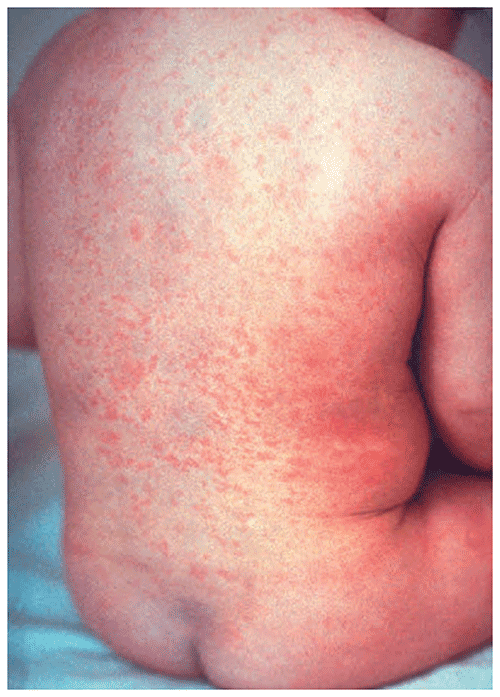
▶Faint pink, macular eruption starts on the face and spreads to the trunk (Figure 20.1) and proximal extremities.
▶Within 48 hours, the face clears and the exanthem spreads in a cephalocaudal fashion to the distal extremities.
▶Petechiae and purpura occur rarely.
▶A characteristic (but not specific) enanthem, Forchheimer spots, may present with erythematous and petechial macules on the soft palate.
▶Patient usually appears well, but associated pharyngitis and arthritis may be present; the latter may last for several months.
▶Fever is usually absent in young children.
▶Rare complications include encephalitis, myocarditis, pericarditis, hepatitis, anemia, thrombocytopenia, and neutropenia.
Figure 20.1. An Erythematous Macular Eruption Occurs in Rubella.
Congenital Rubella
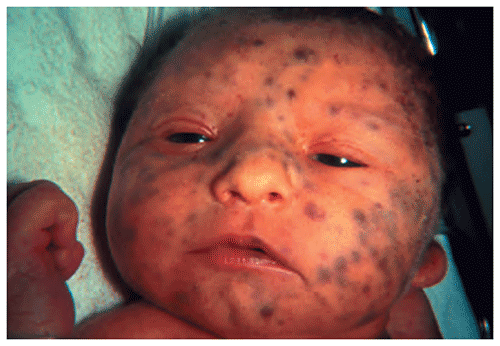
▶Neonate may present with disseminated bluish purple papules and nodules (“blueberry muffin” rash) (Figure 20.2) and thrombocytopenia, typically within the first days of life.
▶Neonatal hepatitis with jaundice can occur.
▶Embryopathy: deafness, congenital heart defects, cataracts, pigmentary retinopathy, glaucoma, intrauterine growth restriction, and developmental delay.
Figure 20.2. Bluish Purple Nodular Eruption (“blueberry Muffin” Rash) in a Newborn with Congenital Rubella Infection.
Look-alikes
| Disorder | Differentiating Features |
|---|
| Classic Rubella |
|---|
| Measles (rubeola) | Patients ill with fever, cough, coryza, and conjunctivitis. Exanthem more intensely red.
|
| Enteroviral infection | May have characteristic clinical syndrome (eg, hand, foot, and mouth disease). Eruption may have a petechial component. Posterior cervical and suboccipital lymphadenopathy uncommon.
|
| Infectious mononucleosis | |
| Exanthematous drug eruption | |
| Congenital Rubella |
|---|
| Cytomegalovirus infection | |
| Toxoplasmosis | |
| Congenital syphilis | Infants have rhinorrhea (often bloody), condylomata lata (flat-topped papules and plaques located at mucocutaneous junctions, including the perineum and angles of the mouth), and scaly, copper-colored papules and plaques. Exanthem may be vesiculobullous, often involves palms and soles.
|
| Herpes simplex virus infection | |
| Congenital thrombocytopenia (eg, Wiskott-Aldrich syndrome, neonatal thrombocytopenia) | Petechiae may be present, but hepatosplenomegaly, cataracts, intrauterine growth retardation, and other features of congenital rubella syndrome are absent.
|
▶The rash of rubella is nonspecific; a clinical diagnosis of rubella cannot be confirmed.
▶Congenital rubella syndrome should be considered in a newborn with “blueberry muffin” lesions and 1 or more characteristic findings of embryopathy, including congenital cataracts, deafness, cardiac defects, thrombocytopenia, hepatosplenomegaly, or microcephaly.
▶Diagnostic tests available for rubella include
■Viral culture from nasal mucosa swabs.
■Viral culture from urine, cerebrospinal fluid, tissue, or nasopharyngeal swabs in congenital rubella.
■Serological testing for rubella immunoglobulin (Ig) M antibodies or a fourfold or greater increase in IgG antibodies in paired acute and convalescent specimens may be helpful. On the day of rash onset, only 50% of patients will have positive rubella IgM results; more than 90% of cases will be IgM positive by 5 days after rash onset. In congenital rubella, IgM remains positive for several months.
■Polymerase chain reaction–based assays available.
▶No specific therapy available.
▶Supportive care includes use of nonsteroidal anti-inflammatory agents for arthritis.
▶Children who are affected should avoid contact with pregnant women and should be excluded from school until 7 days after onset of the rash.
▶Multidisciplinary care is recommended for congenital rubella (including ophthalmology, cardiology, and developmental pediatrics).
▶Rubella is typically a self-limited illness.
▶Arthritis may last for several months.
▶The prognosis for congenital rubella syndrome is guarded and depends on the extent of involvement.
▶Referral may be warranted if the diagnosis is in question.
▶Pregnant women potentially exposed to rubella should consult an infectious disease specialist and their obstetric health professional.