▶Pityriasis rosea is a benign, self-limited eruption of characteristic scaly papules and plaques in children and young adults.
▶Etiology is unknown.
■Seasonal incidence and clustering of cases suggest an infectious agent.
■Some evidence supports a role for human herpesvirus 6 and 7.
▶The initial lesion in as many as 80% of patients is the herald patch, a round or oval erythematous patch with a scaling border and central clearing that may be mistaken for tinea corporis or nummular eczema (Figure 51.1).
▶Within 2 weeks, a generalized, sometimes pruritic eruption appears; individual lesions are erythematous papules and small (5–10 mm), thin, oval plaques with scale.
■The plaques are oriented with their long axes parallel to lines of skin tension.
■Lesions are concentrated on the trunk; on the back, the alignment of lesions may mimic the boughs of a fir (ie, the “Christmas tree” distribution) (Figure 51.2).
– In “inverse” pityriasis rosea, lesions are concentrated on the neck, proximal extremities, groin, and axillae; there may be relative sparing of the trunk (Figure 51.3).
■“Trailing scale” is present: Scale lags behind the advancing red border, with the free edge pointing inward toward the center of the plaque.
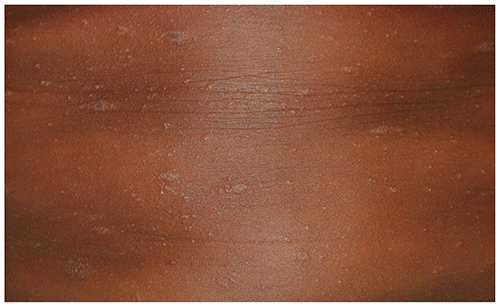
■In persons with skin of color, the appearance of the eruption may differ.
– The eruption may appear papular with few plaques (Figure 51.4).
– The erythematous nature of the eruption may be more difficult to appreciate.
▶New lesions appear for 2 to 3 weeks, and the eruption resolves typically over several weeks to months.
Figure 51.1. The Herald Patch is a Round or Oval Erythematous Patch that May be Mistaken for Tinea Corporis.
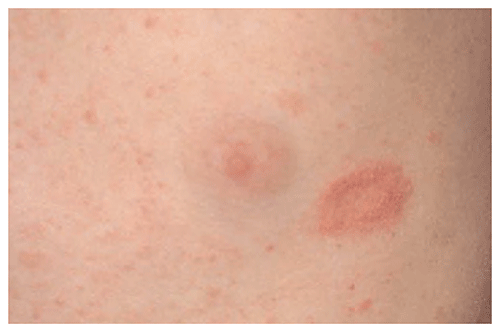
Figure 51.2. On the Back, the Alignment of Lesions Along Lines of Skin Tension May Mimic the Appearance of the Boughs of a Fir Tree (Ie, the “christmas Tree” Appearance).
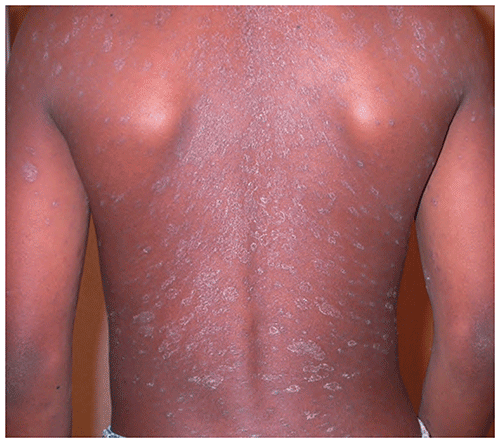
Figure 51.3. This Patient with Inverse Pityriasis Rosea Has Characteristic Oval Thin Scaling Plaques on the Proximal Thighs and Inguinal Folds, as Well as in the Axillae.
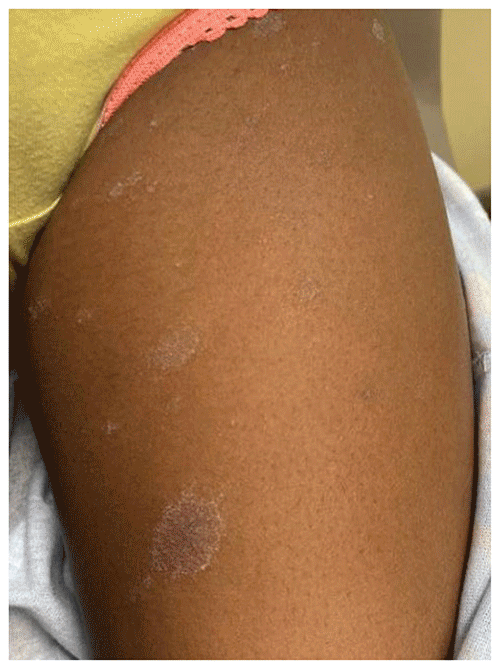
Figure 51.4. In Patients with Darker Skin Tones, Erythema May be More Difficult to Appreciate in the Papules and Plaques of Pityriasis Rosea.
Look-alikes
| Disorder | Differentiating Features |
|---|
| Tinea corporis | May be confused with herald patch of pityriasis rosea. Border often more elevated. Potassium hydroxide preparation performed on scale from lesion reveals hyphae. Generalized eruption not usually seen. Trailing scale is absent.
|
| Nummular eczema | May be confused with herald patch of pityriasis rosea. Covered with crust, as well as scale. Pruritus may be present (but less common than with typical eczema). Generalized eruption not typically seen. Trailing scale is absent.
|
| Secondary syphilis | |
| Guttate psoriasis | |
| Pityriasis lichenoides chronica | Often involves the extremities as well as the trunk. Buttock involvement common. Lesions not classically oriented along lines of skin tension. Course more prolonged than that of pityriasis rosea.
|
▶Most children with pityriasis rosea require no therapy.
▶If pruritus is present, an emollient containing menthol or phenol may be applied as needed (acts as a counterirritant that masks the sensation of pruritus) or a sedating antihistamine prescribed.
▶Judicious sun exposure may reduce pruritus and hasten the resolution of the eruption. Medical phototherapy is occasionally prescribed for severe cases; tanning beds are now classified as group 1 carcinogens and are not recommended for this purpose.
▶Counsel the patient and family about the prolonged course of the eruption.
▶Prognosis is excellent, although the prolonged time required for resolution may be frustrating to patients and families.
▶Consider consultation when the diagnosis is in doubt.
▶If patient exhibits signs of secondary syphilis (eg, oral or genital mucosal lesions, lesions on the palms or soles), perform appropriate testing (ie, rapid plasma reagin or VDRL test).
▶If lesions persist for longer than 3 months, consider referral to a pediatric dermatologist to assess for pityriasis lichenoides chronica, a disorder that (in its early stages) may mimic pityriasis rosea.