▶Reticulated mottling involving one or several limbs (Figures 56.1 and 56.2).
▶Occasional truncal or facial involvement.
▶May have associated skin atrophy (Figure 56.3), occasional deep purple color, or ulceration.
▶Rewarming fails to lead to resolution.
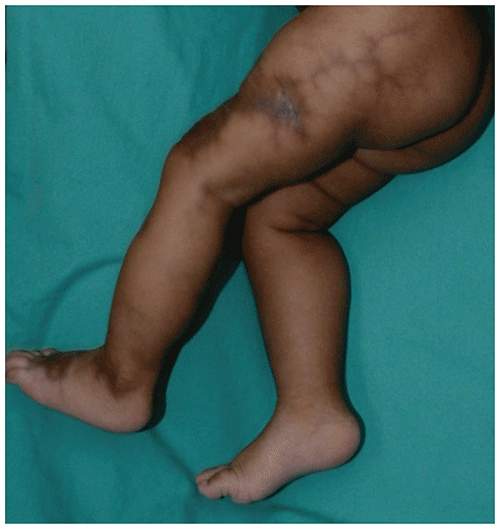
▶Ipsilateral limb hypoplasia common (Figure 56.4), usually of no functional significance; limb length discrepancy or limb hyperplasia far less common.
▶Less common associations include port-wine stain and ophthalmologic or neurologic manifestations.
▶Rare association of macrocephaly, craniofacial and skeletal anomalies, and developmental delay termed macrocephaly-capillary malformations; lesions may appear similar to those of cutis marmorata telangiectatica congenita (CMTC) but actually represent reticulate port-wine stains.
▶Adams-Oliver syndrome characterized by CMTC in association with transverse limb anomalies and scalp aplasia cutis.
Figure 56.1. Cutis Marmorata Telangiectatica Congenita. Reticulated Mottling of the Lower Extremity.
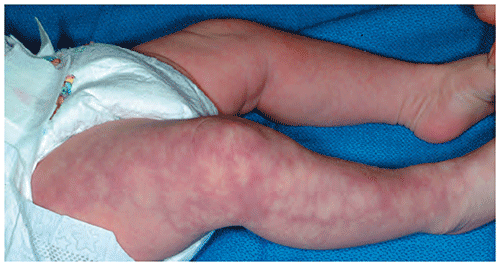
Figure 56.2. Cutis Marmorata Telangiectatica Congenita. Mottling of the Lower Extremity Was Present in This Infant, with Some Areas Showing More Accentuation.
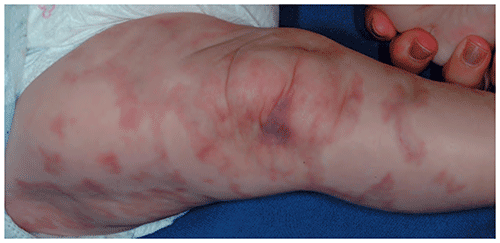
Figure 56.3. Extensive Involvement of the Buttock and Lower Extremity with Cutis Marmorata Telangiectatica Congenita, with Some Subtle Skin Atrophy Noted in Several of the Involved Areas.
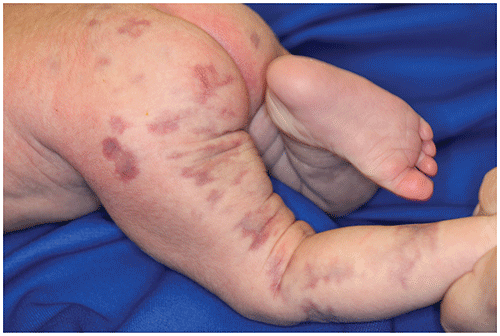
Figure 56.4. Cutis Marmorata Telangiectatica Congenita Affecting the Left Lower Extremity. In Addition to Deep Purple Mottling, There is Hemiatrophy. Reproduced with Permission. Leung Akc, Lam Jm, Leong Kf. Cutis Marmorata Telangiectatica Congenita Associated with Hemiatrophy. Case Rep Pediatr. 2020:88138909.
Look-alikes
| Disorder | Differentiating Features |
|---|---|
| Cutis marmorata |
|
| Reticulated port-wine stain |
|
| Klippel-Trénaunay syndrome |
|
| Persistent cutis marmorata |
|
| Livedo reticularis |
|