▶Traction alopecia is a common cause of hair loss that is most commonly seen in Black children, particularly girls.
▶The condition is due to styling with tight braids, cornrows, or ponytails, especially when using artificial hair integrations (hair extensions) and/or heavy hair adornments that increase tension further on the already-stressed hair.
▶African American hair has inherently lower strength, which may predispose to hair loss under conditions of increased tension or weight on the hair.
▶Usually characterized by thinning of the hair, particularly around the frontal and parietotemporal hairlines.
■Alopecia or thinning of the hair may extend circumferentially around the hairline, depending on how the hair is styled; may result in a higher hairline over time.
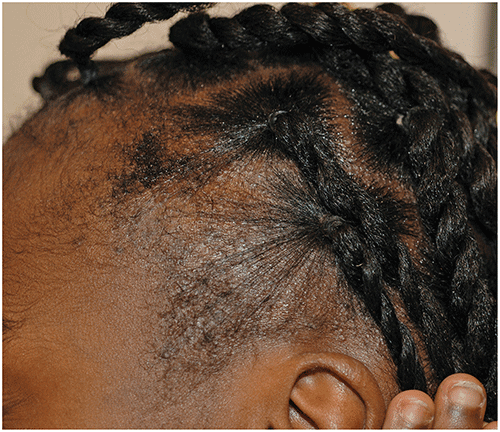
■Hair loss also may be observed between the tight braids where the hair has been parted (Figures 97.1 and 97.2).
■Fine vellus hairs may be observed in affected areas.
▶There usually are no associated scalp changes, although occasionally, perifollicular inflammation can be observed, including erythema or papules and pustules (most often representing sterile folliculitis related to application of greasy pomades).
Figure 97.1. Marked Thinning of the Temporal Scalp Due to Traction Alopecia. Note the Hairstyle with Many Small, Tight Braids Typically Seen in Children with This Disorder.
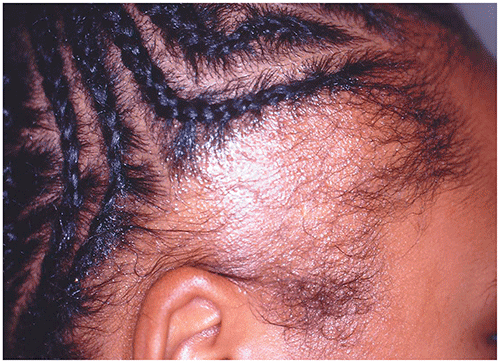
Figure 97.2. Partial Alopecia Involving the Hairline in This Child with Traction Alopecia. Note the Tightly Pulling Braids.
Look-alikes
Presented here are causes of localized hair loss. Hair loss is usually not symmetric in any of these conditions.
| Disorder | Differentiating Features |
|---|
| Tinea capitis | Scaling or inflammation of scalp usually present. Black dot hairs may be observed. Regional lymphadenopathy (cervical, suboccipital) may be present. Fungal (dermatophyte) culture or potassium hydroxide preparation is positive.
|
| Trichotillomania | Irregularly shaped areas of incomplete alopecia. Hairs of differing lengths in affected areas. Broken-off hairs are present.
|
| Alopecia areata | Round or oval smooth areas of complete alopecia. Lesions may be scattered throughout scalp, not limited to frontal or parietotemporal hairlines or areas between braids. Nail pits or trachyonychia (rough nails) may be present.
|
▶The diagnosis usually is made clinically based on the pattern of hair loss.
▶When suspecting traction alopecia, a careful history should be obtained on hairstyling practices, including braids, ponytails, hair adornments, and chemical processing or heat-related procedures.
▶The mainstay of treatment is aimed at changing the hairstyling practices to ones that avoid any undue tension, trauma, or weight on the involved hair.
▶Loose hairstyles without braids or hair adornments should be encouraged.
▶Gentle treatment of the hair with avoidance of chemical processing or heat-related procedures also should be emphasized.
▶Sterile folliculitis is treated best by withdrawing the application of greasy pomades to the scalp.
▶If follicular pustules are present, bacterial and fungal cultures should be performed to rule out bacterial infection and tinea capitis, respectively.
▶If the condition is recognized promptly and the appropriate changes made in hairstyling, the prognosis is excellent, with complete regrowth of hair expected.
▶In patients with more chronic traction alopecia (years), permanent hair loss may result.
▶Consider referral to a dermatologist if the diagnosis is in doubt or for patients with chronic symptoms because permanent hair loss may result.