▶Trichotillomania (ie, hairpulling disorder), the loss of hair because of hairpulling, plucking, twirling, or twisting, is a common cause of hair loss in children.
▶Classified in the past as an impulse control disorder and, more recently, in Diagnostic and Statistical Manual of Mental Disorders, 5th Edition, as an obsessive-compulsive disorder.
▶Seen more frequently in children and adolescents than in adults and more common in female patients.
▶Exact frequency is unknown, but some reports indicate prevalence of up to 1 in 200 persons by 18 years of age.
▶May involve pulling or twisting of the hairs of the scalp (most commonly affected site), eyelashes, eyebrows, or other hair-bearing areas.
▶Most patients and parents deny pulling or twisting (some may not even be cognizant of the behavior), which can make accurate diagnosis a challenge.
▶An often chronic condition that may vary greatly in severity, from a short-lived habit with localized hair loss to a more severe condition with associated psychologic or psychiatric morbidity.
▶Patients often have an associated sense of tension before the act of hairpulling or twisting, which is typically followed by a sense of relief or gratification; may occur more often when patients are tired, bored, or falling asleep.
▶Localized, well-circumscribed areas of hair loss, often with angular or irregular borders (Figures 98.1 and 98.2).
▶Careful examination reveals hairs of variable length within the affected region (unlike the complete hair loss of alopecia areata) (Figures 98.3 and 98.4).
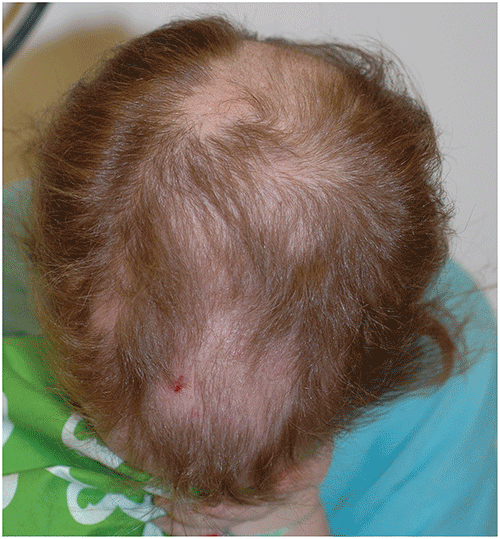
▶Frontal, temporal, and parietal scalp usually affected; eyelashes and eyebrows involved less often (Figures 98.5, 98.6, 98.7, and 98.8).
▶Affected area often has a rough, bristlelike texture due to hair stubble (Figure 98.1).
▶Usually no associated scalp variations, although some erosions may be present.
▶Classically occurs on the contralateral side of the dominant hand.
▶Associated findings may include nail-biting (onychophagia), skin or nose picking, and lip biting.
Figure 98.1. Trichotillomania. There is a Well-Defined Patch of Relative Alopecia within Which Hairs are of Differing Lengths. The Hair in the Affected Area Has a Bristlelike Feel.
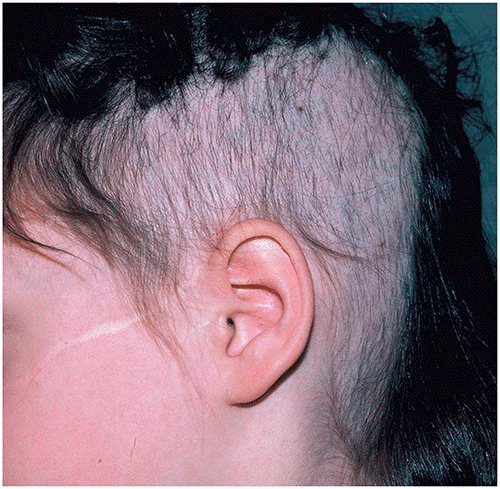
Figure 98.2. Trichotillomania. Irregular Patch of Alopecia with Broken-Off Hairs in This School-Aged Child with a History of Obsessive-Compulsive Behavior and Anxiety.
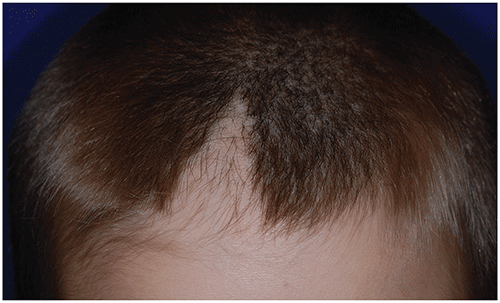
Figure 98.3. Trichotillomania Involving the Vertex Scalp. Note the Well-Demarcated Area of Affected Scalp and Variation in Hair Length within the Affected Areas.
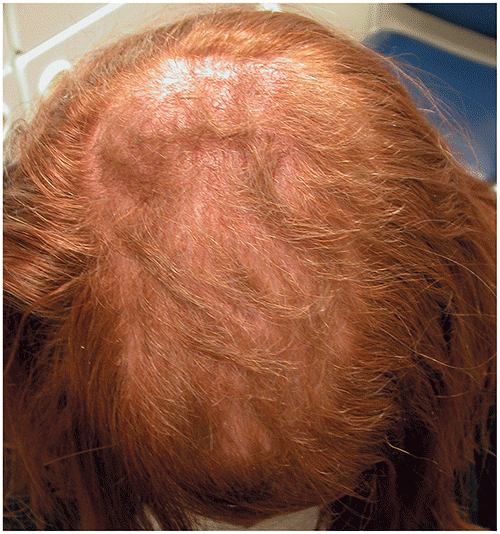
Figure 98.4. Trichotillomania in a Patient with Skin of Color. Note the Large Patch of Alopecia on the Right Frontal and Temporal Scalp within Which are Short Hairs of Varying Lengths. Reproduced with Permission from Usatine Rp, Smith Ma, Chulley Hs, Et Al. The Color Atlas of Pediatrics. Mcgraw-Hill Education.
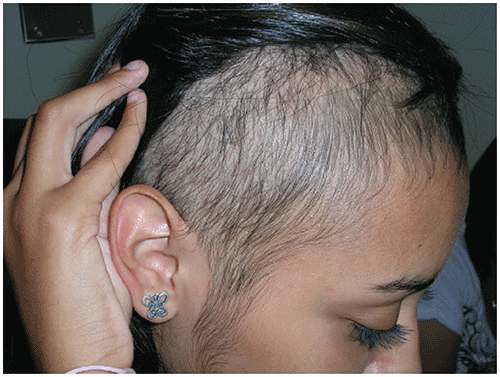
Figure 98.5. Patchy, Irregular Loss of Eyebrows and Eyelashes in This Patient with Trichotillomania.
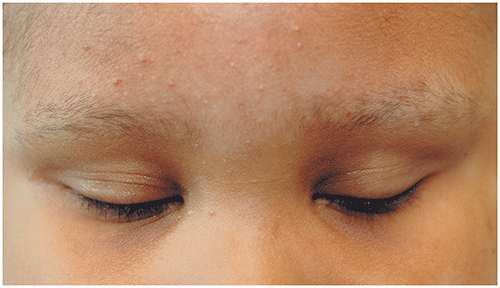
Figure 98.6. Trichotillomania Localized to the Eyelashes. Note the Lashes of Differing Lengths within the Affected Upper Eyelid Margin.
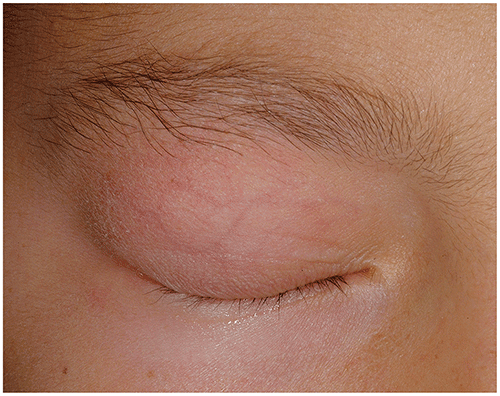
Figure 98.7. Trichotillomania. Patient with Hair Loss on Vertex of Scalp from Hairpulling.
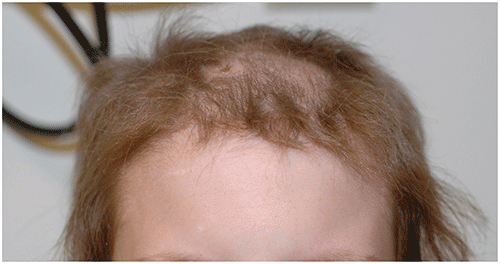
Figure 98.8. Trichotillomania. Same Patient as in Figure 98.7; Note Excoriations on the Scalp.
Look-alikes
| Disorder | Differentiating Features |
|---|
| Tinea capitis | Black dot hairs may be observed. Regional lymphadenopathy (cervical, suboccipital) may be present. Fungal culture or potassium hydroxide preparation result is positive.
|
| Alopecia areata | Round or oval areas (angular borders not observed) of complete hair loss. Exclamation point hairs may be observed. Nail pitting or trachyonychia (rough nails) may be present. Hairs have similar length during regrowth phase. Broken-off hairs are absent.
|
| Traction alopecia | Symmetric bilateral involvement present. Thinning or complete hair loss, especially around hairline or in areas where hair is parted. Broken-off hairs are typically absent.
|
▶The diagnosis can be very challenging because many patients and parents deny the behavior of hairpulling or twisting.
▶In younger children, parents may observe and report the behavior of hairpulling or twisting, whereas in older children and adolescents, the behavior usually occurs in private and family members are not aware of the habit.
▶The diagnosis is made clinically based on the characteristic pattern of irregular and bizarre patterns of hair loss, presence of broken-off hairs, and exclusion of other potential causes (eg, tinea capitis).
▶Although generally not necessary, skin biopsy may be helpful in making the diagnosis. Histologic findings include follicular plugging, melanin casts, distorted hair shafts (trichomalacia), hemorrhage, and an increase in hair follicles in the catagen phase.
▶Special care and sensitivity must be used when the potential diagnosis of trichotillomania is discussed with the patient and family members.
▶There are no specific therapies for trichotillomania.
▶Close collaboration with a child psychologist or psychiatrist is often necessary to reverse the behavior.
■In some patients, behavior modification strategies alone can be helpful (including positive reinforcement and redirectional therapy).
■In others, a combination of behavior modification and pharmacological therapy, such as selective serotonin reuptake inhibitors or N-acetylcysteine, may be necessary, but data on these treatments are limited.
▶Psychiatric comorbidities (eg, obsessive-compulsive disorder, depression, anxiety disorder) should be addressed by a pediatric psychologist or psychiatrist; such comorbidities are unlikely in younger patients.
▶Trichophagia and trichobezoar should be considered in patients presenting with symptoms suggestive of gastric obstruction.
▶Patients with trichotillomania are a heterogeneous group, so the prognosis varies from excellent in those individuals with an isolated habit to poor in individuals who have associated psychiatric morbidity.
▶In general, younger children appear to have a more favorable outcome than do those with a later onset of disease.
▶Referral to a pediatric dermatologist may be helpful when the diagnosis is uncertain.
▶Once the diagnosis is suspected, patients may benefit from referral to a behavioral pediatrician, child psychologist, or psychiatrist experienced in the disorder.
▶The TLC Foundation for Body-Focused Repetitive Behaviors: Provides information, resources, and links for patients and families.
https://www.bfrb.org
▶Trichotillomania Support: Website in the United Kingdom that provides information and support for patients who have trichotillomania.
https://trichotillomania.co.uk/