▶Androgenetic alopecia is hair loss that occurs due to the effects of circulating hormones in individuals who are genetically susceptible.
■Can occur in male or female patients and is the most common type of hair loss in adults.
■Early onset disease starts in the teenage years, rarely earlier. Earlier onset disease tends to be more pronounced.
■This type of hair loss can be inherited from either or both parents. Occurrence in male patients is common and does not require workup. In female patients, consider hormone evaluation.
▶Most patients first note diffuse thinning of the hair, sometimes accompanied by mild shedding.
▶Hair loss occurs in a predictable pattern in male and female patients, and it is therefore sometimes called pattern alopecia.
■The earliest form of male pattern alopecia is triangular recession of the frontal hairline (Figure 93.1). The crown of the scalp is the next to be affected, and eventually hair loss can affect most of the scalp, often sparing a band along the inferior scalp.
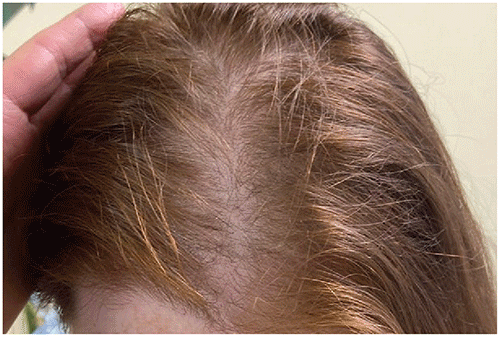
■Female pattern alopecia is typically milder and begins with thinning of hair density on the midline scalp (from frontal to crown), leading to widening of the central hair part (Figure 93.2). Thinning can progress to involve the entire crown of the scalp.
Figure 93.1. This Adolescent Patient Has Triangular Recession of the Frontal Hairline.
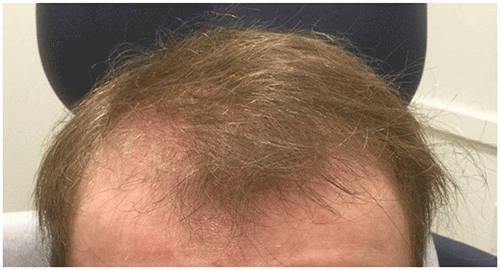
Figure 93.2. This Adolescent Patient Has Thinning of the Midline Scalp Hair, Leading to a Widened Part with Visible Scalp.
Look-alikes
| Disorder | Differentiating Features |
|---|
| Telogen effluvium | Increased shedding of the hair, often noticed with washing or brushing. Causes diffuse hair loss throughout the entire scalp; no distinct pattern is present. History of a severe illness or stressor 6 weeks to 4 months before onset of the hair loss.
|
| Alopecia areata | Usually causes localized hair loss, but occasionally can be widespread. Round or oval areas of complete hair loss. May have associated nail pitting.
|
| Scarring alopecia | The end result of an inflammatory process in and around the hair follicles; multiple causes. The scalp appears smooth and shiny with absence of visible hair follicles. History or presence of papules, pustules, or plaques preceding the hair loss. Typically preceded by scalp symptoms, including pain or pruritus.
|
▶The diagnosis of androgenetic alopecia is often made clinically on the basis of examination findings and family history.
■If the diagnosis is in question, scalp biopsy may be helpful (has characteristic features, including a miniaturized follicle).
■Laboratory testing is not indicated in male patients; consider hormone evaluation in female patients, including free testosterone, dehydroepiandrosterone sulfate, luteinizing hormone, follicle-stimulating hormone, and androstenedione.
▶Without treatment, the condition is progressive.
■Topical minoxidil 5% (solution or foam) can prevent further loss and promote hair growth in both male and female patients. Apply carefully to avoid unwanted hair on forehead and face.
■Off-label oral treatment options and those not approved by the US Food and Drug Administration include finasteride (approved by the US Food and Drug Administration for 18 years and older), spironolactone (female patients only; works via inhibiting effects of androgens), and low-dose oral minoxidil.
▶Topical and oral treatments are generally effective, but recurrent hair loss can be expected if treatment is discontinued.
▶Female patients with other features of hormone excess should be referred to specialists in endocrinology or gynecology for evaluation.