▶Also known as papular acrodermatitis of childhood and papulovesicular acrolocated syndrome.
▶Distinctive exanthem of childhood affecting face, buttocks, and extensor surfaces of extremities.
▶Predominantly occurs in children between the ages of 1 to 6 years.
▶Initially described in association with hepatitis B infection.
▶Subsequently demonstrated also to occur in response to a variety of viral infections and vaccinations.
■Epstein-Barr virus is probably the most common cause worldwide and in the United States.
■Enteroviruses, hepatitis A and B, cytomegalovirus, adenovirus, rotavirus, parvovirus, human herpesvirus 6, rubella, respiratory syncytial virus, paramyxovirus, parainfluenza virus 2, and SARS-CoV-2 have all been associated.
■Potential associations with some vaccines have also been reported.
▶Abrupt onset of symmetrically distributed erythematous or skin-colored papules.
▶May be lichenoid (ie, flat-topped) or firm, dome-shaped edematous papules.
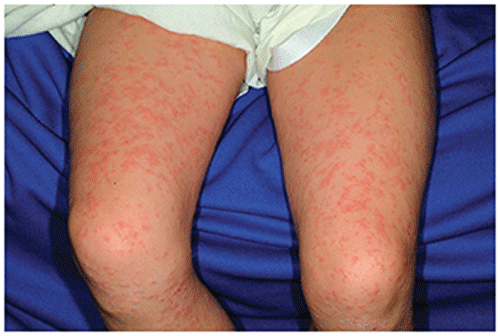
▶Symmetrically localized to the face (Figure 15.1), extensor surfaces of the extremities (Figure 15.2), and buttocks (largely sparing the trunk); occasionally, lesions will be most prominent on the distal surfaces of the extremities and buttocks.
▶Lesions range in size from 1 to 10 mm and typically appear monomorphous within the individual patient.
▶Confluence of papules may lead to the appearance of edematous plaques, especially on the elbows and knees.
▶Pruritus is variable.
▶Occasionally mild prodromal symptoms such as low-grade fever and upper respiratory symptoms may be reported; lymphadenopathy may be present at examination.
▶Hepatomegaly and abnormal liver function study results may be present in hepatitis-associated cases.
Figure 15.1. Erythematous Papules Distributed Symmetrically on the Face of a Child with Gianotti-Crosti Syndrome.
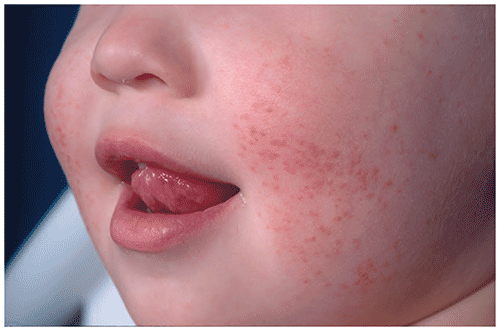
Figure 15.2. The Papules of Gianotti-Crosti Syndrome Often are Located Symmetrically on the Extensor Surfaces of the Lower Extremities. This Young Child Also Had Lesions on the Face and Extensor Surfaces of the Upper Extremities.
Look-alikes
| Disorder | Differentiating Features |
|---|
| Insect bites | |
| Papular atopic dermatitis | |
| Lichen planus | Purple polygonal papules that may have fine, white reticulated scale on surface. Most often distributed on volar surfaces of wrists, lower legs, and ankles. White, reticulated patches often present on buccal mucosae.
|
| Lichenoid drug eruption | |
| Molluscum contagiosum | Not distributed symmetrically. Individual lesions are pearly and translucent and often contain a central punctum or depression. Acute onset unusual; the number of lesions typically increases gradually over weeks to months. Some reports in the literature suggest occasional coexistence of molluscum and a Gianotti-Crosti–type presentation, the latter likely representing an id-type reaction.
|
▶The diagnosis is made clinically on the basis of the unique appearance and distribution of lesions.
▶Skin biopsy may occasionally be useful in diagnosis but rarely is necessary.
▶Routine serological evaluations for hepatitis B infection are not indicated; testing should be based on clinical suspicion and examination findings concerning for hepatitis.
▶Rarely necessary, aside from reassurance and education about the natural history.
▶Oral antihistamines for pruritus.
▶Topical steroids do not change the natural history of the skin eruption; may be helpful for treating pruritus.
▶Self-limited, with eventual complete resolution (sometimes with postinflammatory pigmentary alteration).
▶Lesions may persist for up to 8 to 12 weeks, in contrast to most other viral exanthems.