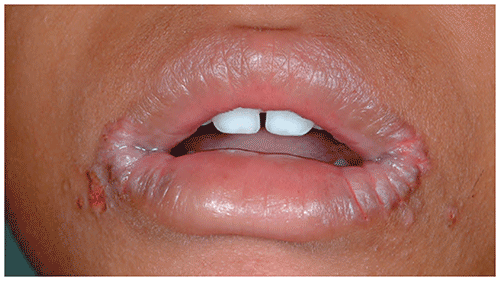
▶Inflammation and maceration of the angles of the mouth (ie, angular cheilitis or perlèche) can result from repeated licking, excessive salivation, or drooling.
▶Candida species may then secondarily infect the areas directly or by extension of oral thrush.
▶Perlèche is frequently observed in children with neurologic deficits who have difficulty managing oral secretions. It may also be seen with increased frequency in children who have increased drooling related to the presence of orthodontic appliances or immunocompromise.
Figure 35A.1. Erythema, Maceration, and Fissuring of the Corners of the Mouth are Observed in Angular Cheilitis.
Look-alikes
| Disorder | Differentiating Features |
|---|
| Localized trauma | |
| Contact dermatitis | |
| Lip-licking dermatitis | Historical information suggesting lip licking. Well-defined erythematous patch surrounding mouth. Occasionally may have associated angular cheilitis.
|
| Secondary syphilis (mucous patch) | A mucous patch may be located at the angle of the mouth, but patients generally have additional labial and intraoral lesions and rash elsewhere. Patients often have systemic symptoms, including fever, malaise, or arthralgias, and generalized lymphadenopathy.
|
▶The diagnosis is usually made clinically.
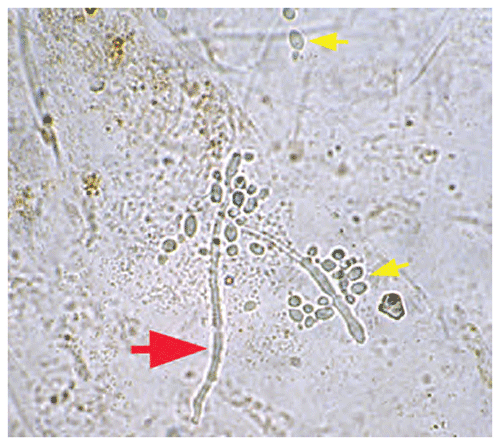
▶If uncertainty exists, the diagnosis may be confirmed by microscopic observation of budding yeast or pseudohyphae in a potassium hydroxide preparation performed on scrapings of lesions or fungal culture (Figure 35A.2).
Figure 35A.2. A Potassium Hydroxide Preparation Reveals Pseudohyphae (Red Arrow) and Spores (Yellow Arrows) of Candida Species.
▶Treatment focuses on the control or elimination of the inflammatory component with a low-potency topical steroid or topical calcineurin inhibitor, often in combination with the application of a topical antifungal agent (eg, nystatin, miconazole, clotrimazole) if secondary Candida infection is suspected.
▶A combination antifungal-corticosteroid preparation (eg, nystatin in 0.1% triamcinolone ointment) is effective for short-term use, applied twice daily to the mouth angles until improved. If long-term use is required, a lower potency topical steroid is preferred.
▶Minimize predisposing factors such as lip licking, thumb-sucking, and vigorous flossing.
▶Persistent or repeated infection suggests a need for consideration of bacterial infection (Staphylococcus aureus or Streptococcus pyogenes) or immunodeficiency.
▶Identify and eliminate exposure to triggers responsible for irritant or allergic contact dermatitis.
▶The prognosis for patients with angular cheilitis is excellent, but underlying predisposing conditions may lead to recurrences.
▶Consider consultation with a dermatologist when the diagnosis is in doubt or lesions fail to respond to appropriate therapy.
▶When confronting treatment-resistant cases, consider contact dermatitis, diabetes mellitus, or other immunosuppression.