▶Also known as creeping eruption, larva migrans.
▶A self-limited skin eruption caused by accidental penetration of the human host by the dog hookworm (Ancylostoma caninum) and cat hookworm (Ancylostoma braziliense). Uncinaria stenocephala, a hookworm that affects dogs and cats, has also been implicated in some cases. Other skin-penetrating nematodes may occasionally cause disease.
▶Usually noted after travel to tropical and subtropical regions, including southeastern United States (especially Florida and Georgia), Central and South America, Africa, and the Caribbean.
▶May occur in epidemics in high-income countries and in tourists.
▶Adult hookworms release eggs in host animal’s intestines, and eggs pass with feces into sandy, warm soil.
▶Eggs hatch, releasing larvae that penetrate human skin and wander arbitrarily, producing serpiginous tracts.
▶Erythematous, serpiginous plaques develop on skin (Figure 42.1).
▶Incubation period is typically days but may last for several weeks in some patients.
▶Lesions may “advance” up to 20 mm per day.
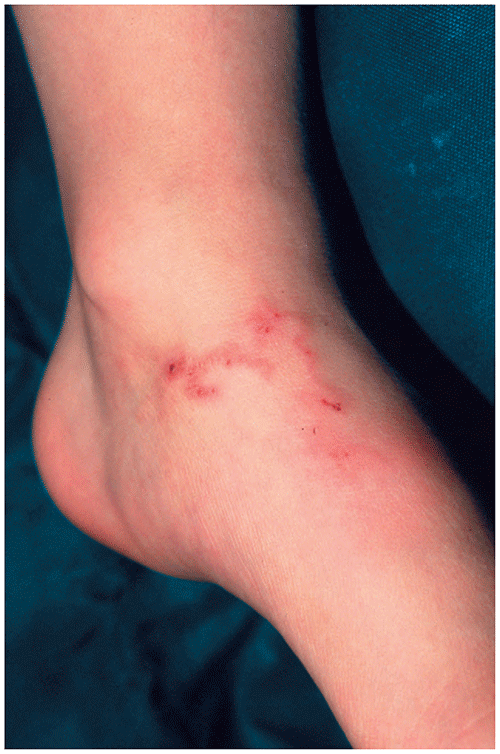
▶Most common locations include feet (Figure 42.2), buttocks, and genitalia.
▶May be intensely pruritic.
▶Blisters may rarely occur.
▶Eosinophilic pneumonitis (Löffler syndrome) may rarely occur and presents with fever, malaise, and cough.
▶Peripheral blood eosinophilia may occur.
▶Rarely, the larvae travel to the intestines, causing eosinophilic enteritis.
Figure 42.1. Cutaneous Larva Migrans. Serpiginous Tracts on the Dorsomedial Aspect of the of a School-Aged Child.
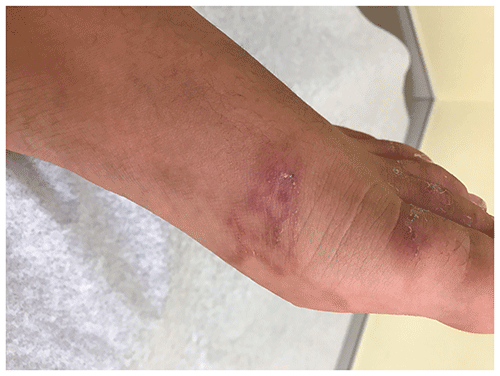
Figure 42.2. Cutaneous Larva Migrans. Note the Serpiginous Erythematous Tracts on the Dorsal Aspect of the Ankle and Proximal Aspect of the Foot.
Look-alikes
| Disorder | Differentiating Features |
|---|
| Scabies | Burrows short (up to a few millimeters), do not migrate. Widespread distribution, favoring folds, wrists, ankles, genitals, palms, and soles.
|
| Tinea corporis | |
| Other nematode infestations | Variety of systemic manifestations depending on nematode; may include Strongyloides stercoralis and Gnathostoma spinigerum. The serpiginous rash of larva currens (hypersensitivity reaction seen in some patients with strongyloidiasis) progresses at a faster rate, up to 10 cm per day.
|
| Allergic contact dermatitis | |
| Phytophotodermatitis | Erythematous eruption, which also usually develops after outdoor activities. Patches correspond to sites of contact with offending photosensitizer (including lime or lemon juice, dill, parsley, parsnips, figs, celery); may present as linear streaks and “drip marks.” In addition to erythematous patches, vesicles and bullae are often present. Heals with marked hyperpigmentation.
|
▶Clinical examination findings combined with extreme pruritus and exposure history are usually confirmatory.
▶Skin biopsy (rarely necessary) typically reveals intense eosinophilic infiltrate.
▶Process is self-limited, but symptoms usually necessitate therapy.
▶Oral albendazole and ivermectin are both effective.
■Albendazole: age older than 2 years: pediatric dose 15 mg/kg/d (maximum 400 mg/d) once daily for 3 days.
■Ivermectin: 200 mcg/kg given orally once daily for 1 day. Safety in young infants (<15 kg) and in pregnant women is not established.
▶Cryotherapy (traditional treatment) is rarely effective and is traumatic for young children; it should be avoided.
▶Referral to a dermatologist should be considered for patients in whom the diagnosis is in question or for whom conventional therapy is unsuccessful.