▶One of the most common forms of non-scarring alopecia in children.
▶Human hair follicle has 3 distinct phases.
■Anagen phase: approximately 80% to 90% of hairs in this growing phase; can last from 2 to 6 years (average 3 years).
■Catagen phase: brief, approximately 3-week period of involution.
■Telogen phase: resting phase typically lasting 3 months; approximately 10% of hairs at any time; an average of 50 to 100 telogen hairs shed daily and simultaneously replaced.
▶It is unclear what stimuli trigger anagen hairs to enter the catagen phase under typical circumstances, although there are several known events that may interrupt the typical hair cycle and cause large numbers of hairs to prematurely enter the catagen, then telogen phase in concert (resulting in greater than typical hair loss). Telogen effluvium typically occurs when more than 25% of the scalp hairs enter the telogen phase.
■Most common forms of telogen effluvium include physiologic hair loss of newborns and postpartum women (in which case childbirth is believed to be the trigger).
■There are also several physical injuries and illnesses that may cause large numbers of anagen hairs to prematurely enter the telogen phase, including
– High fever
– Surgery
– General anesthesia
– Serious infections
– Thyroid disease (hypothyroidism or hyperthyroidism)
– Iron deficiency
– Malnutrition related to underlying medical problems (eg, celiac disease, anorexia nervosa) or crash diets insufficient in calories or protein
– Essential fatty acid, zinc, or biotin deficiency
– Medications (eg, angiotensin-converting enzyme inhibitors, anticonvulsants [eg, valproic acid, carbamazepine], β-blockers, cimetidine, lithium, oral contraceptives)
▶Usually, the onset of hair loss occurs 6 weeks to 4 months after the preceding trigger event/condition.
▶Patients usually present with a history of increased shedding of the hair or hair falling out at the root (often noticed after washing or brushing hair).
▶Process is generally diffuse and very subtle, even undetectable, to the clinician.
▶Condition usually is much more apparent to the affected patient or family members and may be more noticeable when comparing the child’s appearance with photographs taken prior to the onset.
▶Patients lack other symptoms, and the scalp generally appears unremarkable with no evidence of scale, inflammation, or regional lymphadenopathy.
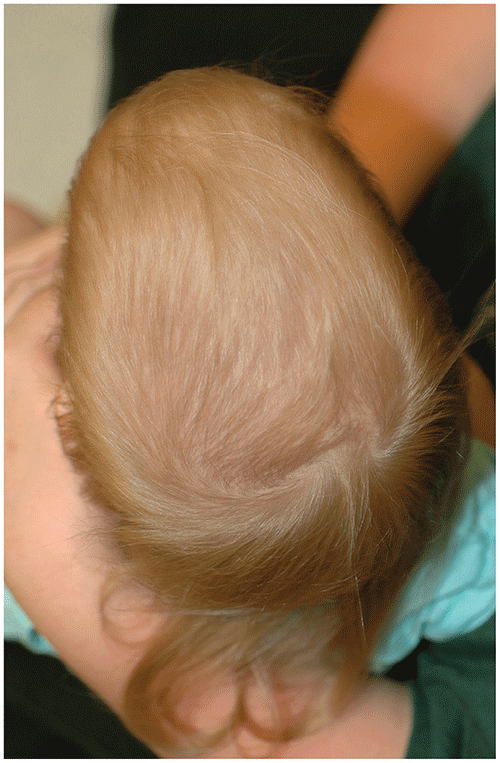
▶There usually are no completely smooth, bald areas but rather diffuse thinning of the scalp hair (Figures 96.1–96.3).
▶It may occasionally be associated with Beau lines on the nails (horizontal bands or grooves in same area of several or all nails).
Figure 96.1. Diffuse Thinning of Scalp Hair Typical of Telogen Effluvium. This Child Experienced Complete Regrowth of the Scalp Hair within Several Months.
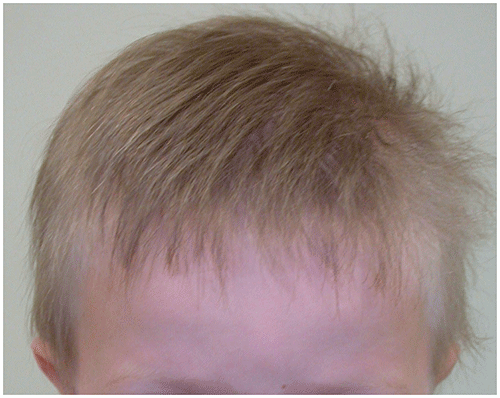
Figure 96.2. Diffuse Thinning of the Scalp Hair in This Child with Telogen Effluvium.
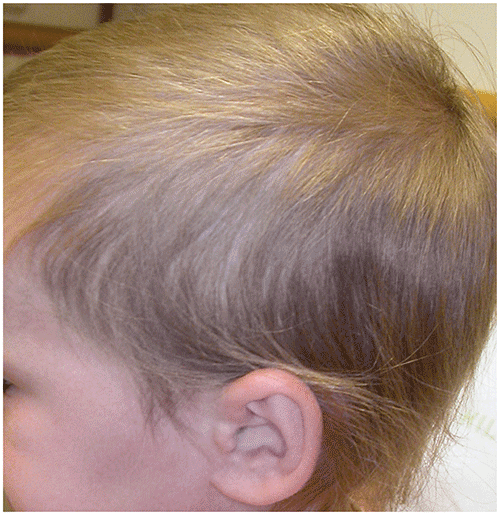
Figure 96.3. Patient with Diffuse Thinning of Telogen Effluvium after an Illness.
Look-alikes
| Disorder | Differentiating Features |
|---|
| Tinea capitis | Usually causes more localized hair loss. Scaling or inflammation of the scalp usually present. Black dot hairs may be observed. Regional lymphadenopathy (cervical, suboccipital) may be present. Fungal culture or potassium hydroxide preparation result is positive.
|
| Traction alopecia | Usually causes localized hair loss with symmetric bilateral involvement. Thinning or complete hair loss, especially around hairline or in areas where hair is parted/under tension. Most common in Black girls; hair styling usually suggestive with tight braids or heavy hair adornments.
|
| Trichotillomania | Usually causes localized hair loss. Irregularly shaped areas of incomplete alopecia. Hairs of differing lengths in affected areas. Broken-off hairs are present.
|
| Alopecia areata | Usually causes localized hair loss (occasionally may be widespread). Round or oval areas of complete alopecia. May have associated nail pitting, trachyonychia (rough nails).
|
| Loose anagen syndrome | Typically long history of diffusely thin and lusterless hair. Hair grows slowly; history of no (or few) haircuts common. Hair mount of easily extracted hairs confirms the diagnosis (reveals ruffled cuticle and dystrophic anagen bulb).
|
▶The diagnosis of telogen effluvium is most commonly made based on a clinical history of hair shedding beginning 2 to 4 months after a significant physical illness, injury, or other stressful event.
▶Examination usually reveals an absence of scalp changes, and hair loss is usually diffuse and subtle.
▶Hair pull examination can be done by firmly placing a lock of hair between the thumb and forefinger and applying steady traction. If more than 6 hairs are removed, this is suggestive of active hair shedding.
▶Microscopic examination of extracted hairs can confirm the pulled hairs are in the telogen phase. Typical appearance of telogen hair reveals nonpigmented root with club shape.
▶If clinical examination is suggestive of telogen effluvium but there is no supportive history, other hair loss disorders should be considered.
■Careful diet history and growth evaluation should be obtained to rule out underlying nutritional deficiencies or history of crash dieting.
■A medication history also should be elicited.
■Laboratory investigation for iron deficiency anemia or thyroid disease should be considered.
▶Cessation of hair loss within 3 to 4 months followed by gradual regrowth is consistent with the diagnosis.
▶The clinician’s main responsibility is to provide reassurance to the patient or parents about the expectation of complete regrowth of hair, usually within 6 months.
▶Treatment should be directed toward any underlying medical conditions, such as correction of iron deficiency anemia or thyroid disease, or management of any identified nutritional deficiencies.
▶The prognosis for telogen effluvium is excellent.
▶Complete hair regrowth usually occurs within 6 months.
▶Can occasionally be chronic or relapsing.
▶If an underlying trigger cannot be elicited via comprehensive history, physical examination, or laboratory studies, the clinician should consider referral to a dermatologist.
▶If progressive hair loss persists for more than 6 months, dermatology referral is recommended.