Before carrying out a medication order, the nurse must ensure that the order is complete. The components of a complete medication order include:
- Name of patient and date of birth (DOB)
- Name of medication
- Dose of medication
- Route of administration
- Frequency and/or time of administration
- Date and time the order was written
- Signature of the prescriber
The patient's name should be a full name, including a middle name or initial. The patient's DOB, though not required by all agencies, is typically used as a second identifier to differentiate patients with similar names. As previously mentioned, to avoid potential errors, the complete name of the drug should be used when ordering a medication. The drug dose is the specific amount of medication to be given at one time. The route or path by which the medication enters the body should be included with the medication order. The frequency indicates how often a medication should be given. Most healthcare facilities have a standard schedule for the frequencies listed in Table 4-1. Examples of standard frequency schedules include:
- q6h: 0600, 1200, 1800, 2400
- q8h: 0800, 1600, 2400 or 0600, 1400, 2200
- q12h: 0800, 2000
Some medications must be scheduled with meals or apart from meals. Nurses are responsible for ensuring that medications are properly scheduled. The final required component of a medication order is the signature of the prescriber, which may be a handwritten or electronic signature. Figure 4-3 depicts five of the seven required components of a medication order on an electronic medical record: patient name and DOB, drug names, doses, routes, and frequencies. The electronic signature and date/time the order is generated, though accessible, is not readily visible on this screen shot.
Medication orders generated through an electronic medical record.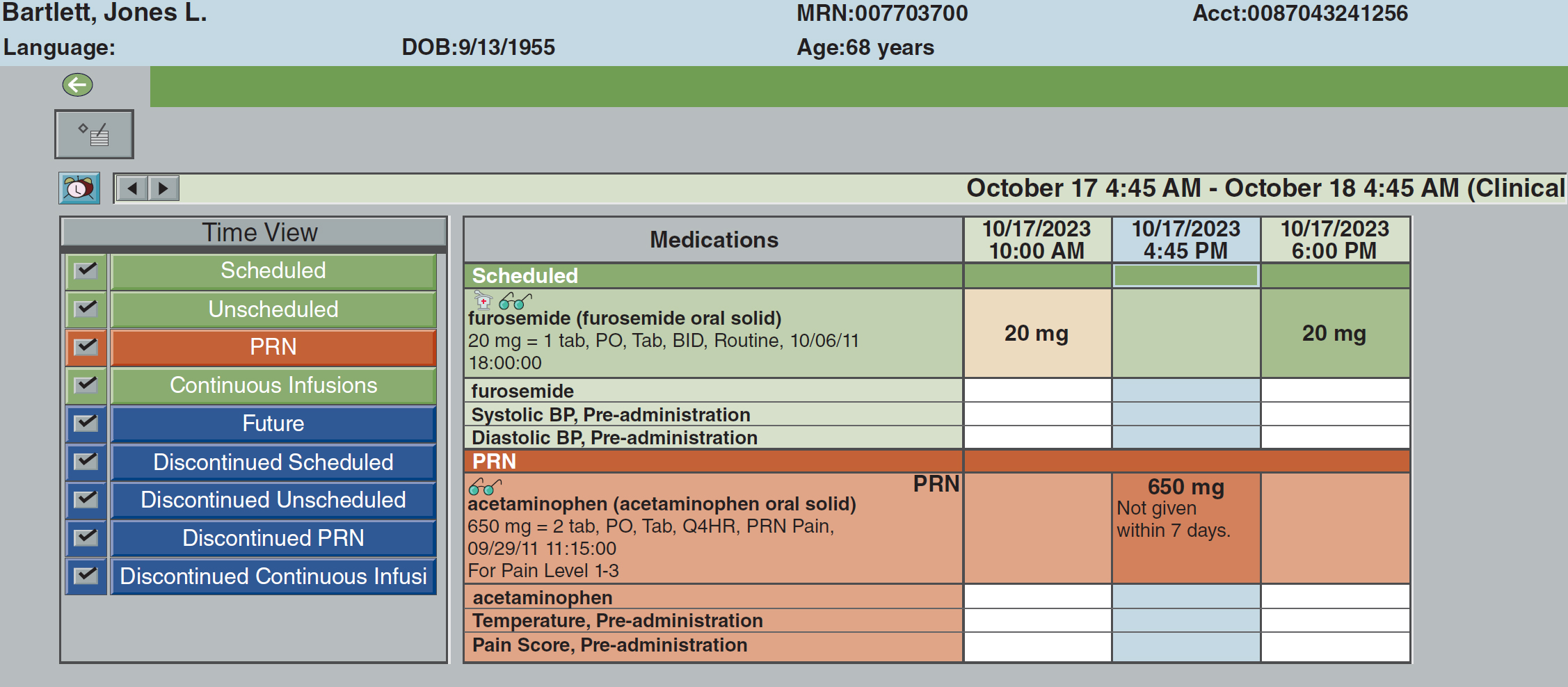
A medication order of Bartlett, Jones L.
The order reads, M R N: 007703700, Account: 0087043241256, blank space for language, date of birth: 13 September 1955, and age 68 years. Below it, the date and time are as October 17, 4:45 A M to October 18, 8:45 A M. The left panel depicts selected check boxes for scheduled, unscheduled, P R N, continuous infusions, future, discontinued scheduled, discontinued unscheduled, discontinued P R N, discontinued continuous infusion under time view. The right panel depicts a table with 4 columns. The column headers read: Medications, 10 forward slash 17 forward slash 2019 10:00 A M, 10 forward slash 17 forward slash 2019 4:45 P M, and 10 forward slash 17 forward slash 2019 6:00 P M. The upper section of the table is labeled, Scheduled and comprises 4 rows. The lower section is labeled P R N and comprises 4 rows. Row 1 reads, furosemide, furosemide oral solid. 20 milligrams equals 1 tablet, P O, Tablet, B I D, Routine, 10 forward slash 06 forward slash 11, 18:00:00, 20 milligrams, blank space, 20 milligrams. Row 2 reads, furosemide, blank space, blank space, blank space. Row 3 reads, Systolic B P, Pre-administration, blank space, blank space, blank space. Row 4 reads, Diastolic B P, Pre-administration, blank space, blank space, blank space. Row 5 reads, acetaminophen, acetaminophen oral solid, 650 milligrams equals 2 tablets, P O, Tablet, Q 4 H R, P R N Pain, 09 forward slash 29 forward slash 11 11:15:00 For Pain Level 1 to 3, blank space, 650 milligrams not given within 7 days, blank space. Row 5 reads, acetaminophen, blank space, blank space, blank space. Row 6 reads, Temperature, Pre-administration, blank space, blank space, blank space. Row 5 reads, Pain Score, Pre-administration, blank space, blank space, blank space.
Although most healthcare facilities utilize electronic medical records and generate medication orders electronically, sometimes medication orders are handwritten on paper forms. For agencies that do not have a computerized order-entry system in place or during unexpected computer downtimes, it is necessary for prescribing practitioners to generate medication orders via a paper documentation form as shown in Figure 4-4.
Handwritten orders on a medication order form.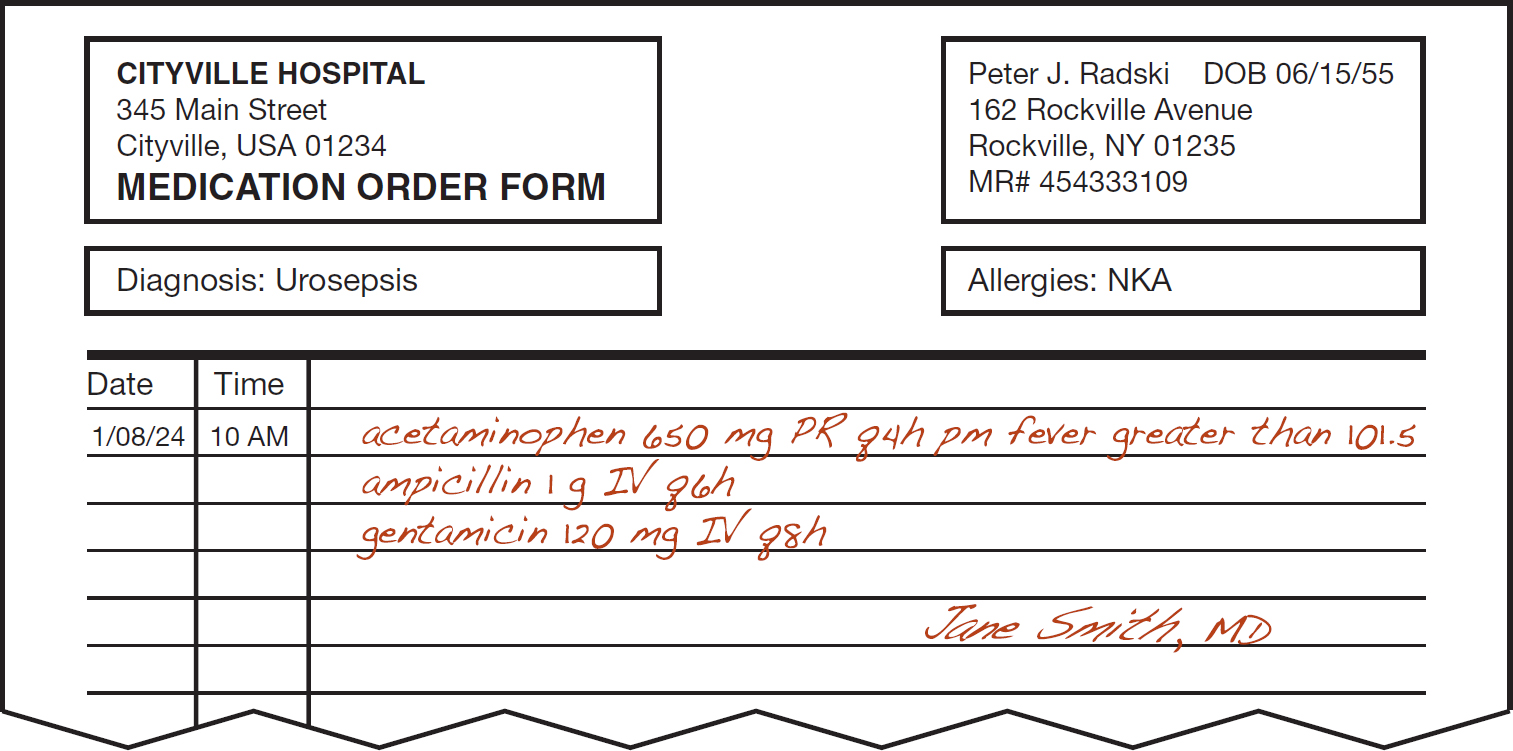
A medication order form of Cityville Hospital.
The form depicts the address of Cityville Hospital at the top left, name and address of the patient at the top right, and diagnosis and allergies below them. Below it, a table depicts the date, time, and medication with capacity signed by Jane Smith, M.D.
Clinical CLUE 4-3| National Patient Safety Goals, published annually by The Joint Commission, are identified to improve the safety of patients. The first of the recent goals published is correct patient identification. Double identification of the patient—that is, using both the patient name and DOB on the medication order—will ensure that each patient gets the correct medication. |
LEARNING ACTIVITY 4-3 Answer questions 1 and 2 as they relate to the order: "Give Mr. Smith (DOB 8/8/1959) ampicillin 500 mg q6h, Lucille Waterman, MD." Answer questions 3–5 as they relate to Figure 4-3.
1. Identify each complete component included in this medication order.
2. Cite the missing components of this medication order.
3. Identify the patient's name and DOB in Figure 4-3.
4. Identify the scheduled medication name, dose, route, and frequency.
5. Identify the PRN medication name, dose, route, and frequency.