AUTHOR: Joseph S. Kass, MD, JD, FAAN


Encephalopathy is a clinical syndrome of global cognitive impairment characterized by impaired arousal, inattention, and disorientation.
| ||||||||||||||||||||||||||||||||||||||||||||||||||||||||||||||||||||||||
Advanced age; cancer; AIDS; terminal illness; bone marrow transplant; postoperative state; poor nutritional status; acute or chronic cardiac, pulmonary, renal, or hepatic dysfunction; history of previous insult to the brain; epilepsy; drug abuse; alcoholism; overtreatment and undertreatment of pain; use of anticholinergics, benzodiazepines, opioids, barbiturates, and neuroleptics
- Common to all encephalopathies is a fluctuating level of arousal, poor attention, and dysfunction of other cognitive domains. Table 1 summarizes stages of encephalopathy in chronic liver disease.
- Some patients may appear agitated and others lethargic.
- Delusions (fixed false beliefs) and hallucinations are common.
- Asterixis (negative myoclonus) is common.
- Other physical findings, such as fever, ascites, jaundice, or tachycardia, may vary depending on the underlying cause of encephalopathy.
- Because toxins and metabolic disturbances are common causes of encephalopathy, the history should focus on exposure to toxins, especially medications with anticholinergic effects, and symptoms suggesting a concurrent illness such as a urinary tract infection, pneumonia, sepsis, meningitis, or encephalitis. Clinical events precipitating hepatic encephalopathy in patients with cirrhosis are summarized in Box 1.
BOX 1 Clinical Events Precipitating Hepatic Encephalopathy in Patients with Cirrhosis
Infection (including spontaneous bacterial peritonitis) Imbalance of electrolytes or acid-base Drugs, toxins, medications (especially sedative-hypnotics or opioids) |
From Vincent JL et al: Textbook of critical care, ed 7, Philadelphia, 2017, Elsevier.
TABLE 1 Stages of Encephalopathy in Chronic Liver Disease (West Haven Criteria)
| Stage | Clinical Signs | ||
|---|---|---|---|
| Stage I | Mental slowness, euphoria or anxiety, shortened attention span, impaired calculating ability | ||
| Stage II | Lethargy or apathy, inappropriate behavior, personality change, more obvious problems with calculations | ||
| Stage III | Lethargic, somnolent, marked confusion and disorientation, but responds to verbal stimuli | ||
| Stage IV | Coma, patient may or may not respond to noxious stimuli |
Patients with chronic liver disease rarely, if ever, demonstrate cerebral edema, regardless of the stage of encephalopathy.
From Vincent JL et al: Textbook of critical care, ed 7, Philadelphia, 2017, Elsevier.
The final common pathway of all causes of encephalopathy is widespread neuronal dysfunction from either a structural or functional cause. Many conditions are reversible and carry a good prognosis if treated in a timely manner.
- Organ failure: Hepatic encephalopathy (Fig. 1), uremia, hypoxia, hypercapnia
- Infection: Systemic (e.g., urinary tract, pneumonia, sepsis) or involving the central nervous system (CNS) (e.g., meningitis, encephalitis)
- Toxin ingestion or withdrawal: Special consideration should be paid to alcohol, cannabis and other recreational drugs, benzodiazepines, anticholinergics, neuroleptics, and antibiotics (e.g., fluoroquinolones, cefepime, metronidazole, ertapenem)
- Electrolyte disturbances: Hypernatremia, hyponatremia, hypercalcemia
- Metabolic disorders: Acidosis, alkalosis, inborn errors of metabolism
- Endocrinopathy: Diabetic ketoacidosis, hyperglycemic hyperosmolar state, hypoglycemia, thyroid storm, myxedema, adrenal insufficiency, hyperadrenalism
- Neoplasm: Tumors of the CNS, primary or metastatic; paraneoplastic limbic encephalitis
- Nutritional deficiency, mostly in alcoholics and chronically ill patients, such as vitamin B1 deficiency (Wernicke encephalopathy)
- Seizures: Postictal state, nonconvulsive status epilepticus, complex partial seizures, absence seizures
- Trauma: Concussion, contusion, subdural hematoma, epidural hematoma, diffuse axonal injury
- Vascular: Ischemic and hemorrhagic strokes, aneurysmal subarachnoid hemorrhage, cerebral vasculitis, cerebral venous sinus thrombosis
- Anoxic brain injury
- Psychiatric disease: Acute psychosis, mania, catatonia
- Acute demyelinating disease: Acute disseminated encephalomyelitis, tumefactive multiple sclerosis
- Other autoimmune diseases: Autoimmune encephalitis (e.g., anti-NMDA receptor encephalitis), lupus cerebritis, cerebral vasculitis (primary angiitis of the CNS or a secondary cerebral vasculitis)
- Other: Posterior reversible encephalopathy syndrome (PRES), hypertensive encephalopathy, postoperative status, sleep deprivation
Figure 1 Proposed pathophysiology of hepatic encephalopathy.

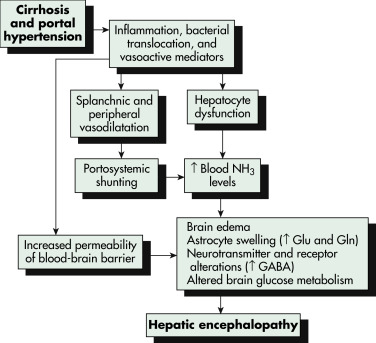
GABA, Gamma-aminobutyric acid; Gln, glutamine; Glu, glutamate; NH3, ammonia.
From Feldman M et al [eds]: Sleisenger and Fordtran’s gastrointestinal and liver disease, ed 10, Philadelphia, 2016, Saunders.

