AUTHOR: Sudeep K. Aulakh, MD, FACP, FRCPC


Familial adenomatous polyposis (FAP) is a highly penetrant, autosomal-dominant condition characterized by hundreds of colorectal adenomatous polyps that inevitably progress to cancer (Fig. E1). Gardner syndrome is a subset of FAP, with prominent extraintestinal manifestations including dental abnormalities, soft tissue lesions, desmoid tumors, and osteomas.
| ||||||||||||||||||||||||
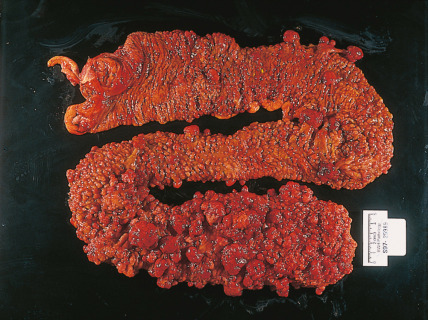
- FAP occurs in approximately 1 in 10,000 births worldwide.1
- FAP accounts for <1% of all colorectal cancers.
- Individuals develop hundreds to thousands of adenomatous colorectal polyps.
- Polyps usually present in adolescence.
- 100% lifetime risk for colorectal cancer; most diagnosed by 40 yr of age.
- Gastric, duodenal, periampullary, and small bowel polyps occur but have lower malignant potential.
- Increased risk for other tumors: Desmoid (15%), duodenal/periampullary (7%), thyroid (2%), brain (1%), childhood hepatoblastoma (1%), nasopharyngeal angiofibroma (benign), pancreatic (2%), adrenal adenoma (10%), and gastric (1%).2
Phenotypic variability is seen in individuals and families with the same mutation. Extraintestinal manifestations may precede intestinal disease. These findings are reported in at least 20% of individuals with FAP.
- Congenital hypertrophy of the retinal pigment epithelium (CHRPE): Benign fundus lesions, usually present at birth
- Dental abnormalities: Supernumerary or unerupted teeth
- Soft tissue lesions: Epidermal or sebaceous cysts, fibromas, lipomas, desmoid tumors (benign, locally invasive, aggressive connective tissue tumor)
- Osteomas (benign bone growths): Skull, mandible, long bone
- Anemia, occult blood in stool, bowel obstruction, weight loss
- FAP is caused by mutations of the tumor suppressor gene adenomatous polyposis coli (APC) on chromosome 5q21 to q22; more than 1000 disease-causing mutations identified. The site of the mutation often correlates with the extraintestinal findings.3
- De novo mutations are responsible for approximately 20% of FAP cases. These may be due to germline mutations or somatic cell mosaicism, which is seen when a new mutation occurs in the APC gene postfertilization and is present in only a subset of cell types or tissues.
- Table E1 summarizes the genetics of colonic polyposis.
TABLE E1 Genetics of Colonic Polyposis
| Syndrome (Abbreviation, Synonym) | Gene(s) | Molecular Phenotype | Noncolonic Organs Affected |
|---|---|---|---|
| Sporadic adenomatous polyp | Unknown | Chromosomal instability (aneuploidy) | None known |
| Familial adenomatous polyposis (FAP) | APC | Chromosomal instability (aneuploidy) | Duodenum, stomach, pancreas, thyroid, liver, central nervous system |
| Attenuated familial adenomatous polyposis (AFAP) | APC | Chromosomal instability (aneuploidy) | Duodenum, thyroid, liver, central nervous system |
| Hereditary nonpolyposis colon cancer (HNPCC, Lynch syndrome) | hMLH1, hMSH2, hMSH6, hPMS2 | MSI | Endometrium, stomach, ovary, biliary and urinary tracts, small bowel, central nervous system |
| MUTYH-linked adenomatous polyposis (MAP) | MUTYH | Chromosomal instability (aneuploidy) | Duodenum |
| Peutz-Jeghers syndrome (PJS) | STK1 (70%) | Unknown | Breast, pancreas, stomach, ovary, lung, small bowel, uterus, testis |
| Juvenile polyposis syndrome | SMAD4, BMPR1A | Unknown | Blood vessels (hereditary hemorrhagic telangiectasia) |
| Hyperplastic polyposis | SMAD4, BMPR1A (40%), PTEN | Unknown | Stomach, pancreas, small bowel |
MSI, Microsatellite instability.
From Niederhuber JE: Abeloff’s clinical oncology, ed 6, Philadelphia, 2020, Elsevier.


