AUTHOR: Joseph S. Kass, MD, JD, FAAN


Frontotemporal dementia (FTD) is an umbrella term that encompasses three distinct syndromes: Behavioral variant FTD (bvFTD), semantic dementia (SD), and progressive nonfluent aphasia (PNFA). All three syndromes are marked by frontal and/or temporal lobe atrophy; however, they manifest with different clinical presentations. The most common subtype is bvFTD, which is marked by changes in behavior and personality with disinhibition, lack of empathy, and the breaking of social norms. SD is characterized by a loss of word comprehension and meaning, and PNFA presents with agrammatic, nonfluent speech.
Frontotemporal lobar degeneration (FTLD) is the term used for the neuropathologic findings seen in the different FTD syndromes.
Pick disease: This term was historically used to refer to FTD. However, it is now strictly a neuropathologic diagnosis for patients found to have Pick bodies at autopsy, as very few diagnoses of FTD are associated with these neuropathologic findings.
| ||||||||||||||||
The current data on epidemiology of FTD are variable due to misdiagnosis and underreporting. The following data are estimations obtained through systematic reviews.
There is a nearly equal distribution by sex, and the average age of presentation is 58 yr.
Approximately 40% of FTD cases have a positive family history, and several genes (Table 1) have been associated with the development of familial FTD. The most common are mutations in C9ORF72, MAPT, and GRN (Table 2).
TABLE 2 Gene Mutations Associated With Frontotemporal Dementia
| Gene | Chromosome | Protein | Protein Function | Mode of Inheritance | Mutation Frequency in Familial FTD | Mutation Frequency in Sporadic FTD | Age of Onset (Mean, Range) |
|---|---|---|---|---|---|---|---|
| C9ORF72 | 9p21.2 | Unknown | Unknown | AD | 21% | 6% | 50s (mid 20-80s) |
| MAPT | 17q21.31 | Microtubule-associated tau protein | Microtubule stabilization and assembly | AD | 6.3% | 1.5% | Mid-50s (20-80s) |
| GRN | 17q21.31 | Progranulin | Activates signaling cascades for development, inflammation, and wound repair | AD | 5%-15% | 5% | 60s (mid 30-80s) |
AD, Autosomal dominant; FTD, frontotemporal dementia.
From Deleon J, Miller BL: Frontotemporal dementia. In Daniel CK et al (eds): Handbook of clinical neurology, ed 148, Philadelphia, 2018, Elsevier, pp. 409-430.
TABLE 1 Clinical, Genetic, and Pathologic Correlations in Frontotemporal Lobar Degeneration
| Comorbidities | Neuropathologic Subtypes | ||||||||||
|---|---|---|---|---|---|---|---|---|---|---|---|
| Clinical Presentation | % of FTLD | Associated | Genes | Parkinsonism | MND | IBM PDB | FTLD-tau | FTLD-TDP | FTLD-FUS | FTLD-UPS | FTLD-ni |
| bvFTD | 57% | + | + | +/– | ++ | ++ | + | +/– | +/– | ||
| C9orf72 | ++ | + | ++ | Type B >A | +/– | ||||||
| GRN | + | + | Type A | ||||||||
| MAPT | + | + | + | ||||||||
| VCP | +/– | +/– | + | Type D | |||||||
| CHMP2B | +/– | +/– | +/– | + | |||||||
| nfvPPA | 24% | + | +/– | ++ | + | ||||||
| C9orf72 | + | ||||||||||
| GRN | ++ | + | Type A | ||||||||
| MAPT | + | + | + | ||||||||
| svPPA | 19% | +/– | +/– | +/– | ++ (Type C) | ||||||
| Rarely genetic | |||||||||||
Number of plus signs (+) signifies relative frequency of the observation; +/– indicates rare observation. bv, Behavioral variant; FTD, frontotemporal dementia; FTLD, frontotemporal lobar degeneration; FUS, fused in sarcoma; IBM, inclusion body myopathy; MND, motor neuron disease; nfv, agrammatic or nonfluent variant; ni, no inclusions; PDB, Paget disease of the bone; PPA, primary progressive aphasia; sv, semantic variant; TDP, TAR DNA-binding protein; UPS, ubiquitin-proteasome system.
From Fillit HM: Brocklehurst’s textbook of geriatric medicine and gerontology, ed 8, Philadelphia, 2017, Elsevier.
- The early stage of bvFTD is characterized by changes in behavior and personality. Patients display a lack of insight into these changes, and family members may initially think they are suffering a midlife crisis or a new-onset psychiatric disorder. Therefore careful history-taking is required.
- Behavioral changes include disinhibition, impulsivity, distractibility, violation of social norms (such as offensive, insensitive, or inappropriate sexual remarks; inappropriate behaviors; inappropriately explicit or personal conversations; or encroachment on the personal space of others), as well as increased irritability and impulsive criminal behavior (such as shoplifting or violating traffic laws).
- Patients also display decreased ability to empathize with others, insensitivity to the needs and emotions of their loved ones, and detachment in their personal relationships.
- Apathy and inertia are also common symptoms, with possible development of immobility as the disorder progresses.
- Other associated symptoms that may develop are changes in language and speech (verbal aspontaneity, stereotyped phrases, mutism in late stages), repetitive motor movements, or hyperphagia, especially for sweet foods.
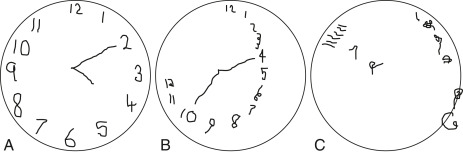
- Physical exam findings for bv FTD can include abnormal cognition (e.g., clock drawing test [Fig. 1]), upper and/or lower motor neuron signs, dysarthria, dysphagia, and pseudobulbar affect. Some patients meet criteria for both FTD and amyotrophic lateral sclerosis. This overlap is typically related to a C9ORF72 mutation.
- Although behavioral changes can also occur in the other FTD syndromes SD and PNFA, these two primarily have language deficits that precede the behavioral changes.
The Patient is Provided with a Circular Outline and Asked to Draw the Numbers as They Appear on the Face of a Clock. Once the Numbering is Complete, the Patient is Asked to Set the Hands to a Particular Time (Often “ten Past” the Hour to Test if the Patient Can Suppress the Impulse to Include the Number 10). (A) This Drawing Demonstrates Good Planning and Use of Space. (B) This Drawing Features Some Impulsiveness Because the Numbers are Drawn Out Without Regard for Actual Location, and the Time “ten Past Four” is Represented by Hands Pointing to the Digits 10 and 4. Note the Perseveration Indicated by the Extra Loops on the Digits 3 and 6. Impulsiveness and Perseveration Indicate Frontal Lobe Dysfunction. (C) This Drawing Demonstrates Gross Disorganization, Although the Patient Took Several Minutes to Draw the Clock and Believed It to Be a Good Representation.
From Stern TA: Massachusetts General Hospital handbook of general hospital psychiatry, ed 7, 2018, Philadelphia, Elsevier.


