Author: Philip A. Chan, MD, MS


The human immunodeficiency virus (HIV) is a retrovirus that is responsible for causing acquired immunodeficiency syndrome (AIDS). HIV infection does not necessarily mean a person has AIDS. Table 1 summarizes surveillance case definition for HIV.
TABLE 1 Surveillance Case Definition for HIV Infection in Adults and Adolescents (Age >13 yr)
| Stage | Laboratory Evidence | Clinical Evidence |
| Stage 1 | Laboratory confirmation of HIV infection and CD4+ T-lymphocyte count of ≥500 cells/μl or CD4+ T-lymphocyte percentage of ≥29%a | No AIDS-defining condition (see Table 2) |
| Stage 2 | Laboratory confirmation of HIV infection and CD4+ T-lymphocyte count of 200-499 cells/μl or CD4+ T-lymphocyte percentage of 14%-28%a | No AIDS-defining condition (see Table 2) |
| Stage 3 | Laboratory confirmation of HIV infection and CD4+ T-lymphocyte count of <200 cells/μl or CD4+ T-lymphocyte percentage of <14%a | Documentation of an AIDS-defining condition with laboratory confirmation of HIV infection (see Table 2) |
| Stage unknown | Laboratory confirmation of HIV infection and no information on CD4+ T-lymphocyte count or percentage | No information on presence of an AIDS-defining condition |
AIDS, Acquired immunodeficiency syndrome.
a The CD4+ T-lymphocyte percentage is a percentage of the total lymphocyte count.
From Hoffman R et al: Hematology, basic principles and practice, ed 7, Philadelphia, 2018, Elsevier.
- HIV
- AIDS: The result of progressive HIV infection in which a person has a weakened immune system and meets specific diagnostic criteria (See "Acquired Immunodeficiency Syndrome" in Section I and Table 2.)
TABLE 2 Surveillance Definitions of AIDS-Defining Conditions
| Opportunistic Infections: | |||
| Lymphomas | |||
| Kaposi Sarcoma | |||
| Cervical Cancer | |||
| AIDS Dementia Syndrome | |||
| Wasting Syndrome |
AIDS, Acquired immunodeficiency syndrome.
From Hoffman R et al: Hematology: basic principles and practice, ed 7, Philadelphia, 2018, Elsevier.
| ICD-10CM CODE | |||
| B20 | Human immunodeficiency virus (HIV) disease | ||
- •An estimated 1.2 million people in the U.S. are infected with HIV, and approximately 14% of them do not know they are infected.1
- •Worldwide each year, an estimated 1.3 million persons living with HIV become pregnant. The vast majority of pregnant persons living with HIV reside in low- and middle-income countries with limited access to antiviral therapy (ART) and in the absence of ART, 15% to 30% of infants born to persons with HIV acquire HIV antenatally or perinatally, with additional transmission during breast feeding.2
- •There are ∼38,000 new HIV diagnoses each year, according to the Centers for Disease Control and Prevention (CDC).1
- •Incidence is highest among gay, bisexual, and other men who have sex with men (MSM) and Black and Hispanic/Latino populations.
- •Gay, bisexual, and other MSM is the group most affected by HIV.
- •MSM account for approximately two thirds of all new diagnoses each year, according to the CDC.1
- •HIV disproportionately affects MSM of younger age and Black and Hispanic/Latino background.
- •Heterosexual transmission accounts for ∼25% of new HIV diagnosis. Injection drug use accounts for ∼6% to 7%.
- •Table 3 summarizes risk factors associated with sexual transmission of HIV.
- •Black individuals account for >40% of all new HIV diagnoses despite being 12% of the U.S. population.1
- •Hispanics/Latinos account for >25% of all new HIV diagnoses despite being 18% of the U.S. population.
Individuals with deletions in the CCR5 gene are immune from infection with macrophage tropic virus (the predominant virus in sexual transmission).3 Other genetic variants may contribute to rapid progression or long-term control of the virus once infected. One in 300 individuals infected with HIV is an "elite controller," which means they are able to maintain a normal CD4 count and undetectable viral load through immune control.4
- •Fewer than 100 children a year <13 yr receive a diagnosis of perinatally acquired HIV, according to the CDC.5
- •No specific congenital abnormalities are associated with HIV infection, although there is a higher risk of spontaneous abortion and low birth weight.
- •May occur during delivery or via breastfeeding
- •Typically asymptomatic
- •All pregnant women should be tested for HIV and, if positive, take antiretrovirals (ARVs)6
- •Signs and symptoms are variable with stage of disease (Fig. 1).
- •Acute HIV infection (0 to 3 mo, usually within several weeks)7:
- 1.Causes a self-limited mononucleosis-like illness in 50% to 80% of individuals, characterized by fever, sore throat, lymphadenopathy, headache, and a rash resembling roseola. Individuals may also be asymptomatic.
- 2.In a minority of acute cases, aseptic meningitis, Bell palsy, or peripheral neuropathy may occur.
- 3.Opportunistic infections such as thrush or Pneumocystis jiroveci pneumonia (PJP) may occur.
- •Chronic HIV infection is usually characterized by a prolonged asymptomatic "latent" phase without symptoms followed by nonspecific symptoms of lymphadenopathy, fatigue, weight loss, diarrhea, and skin changes, including seborrheic dermatitis, localized herpes zoster, and/or fungal infection.
- •Advanced disease is characterized by AIDS-associated diseases, including infections and malignancies (see specific disorders). Anemia may be multifactorial (Table 4).
- •HIV infection in women may be associated with lower levels of viral load at comparable degrees of immunosuppression when compared with men. Furthermore, women may, on average, have higher CD4 counts at the time of HIV diagnosis.
- •Another special consideration in women infected with HIV is the high incidence of human papillomavirus (HPV) coinfection and risk for cervical cancer. HIV-positive women should be screened for cervical cancer at time of initial HIV diagnosis and annually thereafter if Pap testing is normal.8 If the results of three consecutive Pap tests are normal, then follow-up testing can occur every 3 yr. HPV vaccination is also recommended in men and women 9 to 26 yr who are HIV positive (three doses at 0, 1 to 2, and 6 mo). For adults aged 27 to 45 yr, clinicians should discuss and may consider HPV vaccination in persons who are most likely to benefit.
- •Coinfection with HIV and hepatitis C virus (HCV) is common because of similar transmission risk. Hepatitis C is most commonly transmitted by contaminated needles or blood exposure. HCV can be transmitted sexually, but the risk is low. Patients with HIV and HCV progress faster to cirrhosis. Patients may already have signs of advanced liver disease at the time of diagnosis.
Figure 1 Systemic and neurologic events in human immunodeficiency virus (HIV) infection.
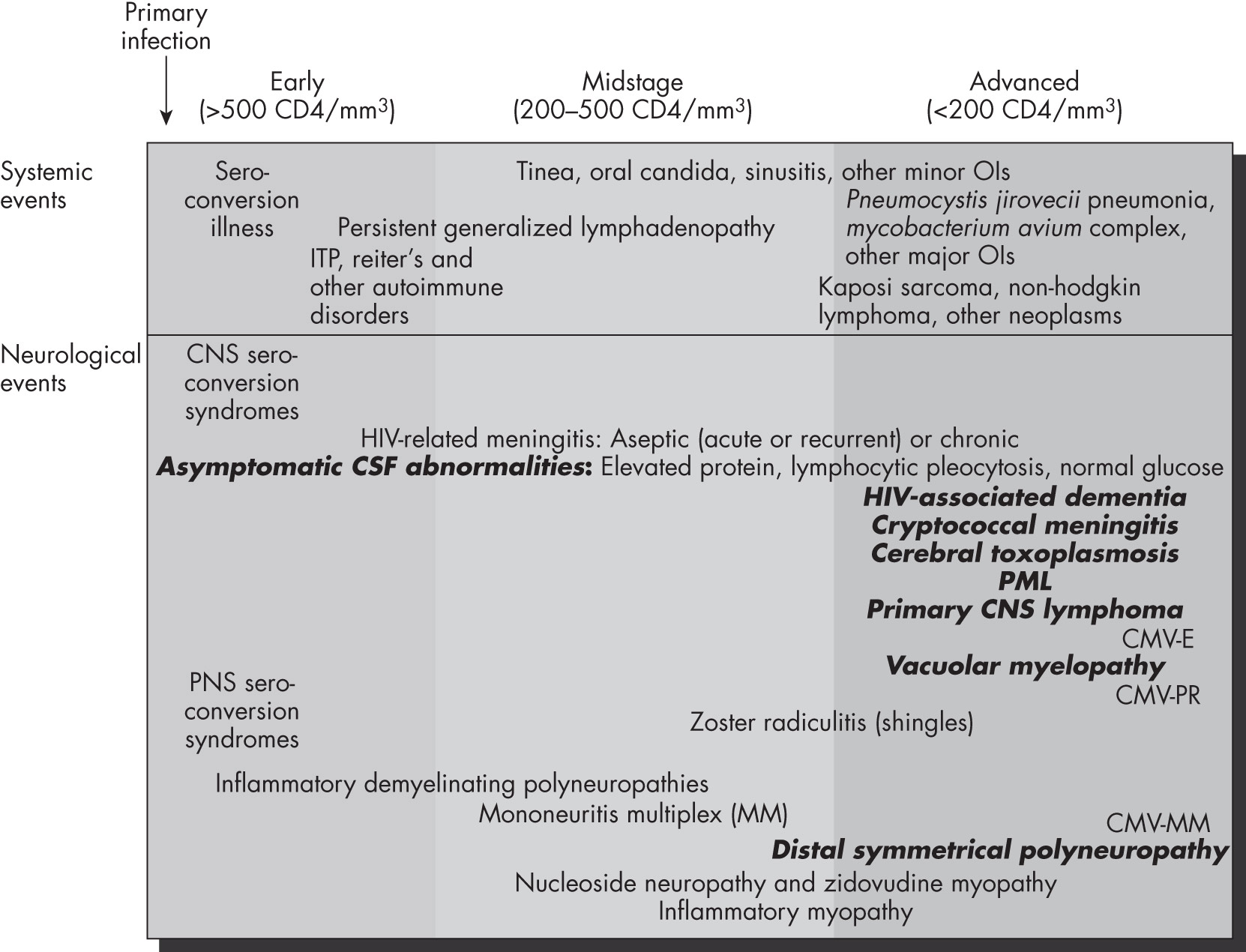
Temporal sequence is approximate and indicates the increasing risk of systemic and neurologic complications as HIV infection advances. CMV-E, Cytomegalovirus encephalitis; CMV-PR, CMV polyradiculitis; CNS, central nervous system; CSF, cerebrospinal fluid; ITP, idiopathic thrombocytopenic purpura; OIs, opportunistic infections; PML, progressive multifocal leukoencephalopathy; PNS, peripheral nervous system.
(From Jankovic J et al: Bradley and Daroff’s neurology in clinical practice, ed 8, Philadelphia, 2022, Elsevier.)
TABLE 4 Etiology of Anemia in Human Immunodeficiency Virus
| HIV Related | |||
| HIV Infection | |||
| |||
| Neoplasms Infiltrating BM | |||
| Non-Hodgkin lymphoma, KS, Hodgkin lymphoma | |||
| Infections of the BM | |||
| Medications Causing Decreased Production | Medications Causing Hemolysis | ||
| HIV Unrelated | |||
| |||
BM, Bone marrow; CFU-GEMM, colony-forming unit-granulocyte, erythrocyte, macrophage, megakaryocyte; CMV, cytomegalovirus; G6PD, glucose-6-phosphate dehydrogenase; KS, Kaposi sarcoma; MAC, Mycobacterium avium complex; MAI, Mycobacterium avium-intracellulare; RT, reverse transcriptase.
From Hoffman R et al: Hematology, basic principles and practice, ed 7, Philadelphia, 2018, Elsevier.
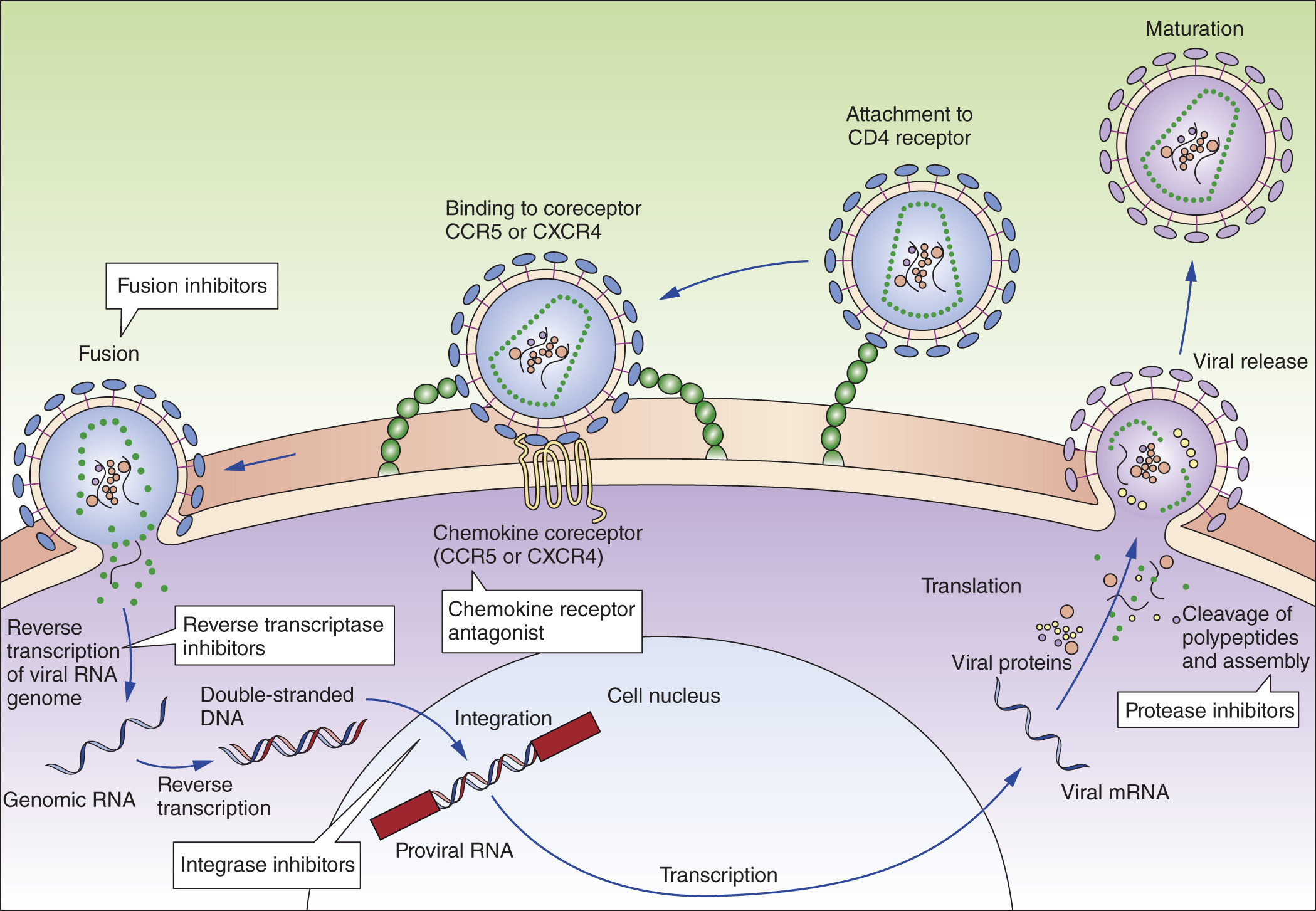
- •HIV is a single-stranded ribonucleic acid (RNA) retrovirus (Fig. E2) that is categorized as type 1 or 2. Fig. E3 illustrates the replicative cycle of the HIV virion.
- •HIV-1 was derived from transmission of a simian immunodeficiency virus (SIV) from chimpanzees in Central Africa; HIV-2 was derived from an SIV found in sooty mangabey monkeys from West Africa.9
- •HIV-1 is the predominant pathogenic retrovirus in human populations; HIV-2 has limited distribution (primarily West Africa) and tends to progress less rapidly than HIV-1. HIV-2 should be considered in individuals from West Africa or whose sexual partners are from West Africa.
- •HIV is transmitted by sexual contact, shared needles, blood transfusion, or from mother to child during pregnancy, delivery, or breastfeeding.
- •Primary target of infection: CD4 lymphocytes.
Figure E2 Structure of the human immunodeficiency virus virion.
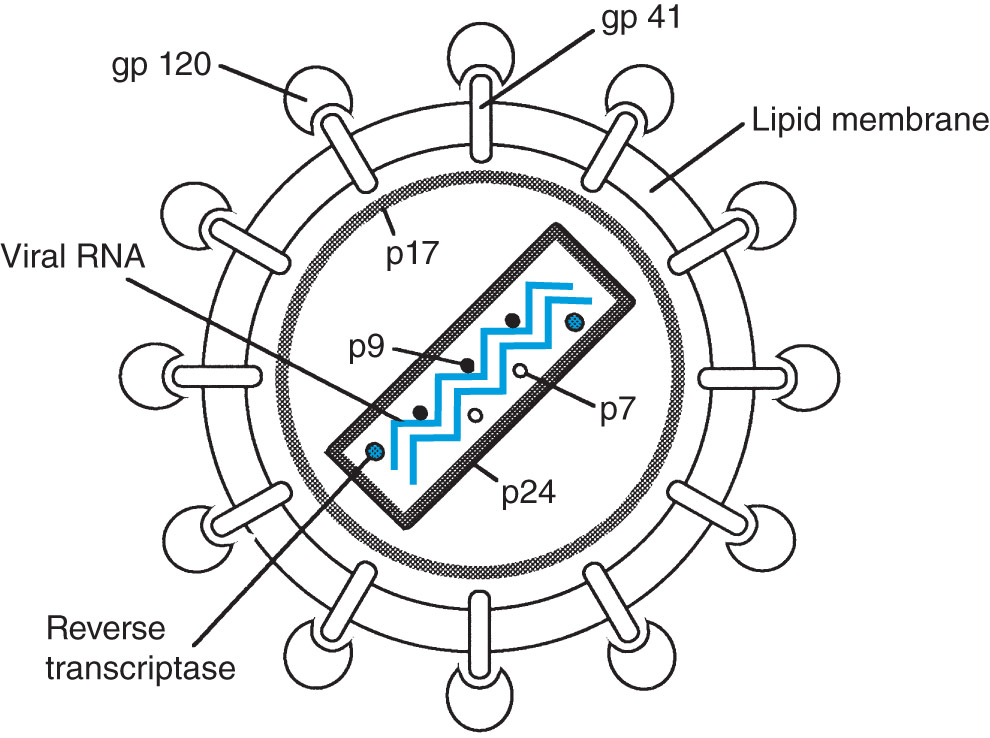
Two coding strands of genomic ribonucleic acid (RNA) are packaged in the nucleoid core with p7, p9, and p24 proteins and reverse transcriptase. The core is surrounded by the p17 matrix protein lining the inner surface of the envelope. The envelope consists of a lipid bilayer derived from the infected cell and glycoprotein spikes that consist of the outer glycoprotein (GP) 120 molecule, which contains the binding site for CD4, and GP41, which anchors the glycoprotein complex to the envelope and mediates fusion of the viral membrane with the cell membrane during viral penetration.
(From Hoffman R et al: Hematology, basic principles and practice, ed 7, Philadelphia, 2018, Elsevier.)