Author: Chi-Ying (Roy) Lin, MD, MPH, FAAN

Progressive supranuclear palsy (PSP) is an atypical parkinsonian syndrome characterized by parkinsonism, supranuclear gaze impairment, prominent and early postural instability with falls, axial greater than appendicular rigidity, and cognitive decline.
| ICD-10CM CODES | |||
| G23.1 | Progressive supranuclear ophthalmoplegia, | ||
| G23.1 | Steele-Richardson-Olszewski syndrome (or Richardson-Steele-Olszewski syndrome) | ||
Slight male predominance; mean age of onset 65 yr, very uncommon for onset <50 yr
The majority of PSP cases are sporadic and not considered a genetic disease. Familial cases have been reported only rarely and are usually associated with the microtubule-associated protein tau (MAPT) gene. Of note, the H1 haplotype in both copies of MAPT on chromosome 17 was more commonly seen in those with PSP than in those who don’t have PSP; however, the presence of H1 haplotype is necessary but not sufficient to explain the development of PSP.2
While there are several subtypes of PSP, the majority of patients present with the following core features:
- •Early postural instability and retropulsion leads to frequent backward falls. In severe cases, patients could fall backward just by sitting on the floor, and the falls frequently occur within the first yr.
- •Akinesia and atremulous parkinsonism with early gait freezing within the first 3 yr or an akinetic-rigid axial parkinsonism. Although sometimes confused for idiopathic Parkinson disease (PD), gait freezing within the first 3 yr and symmetry of symptoms are atypical for PD.
- •Supranuclear gaze palsy is often preceded by slowing of vertical saccades, and patients might report difficulty with tasks that require downward gaze eye movement, such as reading. Square wave jerks are another common but nonspecific finding to PSP, as they can also manifest in cerebellar ataxia. The term "supranuclear" implies that the integrity of third, fourth, and sixth nerve nuclei. Thus, the standard way of examining its supranuclear nature is to conduct the oculocephalic maneuver (Fig E1), the response to which remains normal in PSP.
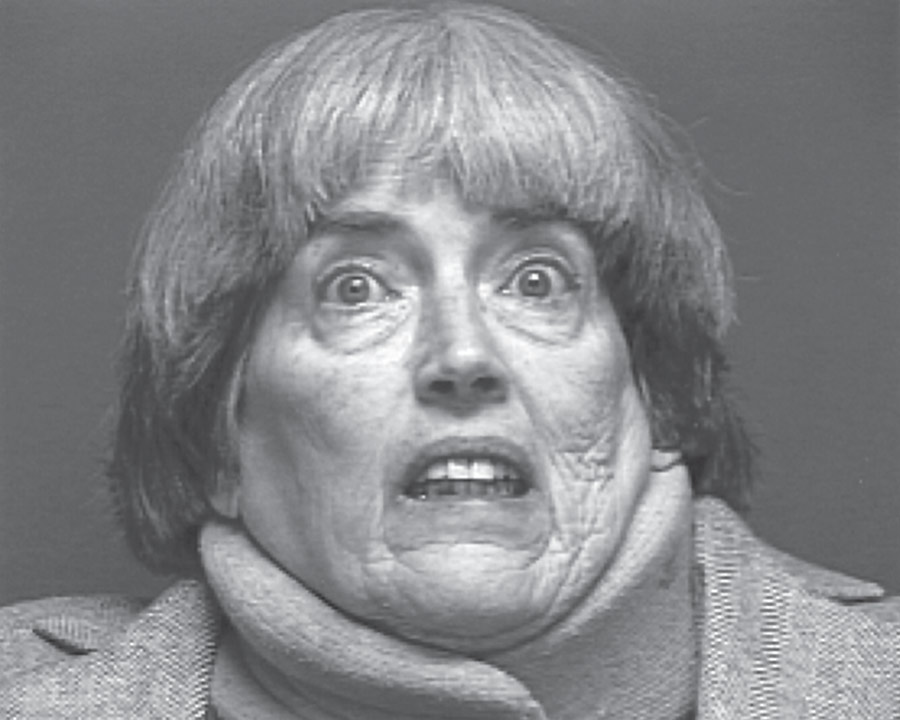
- •Dystonia of the frontalis and procerus muscles gives the PSP patient a "surprised" or "frightened" expression (Fig. E1) as opposed to the hypomimia of PD (Fig. E2). Of note, blepharospasm, a focal dystonia of eyelid closure, and eyelid open apraxia could also manifest in PSP.
- •At the neuropathology level, PSP belongs to frontotemporal lobar degeneration. Thus frontal lobar dysfunction and its related symptoms are commonly seen in PSP, including, but not limited to, the following:
- 1.Speech apraxia: While not universally presenting in every person with PSP, speech apraxia is one of the main features of PSP. Speech is effortful, distorted, groping, and halting, as opposed to the hypophonia seen in PD.
- 2.Pseudobulbar affect can be seen, typically presenting with inappropriate and involuntary crying or laughter without a preceding trigger or with a trigger that is disproportionate to the emotional response.
- 3.Early cognitive impairment and behavioral disturbance, including apathy and/or impulsivity. Impulsivity has been identified as one of the main factors for falls in PSP, in addition to the motor symptoms.
- 4.Applause sign (the inability to execute the same amount of claps as performed by the examiner) can be seen in PSP as well as other neurodegenerative disorders, especially later in the disease course.3
- •There are multiple subtypes of PSP by clinical presentation, and there is significant variability in the correlation between clinical presentation and neuropathology.1,3,4 The majority of PSP subtypes belong to Richardson syndrome (PSP-RS), the classic PSP with constellations of above-mentioned features exhibiting early in the stage. PSP with predominant parkinsonism (PSP-P) demonstrates slower progression and better response to carbidopa/levodopa compared to other PSP subtypes. Depending on the predominant and early clinical features, patients can be further categorized into PSP with predominant oculomotor dysfunction (PSP-OM), postural instability (PSP-PI), progressive gait freezing (PSP-PGF), frontal presentation (PSP-F), or speech/language disorder (PSP-SL). Of note, while the cerebellum and upper motor neuron systems have been traditionally thought to be less involved in PSP, cerebellar ataxia (PSP-C) and upper motor neuron (PSP-PLS) system involvement can be the principal and initial symptoms in PSP, as reported from pre- and postmortem studies.5-7
Figure E1 A, Progressive Supranuclear Palsy (Psp) Patients May have a Facial Grimace Because of Continuous Contractions of Their Facial Muscles
B, Because of the Loss of the Ability to Voluntarily Move the Eyes Vertically, the Hallmark of Psp, This Patient Cannot Comply with the Examiner’s Request to Look Fully Downward. Clinically, This Can Be Evaluated by the Degree of Sclera Visible. C, However, When the Examiner Rocks the Patient’s Head Back (Performs an Oculocephalic Maneuver*), His Eyes Dip Well below the Meridian. *the Oculocephalic Maneuver, Also Known as the Doll’s Eye Reflex, is a Clinical Test Used to Assess the Integrity of Brainstem Function. It Involves Moving the Patient’s Head Briskly to One Side While Observing the Eyes; in a Normal Response, the Eyes Will Move in the Opposite Direction to Maintain a Steady Gaze. In Conditions Like Progressive Supranuclear Palsy, the Eyes Still Respond Normally to This Maneuver Despite Other Limitations in Voluntary Eye Movement, Confirming that the Issue is Supranuclear, Not at the Level of the Cranial Nerves or Their Nuclei.
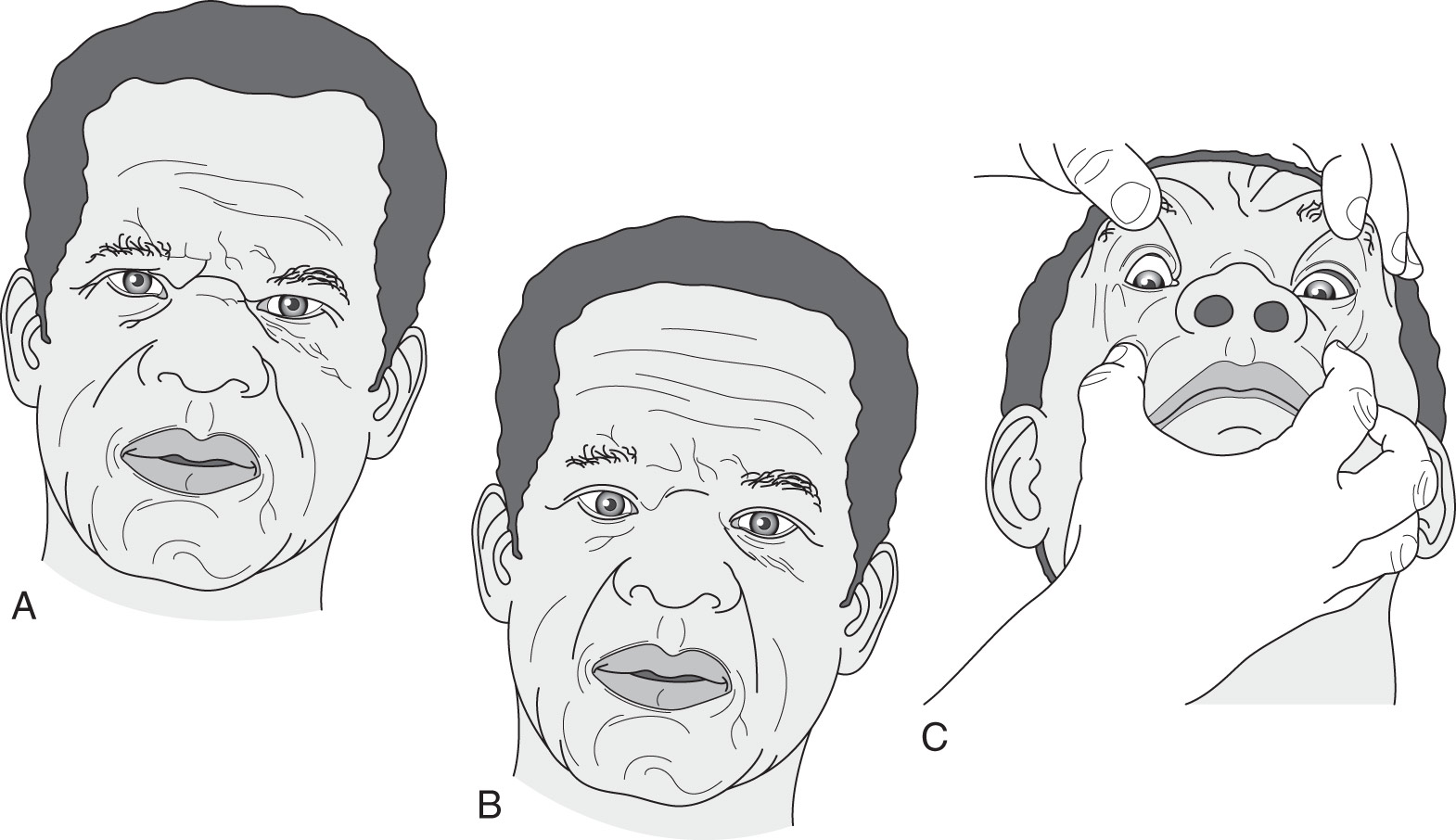
(From Kaufman DM et al: Kaufman’s clinical neurology for psychiatrists, ed 9, Philadelphia 2023, Elsevier.)
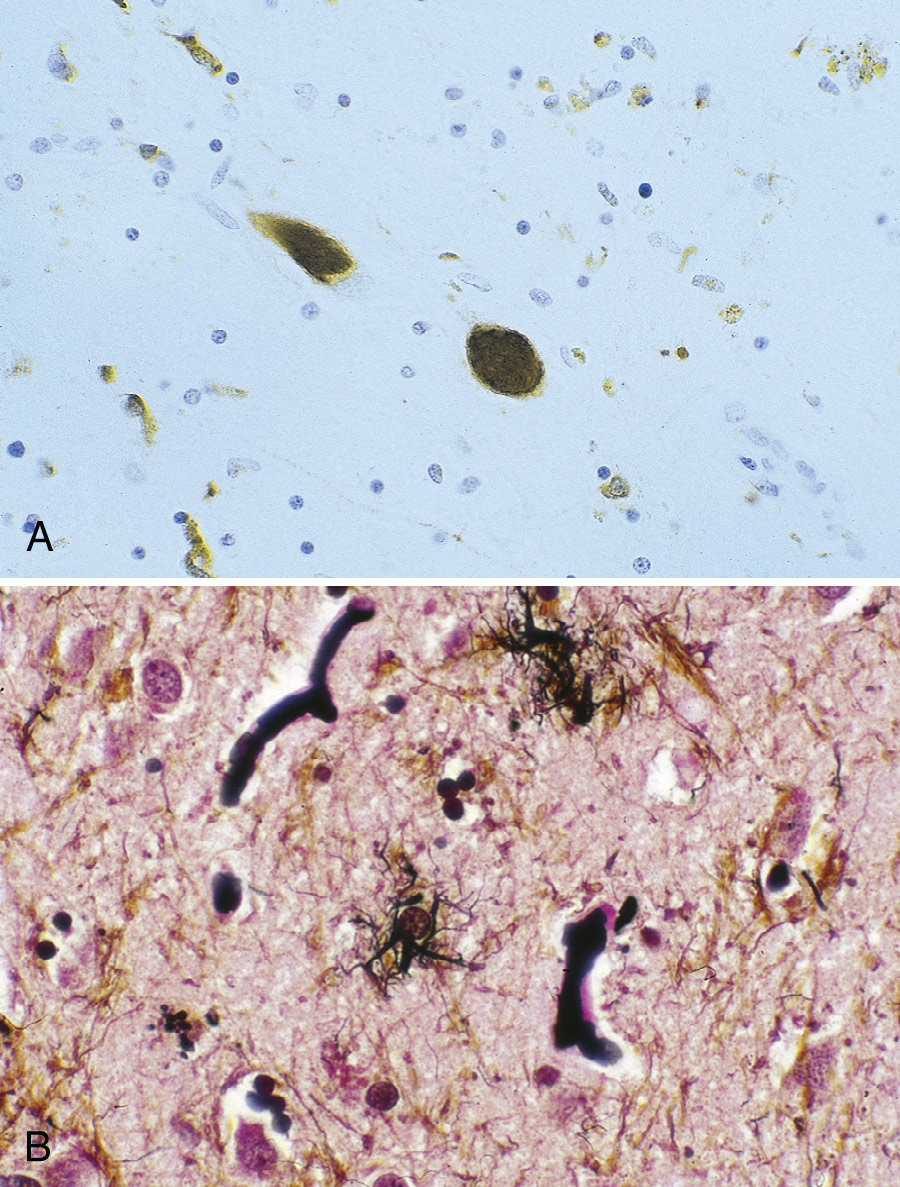
PSP is a tauopathy characterized by widespread atrophy and neuronal degeneration of nuclei in the brain stem and basal ganglia as a result of abnormal tau protein accumulation in tufted astrocytes and neurofibrillary tangles. While sharing the features of MAPT H1 haplotype and four-repeat tau isoforms, the cytopathology of corticobasal degeneration is astrocytic plaque not tufted astrocytes.8