Author: Taylor Buckley, MD and Siri M. Holton, MD

Abnormal uterine bleeding (AUB) describes uterine bleeding that is abnormal in regularity, quantity, frequency, or duration, in the nonpregnant person. Historically, AUB was described as in Table E1. The term dysfunctional uterine bleeding was applied when no clear etiology could be identified. These terms have fallen out of favor. In 2011, the FIGO Working Group on Menstrual Disorders released a classification system intended to simplify these definitions. It is known by the acronym PALM-COEIN (Box E1), which is further described later. This classification system divides the causes of AUB into two groups: Structural (PALM) and nonstructural (COEIN). Today, AUB is described according to these criteria.
BOX E1 PALM-COEIN Classification for Abnormal Uterine Bleeding (AUB)
From Walls RM et al: Rosen’s emergency medicine, concepts and clinical practice, ed 10, Philadelphia, 2023, Elsevier.
TABLE E1 Definitions of Abnormal Uterine Bleeding
| Term | Description | ||
| Oligomenorrhea | Bleeding at intervals greater than 35 days | ||
| Polymenorrhea | Bleeding at intervals less than 21 days | ||
| Hypermenorrhea (menorrhagia) | Excessive flow or bleeding with normal intervals | ||
| Metrorrhagia | Bleeding between menses | ||
| Menometrorrhagia | Excessive flow or duration with periods and between periods | ||
| Withdrawal bleeding | Bleeding after the withdrawal of hormones |
From Crum CP et al: Diagnostic gynecologic and obstetric pathology, ed 3, Philadelphia, 2018, Elsevier.
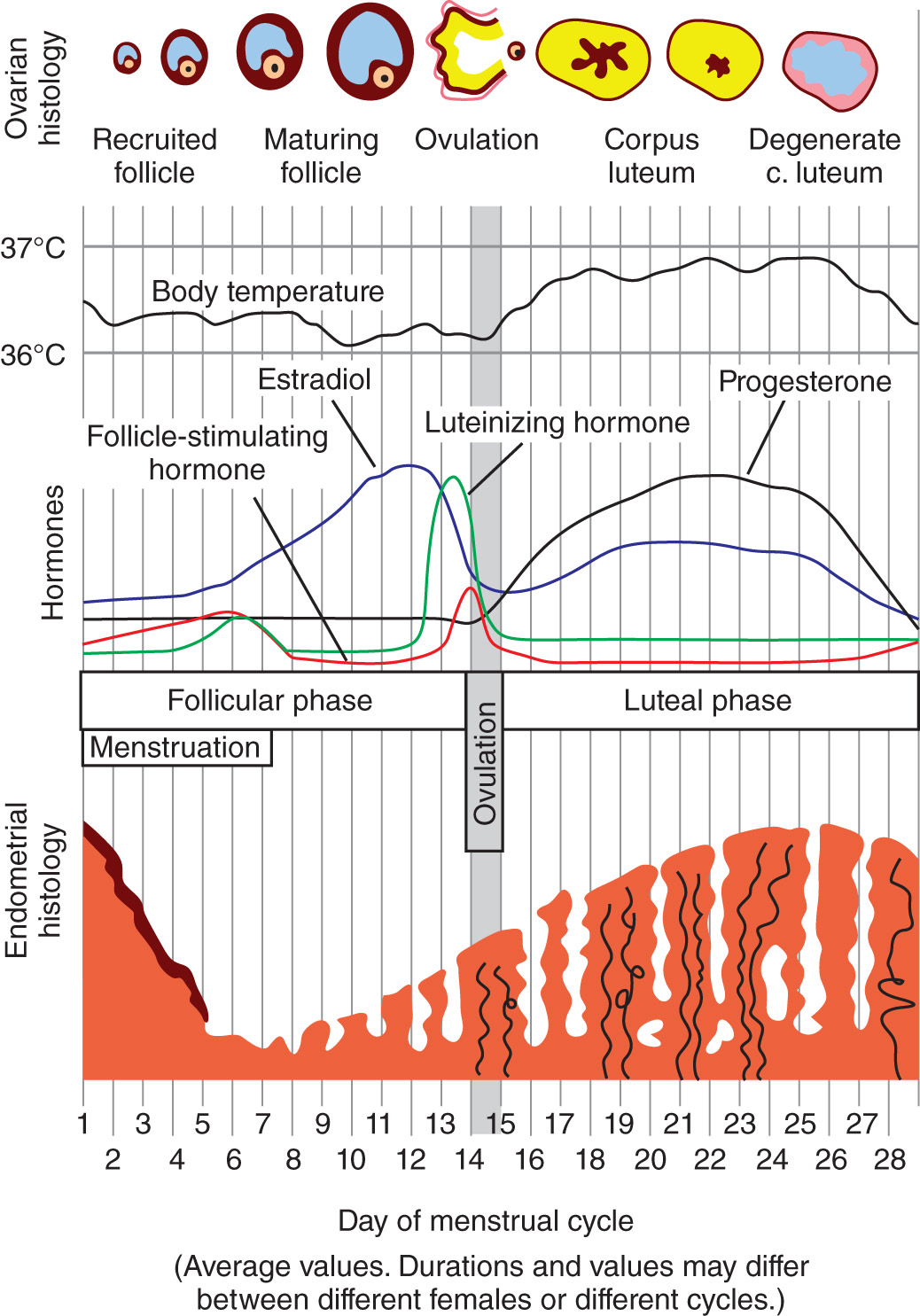
A normal menstrual cycle (Fig. E1) is typically described as lasting 21 to 35 days with up to 7 days of bleeding per cycle. Total blood loss for normal menses is thought to be less than 80 ml.
| ICD-10CM CODES | |||
| N91.5 | Oligomenorrhea, unspecified | ||
| N92.0 | Excessive and frequent menstruation with regular cycle | ||
| N92.1 | Excessive and frequent menstruation with irregular cycle | ||
| N92.5 | Other specified irregular menstruation | ||
| N93.8 | Other specified abnormal uterine and vaginal bleeding | ||
| N93.9 | Abnormal uterine and vaginal bleeding, unspecified | ||
- •The clinical presentation of AUB is variable. Although many patients complain of the abnormality of their cycles, some will present with symptoms of anemia, with AUB being elicited only with a careful history.
- •Physical findings depend on the etiology. For example, an enlarged or irregular uterine contour may suggest fibroids, or a polyp may be seen on the cervix during a speculum examination.
- •A thorough physical and pelvic examination should be done in every case.
- •Workup should be performed to exclude the other causes of abnormal bleeding such as thyroid or endocrine diseases.
- •Table E2 describes many of the various causes of AUB. Causes of vaginal bleeding in adolescence are described in Table E3.
- •Endocrinopathies, including hyperprolactinemia, hyperthyroidism, and hypothyroidism, may also contribute to heavy or irregular menstrual bleeding.
TABLE E2 Causes of Abnormal Uterine Bleeding
| Age (Years) | Differential Diagnosis | ||
| Prepubertal | Precocious puberty (hypothalamic, pituitary, ovarian) | ||
| Adolescence | |||
| Third and Fourth Decades | |||
| Fifth Decade | |||
| Sixth Decade |
From Crum CP et al: Diagnostic gynecologic and obstetric pathology, ed 3, Philadelphia, 2018, Elsevier.
TABLE E3 Causes of Vaginal Bleeding in Adolescence
| Causes of Vaginal Bleeding | Examples | Features |
| Immature hypothalamic-pituitary-ovarian axis (AUB-O) | Patient within 2 yr of menarche | Patient responds to hormonal treatment. |
| Weight changes, disordered eating, or excessive exercise | Anorexia nervosa, bulimia, weight gain or loss of more than 10 pounds from any etiology | Weight loss more frequently results in lighter, less frequent menses. |
| Endocrinologic causes | Thyroid disease, polycystic ovary syndrome (PCOS) | Bleeding typically increases with hypothyroidism and decreases with PCOS and hyperthyroidism. |
| Pregnancy complication | Threatened abortion, postpartum or postabortal endometritis | History of sexual activity and/or pregnancy |
| Infection | Cervicitis, condyloma, pelvic inflammatory disease | Bleeding is usually not heavy and may occur during or after sexual intercourse. |
| Trauma | Sexual assault, straddle injuries | History will be evident in patients of menstruating age unless there is cognitive disability. |
| Vaginal foreign body | Toilet paper, broken condoms, tampons | Associated with odor and vaginal discharge, but usually not heavy bleeding. |
| Hematologic causes (AUB-C) | Type 1, 2, 3 von Willebrand disease, platelet function disorders, thrombocytopenia (idiopathic thrombocytopenic purpura, drug induced), symptomatic hemophilia carrier, clotting factor deficiency, leukemia, aplastic anemia | Bleeding is heavy and/or long and frequently regular, may present at menarche, and may be accompanied by a suggestive personal or family history (hysterectomy, uterine ablation, cautery for epistaxis) or physical examination (ecchymoses, petechiae). |
| Medications |
| Affect the hypothalamic-pituitary-ovarian axis, endometrial lining, platelets, or coagulation pathway. |
| Anatomic | Partial obstruction of vagina or uterus causing asynchronous bleeding; cervical or endometrial polyps or myomas; hemangioma; uterine vascular malformation; genital/reproductive tract cancer | Most of these entities are extremely rare, especially reproductive tract cancers. |
| Systemic disease | Celiac disease, rheumatoid arthritis, Ehlers-Danlos syndrome and other connective tissue disorders | Accompanied by other condition-specific signs. |
NSAIDs, Nonsteroidal antiinflammatory drugs; SSRIs, selective serotonin reuptake inhibitors.
From Kliegman RM et al: Nelson textbook of pediatrics, ed 22, Philadelphia, 2025, Elsevier.