section name header

Basic Information ⬇

Author: Alexandra Mulliken, MD

Definition

Pelvic abscess is an acute or chronic infection, most commonly involving the pelvic viscera. Treatment requires directed therapy including broad-spectrum antimicrobials and, if medical therapy fails, surgical intervention. There are four categories based on etiologic factors:

  • •Ascending infection, spreading from cervix through endometrial cavity to adnexa, forming a tuboovarian complex
  • •Infection occurring in the puerperium, which spreads to the adnexa from the endometrium or myometrium by a hematogenous or lymphatic route
  • •Abscess complicating pelvic surgery
  • •Involvement of the pelvic viscera as a result of spread from contiguous organs, such as appendicitis or diverticulitis
Synonyms

  • Tuboovarian abscess (TOA)
  • Vaginal cuff abscess
ICD-10CM CODES
K63.0Abscess of intestine
K65.1Peritoneal abscess
K68.11Postprocedural retroperitoneal abscess
K68.12Psoas muscle abscess
K68.19Other retroperitoneal abscess
N70.93Salpingitis and oophoritis, unspecified
N70.0Acute salpingitis and oophoritis
N70.1Chronic salpingitis and oophoritis
Epidemiology & Demographics
Incidence:

  • •34% of hospitalized patients with pelvic inflammatory disease
  • •<1% of patients undergoing hysterectomy for benign gynecologic disease, most frequently with vaginal approach1
  • •Peak incidence between 15 and 40 yr
Risk Factors:

Same risk factors as for pelvic inflammatory disease, although in 30% to 50% of patients there is no prior history of salpingitis before abscess forms.

  • •Untreated pelvic inflammatory disease
  • •Bacterial vaginosis
  • •Endometrioma
  • •Hydrosalpinx
  • •Prior laparotomy
  • •Anatomic anomalies
  • •Renal comorbidities
  • •Abdominal hysterectomy (vs. laparoscopic approach)
  • •Prolonged operative time (>3 h)
  • •Postoperative hematoma1
  • •Diabetes
  • •Smoking
  • •Respiratory disease
  • •Overweight or obesity
  • •Immunosuppression
  • •Presence of a foreign body
Physical Findings & Clinical Presentation

  • •Abdominal or pelvic pain (90%)
  • •Fever or chills (50%)
  • •Abnormal bleeding (21%)
  • •Vaginal discharge (28%)
  • •Nausea (26%)
  • •Discernible pelvic mass, often at midline
  • •Diarrhea, if close proximity to rectum
  • •Up to 60% to 80% present without fever or leukocytosis; absence of these findings should not exclude diagnosis
Etiology

  • •Mixed flora of anaerobes, aerobes, and facultative anaerobes, such as Escherichia coli, Bacteroides fragilis, Prevotella spp., aerobic streptococci, and Peptococcus and Peptostreptococcus spp.
  • •Neisseria gonorrhoeae and Chlamydia are the major etiologic bacteria in cervicitis and salpingitis but are rarely found in abscess cavity cultures.
  • •After cesarean delivery, the most common site is the broad ligament, followed by the posterior cul-de-sac and retropubic space.2
  • •After vaginal delivery or hysterectomy, the most common site is the apex of the vagina or the adnexa.2
  • •In elderly patients, consider diverticular disease.

Diagnosis ⬆ ⬇

Differential Diagnosis

  • •Pelvic neoplasms, such as ovarian tumors, leiomyomas, or metastatic disease from another primary source
  • •Ovarian torsion
  • •Pelvic cellulitis
  • •Inflammatory masses involving adjacent bowel or omentum, such as ruptured appendicitis or diverticulitis
  • •Pelvic hematomas, as may occur after cesarean delivery or hysterectomy
  • •Ectopic pregnancy
  • •Nephrolithiasis
  • •Urinary tract infection
Laboratory Tests

  • •CBC with differential
  • •Lactate
  • •Aerobic as well as anaerobic cultures of cervix/vagina, blood, urine, sputum, peritoneal cavity (if entered), and abscess cavity before starting antibiotics. Sensitivities should be obtained if feasible.
  • •Pregnancy test in patients of reproductive age
Imaging Studies

  • •Sonogram: Noninvasive, inexpensive study to confirm diagnosis, estimate size of abscess, and monitor response to therapy; sensitivity >90%
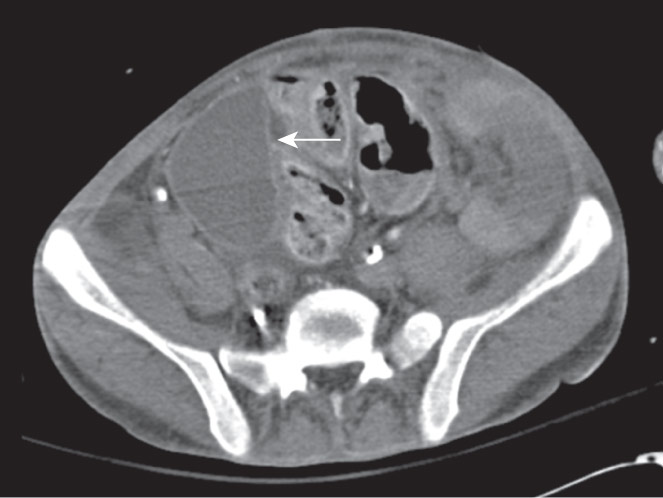
  • •Computed tomography (CT) scan: Used for both diagnosis and therapy (CT-guided drainage) (Fig. 1)
    1. 1.Useful where sonogram provides insufficient information, as with intraabdominal abscesses
    2. 2.Success rate with CT-guided abscess drainage: Unilocular, 90%; multilocular, 40%

Figure 1 Computed Tomography with Oral and Intravenous Contrast in a Patient with a Large Pelvic Abscess Amenable to Percutaneous Drainage

There is classic "rim enhancement" of the abscess cavity (arrow).

(From Vincent JL et al: Textbook of critical care, ed 8, Philadelphia, 2024, Elsevier.)

Treatment ⬆ ⬇

Major concerns:

Acute General Rx

  • •Clinical quandary is whether patient requires immediate surgical intervention (uncertain diagnosis or suspicion of rupture) or management with intravenous (IV) antibiotics, reserving surgery for those with inadequate clinical response (e.g., 48 to 72 h of therapy, with persistent fever or leukocytosis, increasing size of mass, or suspicion of rupture). Laparoscopic surgery should be reserved for experienced surgeons and in cases of unruptured pelvic abscess.
  • •Surgery indicated in poor response to medical therapy. Early surgery may be needed in those with large adnexal masses (>8 cm) or in immunocompromised patients.
  • •60% of patients with abscesses ≥10 cm will require surgical intervention.1
  • •Antibiotic combinations:
    1. 1.Cefotetan 2 g IV q12h or cefoxitin 2 g IV q6h or ampicillin-sulbactam 3 g IV q6h plus doxycycline 100 mg PO or IV q12h
    2. 2.For penicillin allergic patients: Clindamycin 900 mg IV q8h plus gentamicin either 3 to 5 mg/kg q24h or loading dose 2 mg/kg IV/intramuscular loading dose plus maintenance dose 1.5 mg/kg q8h
  • •During medical management, high index of suspicion for acute rupture, such as acute worsening of abdominal pain or new-onset tachycardia and hypotension, mandating immediate surgical intervention after patient stabilization.
  • •Surgical options:
    1. 1.Laparoscopy with drainage and irrigation
    2. 2.CT-guided drainage (interventional radiology)
    3. 3.Transvaginal colpotomy (abscess must be midline, dissect rectovaginal septum, and be adherent to vaginal fornix)
    4. 4.Laparotomy, including total abdominal hysterectomy with bilateral salpingo-oophorectomy or unilateral salpingo-oophorectomy
    5. 5.Evidence of ruptured tuboovarian abscess is a surgical emergency
    6. 6.Antibiotics should be continued during and after surgery2
Disposition

  • •Of patients treated with medical therapy alone, pregnancy rate is 25%. Of patients treated with both medical and laparoscopic surgical management, pregnancy rate is between 32% and 63%. Pregnancy rate decreases with recurrent episodes.
  • •No response in 30% to 40%; can be treated with either CT-guided drainage or surgical intervention, keeping in mind that unilateral adnexectomy may give equal chance of cure vs. hysterectomy, yet preserve reproductive potential.
  • •Antibiotics should be continued until the patient is 48 to 72 h without fever.
Referral

If patient has a tuboovarian abscess, refer to gynecologist.

Pearls & Considerations ⬆ ⬇

Comments

  • •If Actinomyces species is isolated from culture, treatment with penicillin is required for an extended period (6 wk to 3 mo).
  • •Most common cause of preventable death: Physician delay in diagnosis.
Related Content

Reference(s) ⬆

  1. Mahdi H : Predictors of surgical site infection in women undergoing hysterectomy for benign gynecologic disease: a multicenter analysis using the national surgical quality improvement program datadoi: 10.1016/j.jmig.2014.04.003J Minim Invasive Gynecol. 21:901-909, 2014.
  2. Jaiyeoba O : Postoperative infections in obstetrics and gynecologydoi: 10.1097/GRF.0b013e3182714734Clin Obstet Gynecol. 55:904-913, 2012.