▶In loose anagen syndrome, the actively growing anagen hairs (see human hair growth phases in Chapter 96, Telogen Effluvium) are poorly anchored and more easily removed from the scalp than they typically are.
▶Characteristically seen in children, typically blond girls between 2 and 5 years of age, although it may occur in boys and in patients with darker hair types.
▶Possibly an autosomal-dominant disorder, although many cases appear to be sporadic.
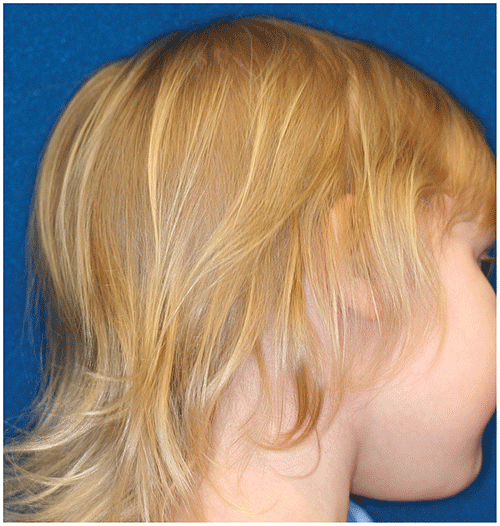
▶Classic presentation is a child presenting with fine, limp hair that does not grow well (Figures 95.1 and 95.2).
▶Parent may report that the child “does not need haircuts because the hair grows so slowly.”
▶Hair loss may be patchy or diffuse, and the hair is often irregular in length (often shorter in the front and longer in the back).
▶Hairs are easily removed from the scalp with gentle traction, although shedding is cyclic, so inability to extract hair does not rule out the diagnosis.
▶Usually no associated nail or skin alterations or systemic manifestations.
Figure 95.1. Typical Appearance of a Patient with Loose Anagen Syndrome: Short, Fine, Blond Hair that Does Not Grow Well.
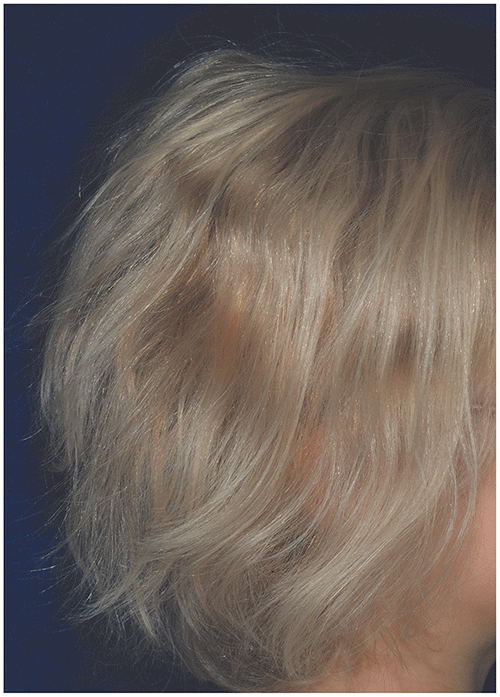
Figure 95.2. Fine, Short, Lightly Pigmented Hair that Does Not Grow Well in a Young Patient with Loose Anagen Syndrome.
Look-alikes
| Disorder | Differentiating Features |
|---|
| Telogen effluvium | Acquired condition; affected children usually have history of previously typical hair texture and rate of growth. History of inciting trigger (eg, febrile illness, surgery, anesthesia) common. Hairs of typical length, diffusely thin. Hair pull reveals multiple telogen hairs rather than dystrophic anagen hairs (identified at microscopy). Improves spontaneously over 3 to 6 months.
|
| Alopecia areata | Usually causes patches of complete alopecia; may have loss of eyebrows or eyelashes. Affected areas often have a smooth, bald appearance. May have associated nail pitting. May see exclamation point hairs.
|
| Trichotillomania | Acquired condition; usually localized, not diffuse. Areas of hair loss often have angulated, irregular borders. Hairs of differing lengths in affected areas. Broken-off hairs are present. Easily extracted anagen hairs not present.
|
| Ectodermal dysplasia | Distinct facial features (eg, dark circles under eyes, frontal bossing, full lips). May have associated nail/skin/dental variations (including missing or conical teeth). Congenital condition; usually does not improve with age. Large group of inherited disorders that may have additional systemic manifestations, including reduced ability to sweat.
|
| Hair shaft abnormalities (eg, trichorrhexis nodosa, monilethrix) | Structural variations of the hair shaft often result in hair fragility and breakage, leading to sparse, short hair that appears dry or lusterless, unkempt. Microscopic examination of hairs often diagnostic, but consultation with a pediatric dermatologist advised if this diagnosis is being considered.
|
▶The diagnosis is usually suggested clinically.
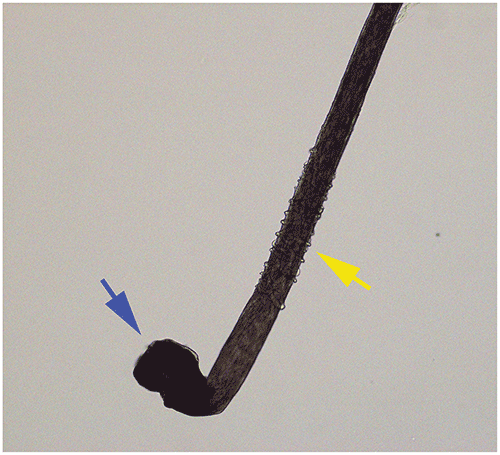
▶Diagnostic confirmation can be made by performing a gentle hair pull and examining the extracted anagen hairs microscopically. The distinctive microscopic findings include a ruffled cuticle and distorted/misshapen anagen hair bulb (Figure 95.3).
Figure 95.3. Light Microscopy of Loose Anagen Syndrome. A Dysplastic Anagen Hair with a “ruffled Sock” or “floppy Sock” Appearance of the Cuticle (Yellow Arrow) and a Distorted Hair Bulb (Blue Arrow).
▶There is no treatment available for loose anagen syndrome.
▶Volumizing shampoos and conditioners are commonly recommended but do not affect the condition itself.
▶Gentle hairstyling should be encouraged to minimize further hair loss (avoiding tight braids or other styles that place tension on the hair shafts).
▶The prognosis is good; the condition usually improves over time.
▶Although the condition has been reported in the setting of Noonan syndrome, most patients do not have systemic associations.
▶If associated nail, dental, or cutaneous alterations are present, referral to a pediatric dermatologist to evaluate for possible ectodermal dysplasia or other genodermatoses should be considered.
▶Also consider referral when the diagnosis is in question, if other variations of the hair shaft are detected at microscopic examination, or in children with potential systemic variations.